PANEL Procedure
Panel Data Unit Root Tests
Unit roots are a big concern in dynamic processes because they have important implications for the stationarity of a process and hence for estimation. Using regular estimation techniques while ignoring the presence of unit roots can lead to spurious regressions and hence produce nonsensical results. Therefore, detecting unit roots in order to be able to analyze stationary processes is of vital concern for dynamic processes. One of the most widely used tests in the time series literature is the augmented Dickey-Fuller (ADF) test. This section introduces and briefly reviews the background information about the tests developed for dynamic panel data, which in most cases are enhancements of the ADF test.
Levin, Lin, and Chu Test
Levin, Lin, and Chu (2002) propose a panel data unit root test for the null hypothesis of a unit root against a hypothesis of homogeneous stationarity. The model is specified as

The panel data unit root test evaluates the null hypothesis of  , for all i, against the alternative hypothesis
  , for all i. Three models are considered: (1)
  (the empty set) with no individual effects; (2)
  , in which the series
  has an individual-specific mean but no time trend; and (3)
  , in which the series has an individual-specific mean and a linear and individual-specific time trend. The lag order
  is unknown and is allowed to vary across individuals. It can be selected by the methods that are described in the section Lag Order Selection in the ADF Regression. The selected lag order is denoted as
  . The necessary condition for the test is that
  . An important assumption is that the errors,
  , are
, are  . In other words, cross-sectional independence is assumed. The test is implemented in the following three steps:
- Step 1
-
The ADF regressions are implemented for each individual i, and then the orthogonalized residuals are generated and normalized. That is, the following model is estimated:

Then, two orthogonalized residuals are generated by the following two auxiliary regressions:


The residuals are then saved as
 and
and  , respectively, and normalized using the regression standard error from the ADF regression in order to remove heteroscedasticity. Let
  denote the standard error from each of the previous ADF regressions, where
  . The normalized residuals are then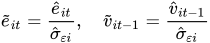
- Step 2
The ratios of long-run to short-run standard deviations of
 are estimated. Denote the ratios and the long-run variances as
  and
and  , respectively. The long-run variances are estimated by the heteroscedasticity- and autocorrelation-consistent (HAC) estimators, which are described in the section Long-Run Variance Estimation. Then the ratios are estimated by
  . Let the average standard deviation ratio be
  , and let its estimator be
  . As the authors note in their paper (Levin, Lin, and Chu 2002), use of the long-run variance based on first differences results in lower bias in finite samples.
- Step 3
-
The panel test statistics are calculated. To calculate the t statistic and the adjusted t statistic, the following equation is estimated:

The total number of observations is
 , with
  . The standard t statistic for testing
  is
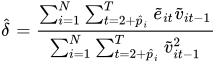
is  , with the OLS estimator
  and standard deviation
  ,
, 
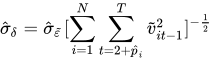
where
 is the root mean square error from the step 3 regression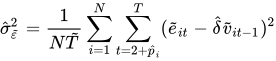
However, the standard t statistic diverges to negative infinity for models (2) and (3). Levin, Lin, and Chu (2002) therefore propose the following adjusted t statistic:
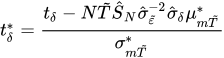
The mean and standard deviation adjustments (
 ) depend on the time series dimension
  and model specification m, which can be found in Table 2 of Levin, Lin, and Chu (2002). The adjusted t statistic converges to the standard normal distribution. Therefore, the standard normal critical values are used in hypothesis testing.
Lag Order Selection in the ADF Regression
The methods of selecting the individual lag orders in the ADF regressions can be divided into two categories: selection based on information criteria and selection via sequential testing.
Lag Selection Based on Information Criteria
In this method, the following information criteria can be applied to lag order selection: Akaike’s information criterion (AIC), the Schwarz Bayesian criterion (SBC), the Hannan-Quinn information criterion (HQIC or HQC), and the modified AIC. As with other model selection applications, the lag order is selected from 0 to the maximum  to minimize the objective function, plus a penalty term, which is a function of the number of parameters in the regression. Let k be the number of parameters and
  be the number of effective observations. For regression models, the objective function is
  , where SSR is the sum of squared residuals. For AIC, the penalty term equals
  . For SBC, this term is
  . For HQIC, it is
  , where c is a constant greater than 1.[8] For MAIC, the penalty term equals
 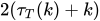 , where
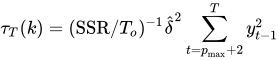
and is the estimated coefficient of the lagged dependent variable  in the ADF regression.
Lag Selection via Sequential Testing
In this method, the lag order estimation is based on the statistical significance of the estimated AR coefficients. Hall (1994) proposed general-to-specific (GS) and specific-to-general (SG) modeling strategies. Levin, Lin, and Chu (2002) recommend the GS strategy, following Campbell and Perron (1991). In the GS modeling strategy, starting with the maximum lag order  , the t test for the largest lag order in
  is performed to determine whether a smaller lag order is preferred. Specifically, when the null of
  is not rejected given the significance level (
 ), a smaller lag order is preferred. This procedure continues until a statistically significant lag order is reached. On the other hand, the SG modeling strategy starts with lag order 0 and moves toward the maximum lag order, .
Long-Run Variance Estimation
The long-run variance of is estimated by an HAC-type estimator. For model (1), given the lag truncation parameter  and kernel weights
  , the formula is

To achieve consistency, the lag truncation parameter must satisfy  and
and  as
as  . Levin, Lin, and Chu (2002) suggest
 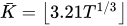 . The weights depend on the kernel function. Andrews (1991) proposes data-driven bandwidth (lag truncation parameter + 1 if integer-valued) selection procedures to minimize the asymptotic mean square error (MSE) criterion. For more information about the kernel functions and Andrews’s (1991) data-driven bandwidth selection procedure, see the section Heteroscedasticity- and Autocorrelation-Consistent Covariance Matrices. Because Levin, Lin, and Chu (2002) truncate the bandwidth as an integer, when LLCBAND is specified as the BANDWIDTH option, it corresponds to
  . Furthermore, kernel weights
  with kernel function
  .
.
For model (2), first the series is de-meaned individual by individual. Therefore, is replaced by  , where
  is the mean of for individual i. For model (3) with individual fixed effects and time trend, both the individual mean and trend should be removed before the long-run variance is estimated. That is, first you regress on
  for each individual and save the residual
  , and then you replace with the residual.
Cross-Sectional Dependence via Time-Specific Aggregate Effects
The Levin, Lin, and Chu (2002) testing procedure is based on the assumption of cross-sectional independence. It is possible to relax this assumption and allow for a limited degree of dependence via time-specific aggregate effects. Let  denote the time-specific aggregate effects; then the data generating process becomes

Two more models are considered: (4) (the empty set), with no individual effects but with time effects; and (5) , in which the series has an individual-specific mean and a time-specific mean.
By subtracting the time averages 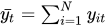 from the observed dependent variable , or equivalently, by including the time-specific intercepts in the ADF regression, the cross-sectional dependence is removed. The impact of a single aggregate common factor that has an identical impact on all individuals but changes over time can also be removed in this way. After cross-sectional dependence is removed, the three-step procedure is applied to calculate the Levin, Lin, and Chu (2002) adjusted t statistic.
Deterministic Variables
Three deterministic variables can be included in the model for the first-stage estimation: CS_FixedEffects (cross-sectional fixed effects), TS_FixedEffects (time series fixed effects), and TimeTrend (individual linear time trend). When a linear time trend is included, the individual fixed effects are also included. Otherwise the time trend is not identified. Moreover, if the time series fixed effects are included, the time trend is not identified either. Therefore, there are five identified models: model (1), no deterministic variables; model (2), CS_FixedEffects; model (3), CS_FixedEffects and TimeTrend; model (4), TS_FixedEffects; and model (5), CS_FixedEffects and TS_FixedEffects. PROC PANEL outputs the test results for all five model specifications.
Im, Pesaran, and Shin Test
To test for the unit root in heterogeneous panels, Im, Pesaran, and Shin (2003) propose a standardized t-bar test statistic based on averaging the (augmented) Dickey-Fuller statistics across the groups. The limiting distribution is standard normal. The stochastic process is generated by the first-order autoregressive process. If  , the data generating process can be expressed as in the Levin, Lin, and Chu (LLC) test,

where is the lag order in the ADF regression, as in the LLC test. In contrast with the data generating process in the LLC test,  is allowed to differ across groups. The null hypothesis of unit roots is

against the heterogeneous alternative,

The Im, Pesaran, and Shin (2003) test also allows for some (but not all) of the individual series to have unit roots under the alternative hypothesis. But the fraction of the individual processes that are stationary is positive,  . The t-bar statistic, denoted by
  , is formed as a simple average of the individual t statistics for testing the null hypothesis of
  . If
. If  is the standard t statistic, then
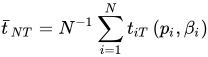
If , then for each i the t statistic (without time trend) converges to the Dickey-Fuller distribution,  , defined by

where  is the standard Brownian motion. The limiting distribution is different when a time trend is included in the regression (Hamilton 1994, p. 499). The mean and variance of the limiting distributions are reported in Nabeya (1999). The standardized t-bar statistic satisfies

where the standard normal is the sequential limit with followed by  . To obtain better finite sample approximations, Im, Pesaran, and Shin (2003) propose standardizing the t-bar statistic by means and variances of
  under the null hypothesis
  . The alternative standardized t-bar statistic is

Im, Pesaran, and Shin (2003) simulate the values of  and
and  for different values of T and p. The lag order in the ADF regression can be selected by the same method as in Levin, Lin, and Chu (2002). For more information, see the section Lag Order Selection in the ADF Regression.
When T is fixed, Im, Pesaran, and Shin (2003) assume serially uncorrelated errors,  ;
;  is likely to have finite second moment, which is not established in the paper. The t statistic is modified by imposing the null hypothesis of a unit root. Denote
  as the estimated standard error from the restricted regression (),

where  is the OLS estimator of (unrestricted model),
  ,
,  , and
, and  , where
  is a given initial value (fixed or random). Under the null hypothesis, the standardized
  -bar statistic converges to a standard normal variate,

where  and
and  are the mean and variance of
  , respectively. The limit is taken as , and T is fixed. Their values are simulated for finite samples without a time trend.
  is also likely to converge to standard normal.
When N and T are both finite, an exact test that assumes no serial correlation can be used. The critical values of and  are simulated.
As in the section Levin, Lin, and Chu Test, it is possible to relax this assumption of cross-sectional independence and allow for a limited degree of dependence via time-specific aggregate effects. In that section, two more models (model 4 and model 5) with time fixed effects are considered. For more information, see the section Cross-Sectional Dependence via Time-Specific Aggregate Effects.
Combination Tests
Combining the observed significance levels (p-values) from N independent tests of the unit root null hypothesis was proposed by Maddala and Wu (1999) and Choi (2001). Suppose  is the test statistic to test the unit root null hypothesis for individual
  , and
, and  is the cumulative distribution function (CDF) of the asymptotic distribution as . Then the asymptotic p-value is defined as

There are different ways to combine these p-values. The first way is the inverse chi-square test (Fisher 1932); this test is referred to as the P test in Choi (2001) and the  test in Maddala and Wu (1999):
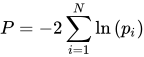
When the test statistics  are continuous,
  are independent uniform
  variables. Therefore,
  as and N is fixed. But as , P diverges to infinity in probability. Therefore, it is not applicable for large N. To derive a nondegenerate limiting distribution, the P test (Fisher test with ) should be modified to

Under the null as  ,[9] and then ,
  .[10]
.[10]
The second way of combining individual p-values is the inverse normal test,
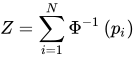
where  is the standard normal CDF. When ,
 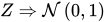 as N is fixed. When N and
  are both large, the sequential limit is also standard normal if first and next.
The third way of combining p-values is the logit test,
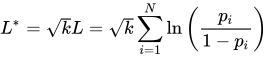
where  . When and N is fixed,
  . In other words, the limiting distribution is the t distribution with degree of freedom
  . The sequential limit is
  as and then . Simulation results in Choi (2001) suggest that the Z test outperforms other combination tests. For the time series unit root test , Maddala and Wu (1999) apply the augmented Dickey-Fuller test. According to Choi (2006), the Elliott, Rothenberg, and Stock (1996) Dickey-Fuller generalized least squares (DF-GLS) test offers significant size and power advantages in finite samples.
As in the section Levin, Lin, and Chu Test, it is possible to relax this assumption of cross-sectional independence and allow for a limited degree of dependence via time-specific aggregate effects. In that section, two more models (model 4 and model 5) with time fixed effects are considered. For more information, see the section Cross-Sectional Dependence via Time-Specific Aggregate Effects.
Breitung’s Unbiased Tests
To account for the nonzero mean of the t statistic in the OLS detrending case, bias-adjusted t statistics were proposed by Levin, Lin, and Chu (2002) and Im, Pesaran, and Shin (2003). The bias corrections imply a severe loss of power. Breitung and associates take an alternative approach to avoid the bias, by using alternative estimates of the deterministic terms (Breitung and Meyer 1994; Breitung 2000; Breitung and Das 2005). The data generating process is the same as in the Im, Pesaran, and Shin (IPS) test (2003). Three models are considered, as described in the section Levin, Lin, and Chu Test. When serial correlation is absent, for model (2) with individual specific means, the constant terms are estimated by the initial values  . Therefore, the series is adjusted by subtracting the initial value. The equation becomes

For model (3) with individual specific means and time trends, the time trend can be estimated by  . The levels can be transformed as

The Helmert transformation is applied to the dependent variable to remove the mean of the differenced variable:

The transformed model is

The pooled t statistic has a standard normal distribution. Therefore, no adjustment is needed for the t statistic. To adjust for heteroscedasticity across cross sections, Breitung (2000) proposes a UB (unbiased) statistic based on the transformed data,
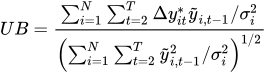
where  . When
  is unknown, it can be estimated as

The UB statistic has a standard normal limiting distribution as followed by sequentially.
To account for the short-run dynamics, Breitung and Das (2005) suggest applying the test to the prewhitened series,  . For model (1) and model (2) (constant-only case), they suggest the same method as in step 1 of the Levin, Lin, and Chu (LLC) test (2002).[11] For model (3) (with a constant and linear time trend), the prewhitened series can be obtained by running the following restricted ADF regression under the null hypothesis of a unit root (
  ) and no intercept and linear time trend (
 ),
),
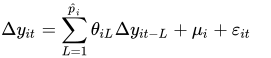
where is a consistent estimator of the true lag order and can be estimated by the procedures listed in the section Lag Order Selection in the ADF Regression. For the LLC and IPS tests, the lag orders are selected by running the ADF regressions. But for Breitung and his associates’ tests, the restricted ADF regressions are used to be consistent with the prewhitening method. Let  be the estimated coefficients.[12] The prewhitened series can be obtained by
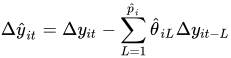
and
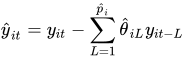
The transformed series are random walks under the null hypothesis,

where  for
for  . When the cross-sectional units are independent, the t statistic converges to standard normal under the null, as followed by ,

where  with the OLS estimator .
To account for cross-sectional dependence, Breitung and Das (2005) propose the robust t statistic and a GLS version of the test statistic. Let  be the error vector for time t, and let
 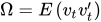 be a positive definite matrix with eigenvalues
  . Let
. Let  and
and  . The model can be written as a system of equations of the seemingly unrelated regressions (SUR) type:

The unknown covariance matrix  can be estimated by its sample counterpart,

The sequential limit followed by of the standard t statistic  is normal with mean 0 and variance
  . The variance
  can be consistently estimated by
  . Thus the robust t statistic can be calculated as

as followed by under the null hypothesis of random walk. Because the finite sample distribution can be quite different, Breitung and Das (2005) list the  , , and
  critical values for different N’s.
When  , a (feasible) GLS estimator is applied; it is asymptotically more efficient than the OLS estimator. The data are transformed by multiplying
  as defined before,
 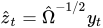 . Thus the model is transformed into

The feasible GLS (FGLS) estimator of  and the corresponding t statistic are obtained by estimating the transformed model by OLS and denoted by
  and
and  , respectively:
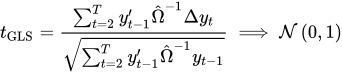
As in the section Levin, Lin, and Chu Test, it is possible to relax this assumption of cross-sectional independence and allow for a limited degree of dependence via time-specific aggregate effects. In that section, two more models (model 4 and model 5) with time fixed effects are considered. For more information, see the section Cross-Sectional Dependence via Time-Specific Aggregate Effects.
Hadri Stationarity Test
Hadri (2000) adopts a component representation where an individual time series is written as a sum of a deterministic trend, a random walk, and a white-noise disturbance term. Under the null hypothesis of stationarity, the variance of the random walk equals 0. Specifically, two models are considered:
-
For model (1), the time series
is stationary around a level  ,
, 
-
For model (2),
is trend stationary, 
where
 is the random walk component,
The initial values of the random walks,
 , are assumed to be fixed unknowns and can be considered as heterogeneous intercepts. The errors
  and
and  satisfy
  ,
,  and are mutually independent.
The null hypothesis of stationarity is  against the alternative random walk hypothesis
  .
.
In matrix form, the models can be written as

where  ;
;  , where
  ; and
; and  , where
  is a
is a  vector of ones,
  , and
, and 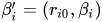 .
.
Let  be the residuals from the regression of
  on
on  ; then the LM statistic is
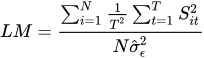
where 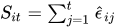 is the partial sum of the residuals and
  is a consistent estimator of
  under the null hypothesis of stationarity. With some regularity conditions,
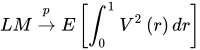
where  is a standard Brownian bridge in model (1) and a second-level Brownian bridge in model (2). Let
  be a standard Wiener process (Brownian motion),

The mean and variance of the random variable  can be calculated by using the characteristic functions,

and

The LM statistics can be standardized to obtain the standard normal limiting distribution,

Consistent Estimator of
Hadri’s (2000) test can be applied to the general case of heteroscedasticity and serially correlated disturbance errors. Under homoscedasticity and serially uncorrelated errors, can be estimated as
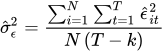
where k is the number of regressors. Therefore,  formodel (1) and
  for model (2).
When errors are heteroscedastic across individuals, the standard errors  can be estimated by
  for each individual i and the LM statistic needs to be modified to
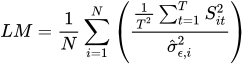
To allow for temporal dependence over t, has to be replaced by the long-run variance of , which is defined as  . An HAC estimator can be used to consistently estimate the long-run variance
  . For more information, see the section Long-Run Variance Estimation.
As in the section Levin, Lin, and Chu Test, it is possible to relax this assumption of cross-sectional independence and allow for a limited degree of dependence via time-specific aggregate effects. In that section, two more models (model 4 and model 5) with time fixed effects are considered. For more information, see the section Cross-Sectional Dependence via Time-Specific Aggregate Effects.
Harris and Tzavalis Panel Unit Root Test
Harris and Tzavalis (1999) derive the panel unit root test under fixed T and large N. Five models are considered, as in Levin, Lin, and Chu (2002). Model (1) is the homogeneous panel,

Under the null hypothesis,  . For model (2), each series is a unit root process with a heterogeneous drift,

Model (3) includes heterogeneous drifts and linear time trends,

As in the section Levin, Lin, and Chu Test, it is possible to relax this assumption of cross-sectional independence and allow for a limited degree of dependence via time-specific aggregate effects. In that section, two more models (model 4 and model 5) with time fixed effects are considered. For more information, see the section Cross-Sectional Dependence via Time-Specific Aggregate Effects.
Let  be the OLS estimator of
  ; then

where  ,
,  , and
, and  is the projection matrix. Formodel (1), there are no regressors other than the lagged dependent value, so is the identity matrix
  . For model (2), a constant is included, so
  , where
  is a column of ones. For model (3), a constant and time trend are included. Thus
  , where
  and
and  .
.
When  in model (1) under the null hypothesis, as

As , it becomes  .
.
When the drift is absent in model (2),  , under the null hypothesis, as

As ,  .
.
When the time trend is absent in model (3), , under the null hypothesis, as

When ,  .
.
[9] The time series length T is subindexed by  because the panel can be unbalanced.
[10] Choi (2001) also points out that the joint limit result where N and  go to infinity simultaneously is the same as the sequential limit, but it requires more moment conditions.
[11] For more information, see the section Levin, Lin, and Chu Test. The only difference is the standard error estimate  . Breitung suggests using
  instead of
  as in the LLC test to normalize the standard error.
[12] Breitung (2000) suggests the approach in step 1 of Levin, Lin, and Chu (2002), whereas Breitung and Das (2005) suggest the prewhitening method as described in this section. In Breitung’s code, to be consistent with the papers, different approaches are adopted for model (2) and model (3). Meanwhile, for the order of variable transformation and prewhitening, in model (2), the initial values are deducted (variable transformation) first, and then the prewhitening is applied. In model (3), the order is reversed: the series is prewhitened and then transformed to remove the mean and linear time trend.