PANEL Procedure
Heteroscedasticity- and Autocorrelation-Consistent Covariance Matrices
The HAC option in the MODEL statement selects the type of heteroscedasticity- and autocorrelation-consistent covariance matrix. As with the HCCME= option, an estimator of the middle expression  in sandwich form is needed. With the HAC option, it is estimated as

where  is the real-valued kernel function,[7] b is the bandwidth parameter, and a is the adjustment factor of small-sample degrees of freedom (that is,
  if the ADJUSTDF option is not specified and otherwise
  , where k is the number of parameters including dummy variables). The types of kernel functions are listed in Table 4.
Table 4: Kernel Functions
| Kernel Name | Equation |
|---|---|
| Bartlett | 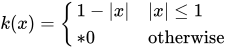 |
| Parzen | 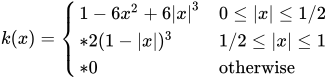 |
| Quadratic spectral |  |
| Truncated | 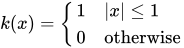 |
| Tukey-Hanning |  |
When you specify the BANDWIDTH=ANDREWS option, the bandwidth parameter is estimated as shown in Table 5.
Table 5: Bandwidth Parameter Estimation
| Kernel Name | Bandwidth Parameter |
|---|---|
| Bartlett |  |
| Parzen |  |
| Quadratic spectral |  |
| Truncated |  |
| Tukey-Hanning |  |
Let  denote each series in
  , and let
  denote the corresponding estimates of the autoregressive and innovation variance parameters of the AR(1) model on ,
  , where the AR(1) model is parameterized as
  with
with  . The terms
  and
and  are estimated by the formulas

When you specify BANDWIDTH=NEWEYWEST94, according to Newey and West (1994) the bandwidth parameter is estimated as shown in Table 6.
Table 6: Bandwidth Parameter Estimation
| Kernel Name | Bandwidth Parameter |
|---|---|
| Bartlett |  |
| Parzen |  |
| Quadratic spectral |  |
| Truncated |  |
| Tukey-Hanning |  |
The terms  and
and  are estimated by the formulas

where n is the lag selection parameter and is determined by kernels, as listed in Table 7.
Table 7: Lag Selection Parameter Estimation
| Kernel Name | Lag Selection Parameter |
|---|---|
| Bartlett |  |
| Parzen |  |
| Quadratic spectral |  |
| Truncated |  |
| Tukey-Hanning | |
The c in Table 7 is specified by the C= option; by default, C=12.
The  are estimated by the equation

where  is the same as in the Andrews method and i is 1 if the NOINT option is specified in the MODEL statement, and 2 otherwise.
When you specify BANDWIDTH=SAMPLESIZE, the bandwidth parameter is estimated by the equation

where T is the sample size;  is the largest integer less than or equal to x; and
  , r, and c are values specified by the BANDWIDTH=SAMPLESIZE(GAMMA=, RATE=, CONSTANT=) options, respectively.
If the PREWHITENING option is specified in the MODEL statement,  is prewhitened by the VAR(1) model,

Then  is calculated by

