Disaggregating Overrides in a Filter
- Example 1: Simple Disaggregation to the Lower-Level Time Series
- Example 2. Constrained Scenario with One Override
- Example 3. Overlapping Overrides
Overrides submitted at an aggregate level have to be disaggregated to lower levels in a systematic manner to resolve the low-level forecasts with the override values. Likewise, overrides at the lower levels cause changes to the aggregate level.
The following examples show how overrides are disaggregated within a filtera set of specified criteria that are applied to data in order to identify the subset of data for a subsequent operation, such as continued processing. .
Example 1: Simple Disaggregation to the Lower-Level Time Series
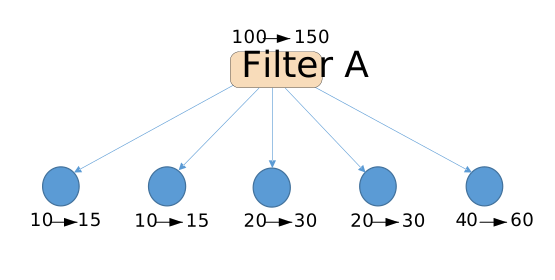
In the first example, an aggregate level forecasta numerical prediction of a future value for a specified time period for each unique combination of BY variable values of 100 is distributed among the lower levels as 10, 10, 20, 20, 40. Overriding the aggregate level forecast of Filter A to 150 changes the values of the lower levels by 50 percent (15, 15, 30, 30, 60).
Example 2. Constrained Scenario with One Override
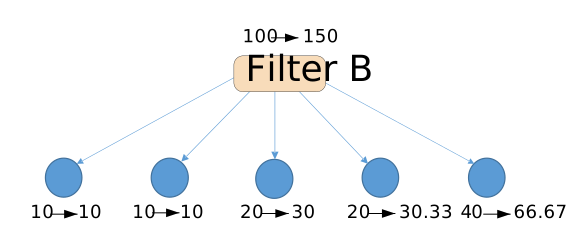
Constraints in overrides occur when locks are applied to forecasts. See Lock and Unlock Overrides for a description. In this example, the statistical forecast for the first two lower-level forecasts is 10 and the value is locked. Next, the third lower-level forecast is increased to 30 and locked. Then the aggregated value of Filter B is increased to 150. The remaining two lower-level values must be adjusted to account for the first three values that are locked. The two lower-level values are increased proportionally to provide a total of 150 to cover all five values.
- The fourth value is increased by (100-60)*20/60. The result is 20 + 13.33 = 33.3.
- The fifth value is increased by (100-60)*40/60. The result is 40 + 26.67 = 66.67.
Example 3. Overlapping Overrides
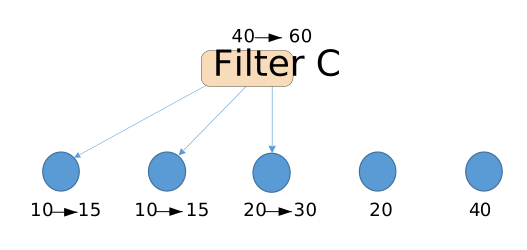
The next example shows how overlapping overrides are disaggregated. The override for Filter C increases the first three low-level forecasts by 50%. As a result, the aggregate level increases from 40 to 60.
The next override for Filter D doubles the value of the last three low-level forecasts. The third low-level forecast was already increased to 30, so the aggregate of the last three forecasts increases from 90 to 180.
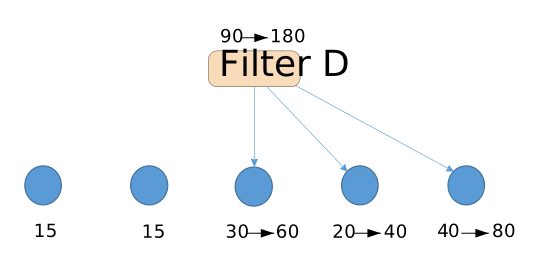
The third low-level forecast is changed twice, once from 20 to 30 and then 30 to 60.