Descriptions of Model Selection Criteria
The definitions and formulas for the statistics of fit that are available in SAS Visual Forecasting are described below. You can use statistics of fit to measure how well different models fit the data. The statistics of fit for the various forecasting models can be printed or stored in a data set.
The formulas below use the notations described in Notations Used in the Formulas.
For most statistics of fit, a lower number indicates a better fit. If a different measure is used to determine a better fit, it is indicated in the description below. Choose from one of the following options.
- Adjusted R-square (ADJRSQ)
-
The adjusted R2 statistic,
 , where R2 is defined in the RSQUARE statistic .
Better performance is indicated when this measurement is closer to 1.
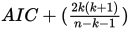
- Akaike information Corrected criterion (AICC)
-
Akaike’s information criterion with an empirical correction for small sample sizes,
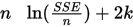
- Akaike information criterion (AIC)
-
Akaike’s information criterion,
- Amemiya's adjusted R-square (AADJRSQ)
-
Amemiya’s adjusted R2,

Better performance is indicated when this measurement is closer to 1.
- Amemiya's prediction criterion (APC)
-
Amemiya’s prediction criterion,

- Geometric mean absolute error percent of standard deviation (GMAPES)
-
The geometric mean of the absolute error as a percentage of the standard deviation
- Geometric mean percent error (GMAPE)
-
The geometric mean percent error
- Geometric mean predictive percent error (GMAPPE)
-
The geometric mean absolute predictive percent prediction error
- Geometric mean relative absolute error (GMRAE)
-
The geometric mean of the relative absolute errors
- Geometric mean symmetric percent error (GMASPE)
-
The geometric mean of the absolute symmetric percent errors
- In-sample mean absolute scaled error (IMASE)
-
The mean of the in-sample absolute scaled errors (IMASE):
- For the fit region,
 , where MRWAE is the mean absolute error of the random walk model in the
fit region:
, where MRWAE is the mean absolute error of the random walk model in the
fit region:  .
. - For the forecasta numerical prediction of a future value for a specified time period for each unique
combination of BY variable values region,
 where FCSTMAE is the mean absolute error in the forecast region:
- For the fit region,
- Maximum Absolute Error Percent of Standard Deviation (MAXAPES)
-
The maximum of the absolute error as a percentage of the standard deviation
- Maximum error (MAXERR)
-
The largest prediction error
- Maximum percent error (MAXPE)
-
The largest percent prediction error,
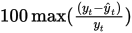 . The summation ignores observations where
  .
. - Maximum predictive percent error (MAXPPE)
-
The maximum of the predictive percent errors
- Maximum relative error (MAXRE)
-
The maximum of the relative errors
- Maximum symmetric percent error (MAXSPE)
-
The maximum of the symmetric percent errors
- Mean absolute error (MAE)
-
The mean absolute prediction error,

- Mean absolute error percent of standard deviation (MAPES)
-
The mean of the absolute error as a percentage of the standard deviation
- Mean absolute percent error (MAPE)
-
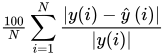
The mean of the absolute percent errors,
- Mean absolute predictive symmetric percent error (MAPPE)
-
The mean of the absolute symmetric predictive percent error
- Mean absolute scaled error (MASE)
-
The mean of the absolute scaled errors
- For the fit region,
 where MRWAE (mean absolute error of the random walk model in the fit
region) is .
where MRWAE (mean absolute error of the random walk model in the fit
region) is . - For the forecast region,
 , where FCSTMAE (mean absolute error in the forecast region) is and where FCSTMRWAE (mean absolute error of the random walk model in the
forecast region) is
, where FCSTMAE (mean absolute error in the forecast region) is and where FCSTMRWAE (mean absolute error of the random walk model in the
forecast region) is 
- For the fit region,
- Mean error (ME)
-
The mean prediction error,

- Mean percent error (MPE)
-
The mean percent prediction error,
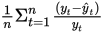 . The summation ignores observations where .
 - Mean predictive percent error (MPPE)
-
The mean of the predictive percent error
- Mean relative absolute error (MRAE)
-
The mean of the relative absolute errors
- Mean relative error (MRE)
-
The mean of the relative errors
- Mean squared error (MSE)
-
The mean squared prediction error calculated from the one-step-ahead forecasts,
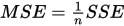 . This formula enables you to evaluate small holdout samples.
 - Mean symmetric percent error (MSPE)
-
The mean of the symmetric percent errors
- Mean absolute symmetric percent error (SMAPE)
-
The symmetric mean of the absolute percent error
- Median absolute error percent of standard deviation (MDAPES)
-
The median of the absolute error as a percentage of the standard deviation
- Median absolute percent error (MDAPE)
-
The median of the percent errors
- Median predictive percent error (MDAPPE)
-
The median of the predictive percent errors
- Median relative absolute error (MDRAE)
-
The median of the relative absolute errors
- Median symmetric percent error (MDASPE)
-
The median of the symmetric percent errors
- Minimum Absolute Error Percent of Standard Deviation (MINAPES)
-
The minimum of the absolute error as a percentage of the standard deviation
- Minimum error (MINERR)
-
The smallest prediction error
- Minimum percent error (MINPE)
-
The smallest percent prediction error,
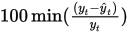 . The summation ignores observations where .
 - Minimum predictive percent error (MINPPE)
-
The smallest predictive percent error
- Minimum relative error (MINRE)
-
The smallest relative error
- Minimum symmetric percent error (MINSPE)
-
The smallest symmetric percent error
- R-square (RSQUARE)
-
The R2 statistic,
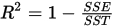 . If the model fits the series badly, the model sum of squares errors,
SSE, might be larger than SST and the
R2 statistic is negative.
. If the model fits the series badly, the model sum of squares errors,
SSE, might be larger than SST and the
R2 statistic is negative. Better performance is indicated when this measurement is closer to 1.
- Random walk R-square (RWRSQ)
-
The random walk R2 statistic (Harvey’s R2 statistic using the random walk model for comparison),
 , where RWSSE (sum of square errors of the random walk model) is
  , and
, and 
Better performance is indicated by a higher value.
- Root mean squared error (RMSE)
-
The root mean square error,

- Root mean square scaled error (RMSSE)
-
The root value of the mean of the square scaled errors
- For the fit region,
 where MRWSE is the mean square error of the random walk model:
- For the forecast region,
 where FCSTMSE is the mean square error in the forecast region:
- For the fit region,
- Schwarz Bayesian information criterion (SBC)
-
Schwarz Bayesian information criterion,

- Sum of square error (SSE)
-
The sum of the squared prediction errors,
 , where
  is the one-step predicted value
 - Unbiased mean squared error (UMSE)
-
The unbiased mean squared error
- Unbiased root mean squared error (URMSE)
-
The unbiased root mean squared error
- Corrected Total Sum of Squares (SST)
-
The total sum of squares for the series corrected for the mean:
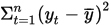 , where
  is the series mean Note: This statistic is not available for model selection.
 - Total Sum of Squares (TSS)
-
The total sum of squares for the series, uncorrected for the mean:
 Note: This statistic is not available for model selection.