Time Interval Accumulation Settings
Specify how you want the data to be accumulated within each time interval. Accumulation combines data within the same time interval into a summary value for that time period. Accumulation can be used in the following situations:
- converting a time seriesan aggregation of transactional data into specified time intervals and sorted according to unique combinations of the default attributes (BY variables) that has no fixed interval into a time series that has a fixed interval (such as hourly or monthly)
- converting a time series that has a fixed interval into a time series with a lower frequency time interval (such as hourly into daily)
Let  be the data vector ordered by the time series occurrence in the data set with respect to the observation index. Let
  be the index that represents this ordering. Let QN be
the number of nonmissing values and let
be the index that represents this ordering. Let QN be
the number of nonmissing values and let  be the number of missing values in the data vector.
Let
be the number of missing values in the data vector.
Let 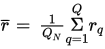 be the average value of the data vector with the
missing values ignored.
be the average value of the data vector with the
missing values ignored.
The following example
accumulates the observation series 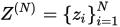 to the time series
  , for
, for  . In this situation,
  and
and  for .
for .
Let  be this accumulated value for this data vector when the following accumulationeither of two processes that are used to convert a time series. (1) Accumulation converts
a time series that has no fixed interval into a time series that does have a fixed
interval (such as hourly or monthly). (2) Accumulation converts a time series that
has a fixed interval into a time series with a lower frequency time interval (such
as hourly into daily). Accumulation combines data within the same time interval into
a summary value for that time period. methods are applied:
be this accumulated value for this data vector when the following accumulationeither of two processes that are used to convert a time series. (1) Accumulation converts
a time series that has no fixed interval into a time series that does have a fixed
interval (such as hourly or monthly). (2) Accumulation converts a time series that
has a fixed interval into a time series with a lower frequency time interval (such
as hourly into daily). Accumulation combines data within the same time interval into
a summary value for that time period. methods are applied:
- Average of Values
-
accumulates the vector values based on the average of their values.
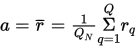
Missing values are ignored in the summation. If
 , then a is set to missing.
 - Corrected Sum of Squares
-
accumulates the vector values based on their corrected sum of squares.
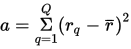
Missing values are ignored in the summation. If
, then a is set to missing. - Maximum of Values
-
accumulates the vector values based on the maximum of their values.
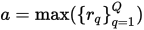
Missing values are ignored in the summation. If
, then a is set to missing. - Minimum of Values
-
accumulates the vector values based on the minimum of their values.
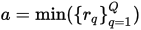
Missing values are ignored in the summation. If
, then a is set to missing. - Number of non-missing values
-
accumulates the vector values based on the number of nonmissing values.

- Number of Missing values
-
accumulates the vector values based on the number of missing values.
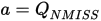
- Standard Deviation of Values
-
accumulates the vector values based on their standard deviation.
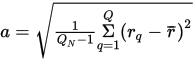
Missing values are ignored in the summation. If
 , then a is set to missing.
 - Sum of Values
-
accumulates the vector values based on the summation of their values.

Missing values are ignored in the summation. If
, then a is set to missing. - Uncorrected Sum of Squares
-
accumulates the vector values based on their uncorrected sum of squares.
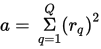
Missing values are ignored in the summation. If
, then a is set to missing.