SPATIALREG Procedure
Approximations to the Jacobian
In order for PROC SPATIALREG to obtain maximum likelihood estimates for all models except linear regression models, it needs to compute the Jacobian term because that term appears in the log-likelihood function. The Jacobian term is 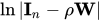 for SDMs and SAR models and
 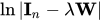 for SEMs and SDEMs, where n is the number of observations and
  is the spatial weights matrix. When n is not large, the Jacobian is computed as
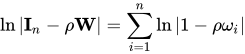
where  are the eigenvalues of . This computation requires that all eigenvalues of be precomputed, which works fine for small data sets. However, when n is large, computing the Jacobian term by using the eigenvalue method can be computationally infeasible. Instead, you can use approximations to the Jacobian.
The SPATIALREG procedure supports two different approximations to the Jacobian for SDMs, SEMs, SDEMs, and SAR models: Taylor approximation or Chebyshev approximation. Using SDMs and SAR models as an example, the two approximations for the Jacobian term can be described as follows (for more information, see LeSage and Pace 2009, and the references therein):
-
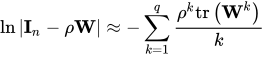
Taylor approximation uses finite, lower-order series to approximate the log-determinant as
-
Chebyshev approximation uses finite, lower-order Chebyshev polynomials of the first kind to approximate the log-determinant as

where
 ,
, 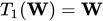 , and
, and  for
for  . The coefficients
  are defined as
with
 for
for  .
.
The traces of powers of can be computed exactly or approximated using Monte Carlo simulation. The Monte Carlo simulation is done as follows,
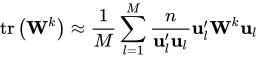
where 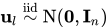 and M is the total number of Monte Carlo samples.
When you apply these two approximations, it is often assumed that the maximum eigenvalue of equals 1 and the minimum eigenvalue of is greater than or equal to –1 (see LeSage and Pace 2009, and the references therein). One way to satisfy this assumption is to use a row-standardized spatial weights matrix that is similar to a symmetric matrix. If the spatial weights matrix is not symmetric or similar to a symmetric matrix, it becomes more difficult to apply Chebyshev approximation and thus requires extra care (LeSage and Pace 2009).
When you request an approximation to the Jacobian, the choices that you need to make might include the approximation method to use (that is, Taylor approximation or Chebyshev approximation); the order of series q; and the number of Monte Carlo samples (that is, M). Your choice can be accommodated through the APPROXIMATION= option in the PROC SPATIALREG statement. For the approximation method, you can use the keyword TAYLOR in the APPROXIMATION= option to request Taylor approximation. Otherwise, the approximation method defaults to Chebyshev approximation. You specify ORDER=q in the APPROXIMATION= option to request a series of order q when approximating the log-determinant. In addition, you specify NMC=M in the APPROXIMATION= option to request M Monte Carlo samples to be drawn when approximating the traces of powers of . In addition, you can use the SEED= suboption of the APPROXIMATION= option to specify an integer seed for a random number generator to replicate your analysis.