PANEL Procedure
Hausman-Taylor Estimation (HTAYLOR Option)
You perform Hausman-Taylor estimation by specifying the HTAYLOR option in the MODEL statement. The Hausman and Taylor (1981) model is a hybrid that combines the consistency of a fixed-effects model with the efficiency and applicability of a random-effects model. One-way random-effects models assume exogeneity of the regressors; that is, they are independent of both the cross-sectional and observation-level errors. When some regressors are correlated with the cross-sectional errors, you can adjust the random-effects model to deal with this form of endogeneity.
Consider the one-way model:

The regressors are subdivided so that  and
and  vary within cross sections, whereas
  and
and  do not and would otherwise be dropped from a fixed-effects model. The subscript 1 denotes variables that are independent of both error terms (exogenous variables), and the subscript 2 denotes variables that are independent of the observation-level errors
  but correlated with cross-sectional errors
  . The intercept term (if your model has one) is included as part of .
The Hausman-Taylor estimator is a two-stage least squares (2SLS) regression on data that are weighted similarly to data for random-effects estimation. The weights are functions of the estimated variance components.
The observation-level variance is estimated from a one-way fixed-effects model fit. Obtain  ,
,  , and
, and  from the section One-Way Fixed-Effects Model (FIXONE and FIXONETIME Options). Then
  , where

To estimate the cross-sectional error variance, form the mean-residual vector  , where
  . You can use the mean residuals to obtain intermediate estimates of the coefficients for
  and
and  via two-stage least squares (2SLS) estimation. At the first stage, use
  and as instrumental variables to predict . At the second stage, regress
  on both and the predicted to obtain
  and
and  .
.
To estimate the cross-sectional variance, compute  , where
  and
and

The design matrices  and
and  are formed by stacking the data observations of and , respectively.
After variance-component estimation, transform the dependent variable into partial deviations: 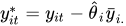 . Likewise, transform the regressors to form
  ,
,  ,
,  , and
, and  . The partial weights
  are determined by
  , with
  .
.
Finally, you obtain the Hausman-Taylor estimates by performing 2SLS regression of  on , , , and . For the first-stage regression, use the following instruments:
 , the deviations from cross-sectional means for all time-varying variables (correlated and uncorrelated) for the ith cross section during time period t
  , where
  are the means of the time-varying exogenous variables for the ith cross section
Multiplication by the factor  is redundant in balanced data but necessary in the unbalanced case to produce accurate instrumentation; see Gardner (1998).
Let  equal the number of regressors in , and let
  equal the number of regressors in . Then the Hausman-Taylor model is identified only if
  ; otherwise, no estimation takes place.
Hausman and Taylor (1981) describe a specification test that compares their model to a fixed-effects model. For a null hypothesis of fixed effects, Hausman’s m statistic is calculated by comparing the parameter estimates and variance matrices for both models, which is identical to how it is calculated for one-way random-effects models; for more information, see the section Hausman Test. However, the number of degrees of freedom of the test is not based on matrix rank but instead is equal to  .
.