PANEL Procedure
Tests for Random Effects
Hausman Test
For models that include random effects, the PANEL procedure outputs the results of the Hausman (1978) specification test, which provides guidance of choosing random-effect model or fixed-effect model. This test was also proposed by Wu (1973) and further extended in Hausman and Taylor (1982).
Consider two estimators,  and
and  , which under the null hypothesis are both consistent, but only is asymptotically efficient. Under the alternative hypothesis, only is consistent. The m statistic is

where  and
and  are estimates of the asymptotic covariance matrices of and . The statistic
  follows a
  distribution with
  degrees of freedom, where is the rank of
 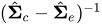 . This rank is normally equal to the dimension of
  , but it is reduced when regressors that are constant within cross sections are dropped from the fixed-effects model.
The null hypothesis is that the effects are independent of the regressors. Under the null hypothesis, the fixed-effects estimator is consistent but inefficient, whereas the random-effects estimator is both consistent and efficient. Failure to reject the null hypothesis favors the random-effects specification.
Breusch and Pagan Test for Random Effects
Breusch and Pagan (1980) developed a Lagrange multiplier test for random effects. The null hypothesis of this test is that the variance of the random effect is zero. The test helps you choose between random-effects model regression and pooled OLS regression, and it is based on the pooled OLS estimator. If  is the
  th residual from the pooled OLS regression, then the Breusch-Pagan (BP) test for one-way random effects is
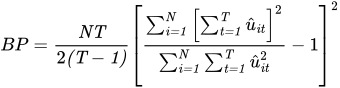
The BP test generalizes to the case of a two-way random-effects model (Greene 2000, p. 589). Specifically,
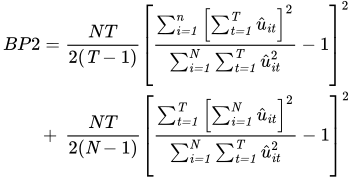
is distributed as a  statistic with two degrees of freedom.
Because a two-way model generalizes a one-way model, failure to reject the null hypothesis of no random effects with BP2 usually implies a failure reject with BP as well. For both the BP and BP2 tests, the residuals are obtained from a pooled regression. There is very little extra cost in selecting both the BP and BP2 tests. Notice that in the case of only groupwise heteroscedasticity, the BP2 test approximates the BP test. In the case of time-based heteroscedasticity, the BP2 test reduces to a BP test of time effects. In the case of unbalanced panels, neither the BP nor BP2 statistics are valid.
Finally, you should be aware that the BP option generates different results, depending on whether the estimation option is FIXONE or FIXONETIME. When you specify the FIXONE option, the BP option requests a test for cross-sectional random effects. When you specify the FIXONETIME option, the BP option requests a test for time random effects.
Although the Hausman test is automatically provided, you can request the Breusch-Pagan tests via the BP and BP2 options in the MODEL statement.
For more information about the Breusch and Pagan tests, see Baltagi (2013, sec. 4.2).