PANEL Procedure

Da Silva Method for Moving Average Models (DASILVA Option)

The Da Silva method assumes that the observed value of the dependent variable at the tth time point on the ith cross-sectional unit can be expressed as

y Subscript i t Baseline equals bold x Subscript i t Superscript Super Superscript prime Superscript Baseline beta plus a Subscript i Baseline plus b Subscript t Baseline plus e Subscript i t Baseline i equals 1 comma ellipsis comma upper N semicolon t equals 1 comma ellipsis comma upper T

where

bold x Subscript i t Superscript prime Baseline equals left-parenthesis x Subscript i t Baseline 1 Baseline comma ellipsis comma x Subscript i t p Baseline right-parenthesis is a vector of explanatory variables for the tth time point and ith cross-sectional unit

beta equals left-parenthesis beta 1 comma ellipsis comma beta Subscript p Baseline right-parenthesis prime is the vector of parameters

a Subscript i is a time-invariant, cross-sectional unit effect

b Subscript t is a cross-sectionally invariant time effect

e Subscript i t is a residual effect unaccounted for by the explanatory variables and the specific time and cross-sectional unit effects

Since the observations are arranged first by cross sections, then by time periods within cross sections, these equations can be written in matrix notation as

bold y equals bold upper X beta plus bold u

where

bold u equals left-parenthesis bold a circled-times bold 1 Subscript upper T Baseline right-parenthesis plus left-parenthesis bold 1 Subscript upper N Baseline circled-times bold b right-parenthesis plus bold e
bold y equals left-parenthesis y 11 comma ellipsis comma y Subscript 1 upper T Baseline comma y 21 comma ellipsis comma y Subscript upper N upper T Baseline right-parenthesis prime
bold upper X equals left-parenthesis bold x 11 comma ellipsis comma bold x Subscript 1 upper T Baseline comma bold x 21 comma ellipsis comma bold x Subscript upper N upper T Baseline right-parenthesis prime
bold a equals left-parenthesis a 1 ellipsis a Subscript upper N Baseline right-parenthesis prime
bold b equals left-parenthesis b 1 ellipsis b Subscript upper T Baseline right-parenthesis prime
bold e equals left-parenthesis e 11 comma ellipsis comma e Subscript 1 upper T Baseline comma e 21 comma ellipsis comma e Subscript upper N upper T Baseline right-parenthesis prime

Here 1 Subscript upper N is an upper N times 1 vector with all elements equal to 1, and circled-times denotes the Kronecker product.

The following conditions are assumed:

  1. bold x Subscript i t is a sequence of nonstochastic, known p times 1 vectors in normal black letter upper R Superscript p whose elements are uniformly bounded in normal black letter upper R Superscript p. The matrix X has a full column rank p.

  2. bold-italic beta is a p times 1 constant vector of unknown parameters.

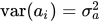
  3. a is a vector of uncorrelated random variables such that upper E left-parenthesis a Subscript i Baseline right-parenthesis equals 0 and normal v normal a normal r left-parenthesis a Subscript i Baseline right-parenthesis equals sigma Subscript a Superscript 2, sigma Subscript a Superscript 2 Baseline greater-than 0 comma i equals 1 comma ellipsis comma upper N.

  4. b is a vector of uncorrelated random variables such that upper E left-parenthesis b Subscript t Baseline right-parenthesis equals 0 and normal v normal a normal r left-parenthesis b Subscript t Baseline right-parenthesis equals sigma Subscript b Superscript 2 where sigma Subscript b Superscript 2 Baseline greater-than 0 and t equals 1 comma ellipsis comma upper T.

  5. bold e Subscript i Baseline equals left-parenthesis e Subscript i Baseline 1 Baseline comma ellipsis comma e Subscript i upper T Baseline right-parenthesis prime is a sample of a realization of a finite moving-average time series of order m less-than upper T minus 1 for each i ; hence,

    e Subscript i t Baseline equals alpha 0 epsilon Subscript i t Baseline plus alpha 1 epsilon Subscript i t minus 1 Baseline plus midline-horizontal-ellipsis plus alpha Subscript m Baseline epsilon Subscript i t minus m Baseline t equals 1 comma ellipsis comma upper T semicolon i equals 1 comma ellipsis comma upper N

    where alpha 0 comma alpha 1 comma ellipsis comma alpha Subscript m Baseline are unknown constants such that alpha 0 not-equals 0 and alpha Subscript m Baseline not-equals 0, and StartSet epsilon Subscript i j Baseline EndSet Subscript j equals negative normal infinity Superscript j equals normal infinity is a white noise process for each i—that is, a sequence of uncorrelated random variables with upper E left-parenthesis epsilon Subscript t Baseline right-parenthesis equals 0 comma upper E left-parenthesis epsilon Subscript t Superscript 2 Baseline right-parenthesis equals sigma Subscript epsilon Superscript 2, and sigma Subscript epsilon Superscript 2 Baseline greater-than 0. StartSet epsilon Subscript i j Baseline EndSet Subscript j equals negative normal infinity Superscript j equals normal infinity for i equals 1 comma ellipsis comma upper N are mutually uncorrelated.

  6. The sets of random variables StartSet a Subscript i Baseline EndSet Subscript i equals 1 Superscript upper N, StartSet b Subscript t Baseline EndSet Subscript t equals 1 Superscript upper T, and StartSet e Subscript i t Baseline EndSet Subscript t equals 1 Superscript upper T for i equals 1 comma ellipsis comma upper N are mutually uncorrelated.

  7. The random terms have normal distributions a Subscript i Baseline tilde upper N left-parenthesis 0 comma sigma Subscript a Superscript 2 Baseline right-parenthesis comma b Subscript t Baseline tilde upper N left-parenthesis 0 comma sigma Subscript b Superscript 2 Baseline right-parenthesis comma and epsilon Subscript t minus k Baseline tilde upper N left-parenthesis 0 comma sigma Subscript epsilon Superscript 2 Baseline right-parenthesis comma for i equals 1 comma ellipsis comma upper N semicolon t equals 1 comma ellipsis comma upper T semicolon and k equals 1 comma ellipsis comma m.

If assumptions 1–6 are satisfied, then

upper E left-parenthesis bold y right-parenthesis equals bold upper X beta

and

normal v normal a normal r left-parenthesis bold y right-parenthesis equals sigma Subscript a Superscript 2 Baseline left-parenthesis upper I Subscript upper N Baseline circled-times upper J Subscript upper T Baseline right-parenthesis plus sigma Subscript b Superscript 2 Baseline left-parenthesis upper J Subscript upper N Baseline circled-times upper I Subscript upper T Baseline right-parenthesis plus left-parenthesis upper I Subscript upper N Baseline circled-times normal upper Psi Subscript upper T Baseline right-parenthesis

where normal upper Psi Subscript upper T is a upper T times upper T matrix with elements psi Subscript t s,

normal upper C normal o normal v left-parenthesis e Subscript i t Baseline e Subscript i s Baseline right-parenthesis equals StartLayout Enlarged left-brace 1st Row 1st Column psi left-parenthesis StartAbsoluteValue t minus s EndAbsoluteValue right-parenthesis 2nd Column normal i normal f StartAbsoluteValue t minus s EndAbsoluteValue less-than-or-equal-to m 2nd Row 1st Column 0 2nd Column normal i normal f StartAbsoluteValue t minus s EndAbsoluteValue greater-than m EndLayout

where psi left-parenthesis k right-parenthesis equals sigma Subscript epsilon Superscript 2 Baseline sigma-summation Underscript j equals 0 Overscript m minus k Endscripts alpha Subscript j Baseline alpha Subscript j plus k for k equals StartAbsoluteValue t minus s EndAbsoluteValue. For the definition of upper I Subscript upper N, upper I Subscript upper T, upper J Subscript upper N, and upper J Subscript upper T, see the section Fuller-Battese Method.

The covariance matrix, denoted by V, can be written in the form

bold upper V equals sigma Subscript a Superscript 2 Baseline left-parenthesis upper I Subscript upper N Baseline circled-times upper J Subscript upper T Baseline right-parenthesis plus sigma Subscript b Superscript 2 Baseline left-parenthesis upper J Subscript upper N Baseline circled-times upper I Subscript upper T Baseline right-parenthesis plus sigma-summation Underscript k equals 0 Overscript m Endscripts psi left-parenthesis k right-parenthesis left-parenthesis upper I Subscript upper N Baseline circled-times normal upper Psi Subscript upper T Superscript left-parenthesis k right-parenthesis Baseline right-parenthesis

where normal upper Psi Subscript upper T Superscript left-parenthesis 0 right-parenthesis Baseline equals upper I Subscript upper T, and, for k equals 1 comma ellipsis comma m, normal upper Psi Subscript upper T Superscript left-parenthesis k right-parenthesis is a band matrix whose kth off-diagonal elements are 1’s and all other elements are 0’s.

Thus, the covariance matrix of the vector of observations y has the form
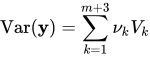
normal upper V normal a normal r left-parenthesis bold y right-parenthesis equals sigma-summation Underscript k equals 1 Overscript m plus 3 Endscripts nu Subscript k Baseline upper V Subscript k

where

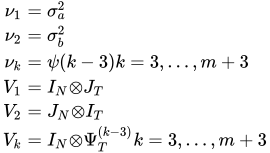
StartLayout 1st Row 1st Column nu 1 2nd Column equals 3rd Column sigma Subscript a Superscript 2 2nd Row 1st Column nu 2 2nd Column equals 3rd Column sigma Subscript b Superscript 2 3rd Row 1st Column nu Subscript k 2nd Column equals 3rd Column psi left-parenthesis k minus 3 right-parenthesis k equals 3 comma ellipsis comma m plus 3 4th Row 1st Column upper V 1 2nd Column equals 3rd Column upper I Subscript upper N Baseline circled-times upper J Subscript upper T 5th Row 1st Column upper V 2 2nd Column equals 3rd Column upper J Subscript upper N Baseline circled-times upper I Subscript upper T 6th Row 1st Column upper V Subscript k 2nd Column equals 3rd Column upper I Subscript upper N Baseline circled-times normal upper Psi Subscript upper T Superscript left-parenthesis k minus 3 right-parenthesis Baseline k equals 3 comma ellipsis comma m plus 3 EndLayout

The estimator of bold-italic beta is a two-step GLS-type estimator—that is, GLS with the unknown covariance matrix replaced by a suitable estimator of V. It is obtained by substituting Seely estimates for the scalar multiples nu Subscript k Baseline comma k equals 1 comma 2 comma ellipsis comma m plus 3.

Seely (1969) presents a general theory of unbiased estimation when the choice of estimators is restricted to finite dimensional vector spaces, with a special emphasis on quadratic estimation of functions of the form sigma-summation Underscript i equals 1 Overscript n Endscripts delta Subscript i Baseline nu Subscript i.

The parameters nu Subscript i (i equals 1 comma ellipsis comma n) are associated with a linear model upper E left-parenthesis bold y right-parenthesis equals bold upper X beta with covariance matrix sigma-summation Underscript i equals 1 Overscript n Endscripts nu Subscript i Baseline upper V Subscript i where upper V Subscript i (i equals 1 comma ellipsis comma n) are real symmetric matrices. The method is also discussed by Seely (1970b, 1970a); Seely and Zyskind (1971). Seely and Soong (1971) consider the MINQUE principle, using an approach along the lines of Seely (1969).

Last updated: June 19, 2025