PANEL Procedure
One-Way Random-Effects Model (RANONE Option)
You perform one-way random-effects estimation by specifying the RANONE option in the MODEL statement. The specification for the one-way random-effects model is

where the  are iid with zero mean and variance
  , and the
  are iid with zero mean and variance
  . Furthermore, a random-effects specification assumes that the error terms are mutually uncorrelated and that each error term is uncorrelated with
  .
.
Estimation proceeds in two steps. First, you obtain estimates of the variance components and . Second, with the variance components in hand, you form a weight for each cross section,

where  . Taking
  , you form the partial deviations:
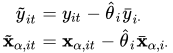
The random-effects estimation is then the result of OLS regression on the transformed data.
The PANEL procedure provides four methods of estimating variance components, as described in the following subsections.
Wallace-Hussain Method
You can use the Wallace-Hussain (1969) method of estimating variance components by specifying the VCOMP=WH option in the MODEL statement. The Wallace-Hussain method is part of a class of methods known as analysis of variance (ANOVA) estimators.
ANOVA estimators obtain variance components by solving a system of equations that is based on expected sums of squares. The following quadratic forms correspond to the within and between sums of squares, respectively:
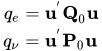
In these equations,  ,
,  , and
, and  is the vector of true residuals.
The ANOVA methods differ only in how they estimate . The Wallace-Hussain method uses the residuals from pooled (OLS) regression,  , in both quadratic forms.
The expected values of the quadratic forms are

where



Wansbeek-Kapteyn Method
You can use the Wansbeek-Kapteyn method of estimating variance components by specifying the VCOMP=WK option in the MODEL statement. The method is a specialization (Baltagi and Chang 1994) of the approach used by Wansbeek and Kapteyn (1989) for unbalanced two-way models. The method was also suggested by Amemiya (1971) for balanced data.
The Wansbeek-Kapteyn method is an ANOVA method that uses the within residuals from one-way fixed effects,  , in both quadratic forms.
The expected values of the quadratic forms are
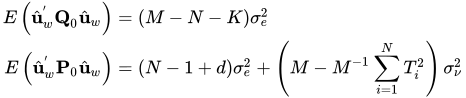
where

Fuller-Battese Method
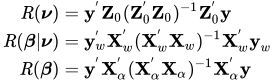
You can use the Fuller-Battese (1974) method of estimating variance components by specifying the VCOMP=FB option in the MODEL statement. Following Baltagi (2013, sec. 9.2), you obtain  as the mean square error (MSE) from one-way fixed effects. The cross-sectional variance is

where

for
Nerlove Method
You can use the Nerlove (1971) method of estimating variance components by specifying the VCOMP=NL option in the MODEL statement. The Nerlove method provides a simple alternative to the previous three estimation strategies. You estimate as the sample variance of the cross-sectional effects, estimated from a one-way fixed-effects regression. Specifically,  , where
  is the mean of the estimated fixed effects. You estimate
  by taking the error sum of squares from one-way fixed-effects regression and then dividing by M.
Selecting the Appropriate Variance Component Method
By default, variance components are estimated by the Fuller-Battese method (VCOMP=FB) when the data are balanced, and by the Wansbeek-Kapteyn method (VCOMP=WK) when the data are unbalanced.
Baltagi and Chang (1994) conducted an extensive simulation study of the finite-sample properties of the variance estimators that the PANEL procedure supports. The choice of method has little bearing on estimates of regression coefficients, their standard errors, and estimation of the error variance . If your goal is inference on  , then the variance-component method will matter little.
The methods have varying performance in how they estimate , the cross-sectional variance. All four methods tend to perform poorly if either the data are severely unbalanced or the ratio  is much greater than 1.
Of these four methods, the Nerlove method is the only one that guarantees a nonnegative estimate of ; the other three methods reset a negative estimate to 0. However, the Nerlove method is particularly unsuitable for unbalanced data because the sample variance that it computes is not weighted by  .
.