MODEL Procedure
Heteroscedasticity
One of the key assumptions of regression is that the variance of the errors is constant across observations. If the errors have constant variance, the errors are called homoscedastic. Typically, residuals are plotted to assess this assumption. Standard estimation methods are inefficient when the errors are heteroscedastic or have nonconstant variance.
Heteroscedasticity Tests
The MODEL procedure provides two tests for heteroscedasticity of the errors: White’s test and the modified Breusch-Pagan test.
Both White’s test and the Breusch-Pagan are based on the residuals of the fitted model. For systems of equations, these tests are computed separately for the residuals of each equation.
The residuals of an estimation are used to investigate the heteroscedasticity of the true disturbances.
The WHITE option tests the null hypothesis

White’s test is general because it makes no assumptions about the form of the heteroscedasticity (White 1980). Because of its generality, White’s test might identify specification errors other than heteroscedasticity (Thursby 1982). Thus, White’s test might be significant when the errors are homoscedastic but the model is misspecified in other ways.
White’s test is equivalent to obtaining the error sum of squares for the regression of squared residuals on a constant and all the unique variables in  , where the matrix J is composed of the partial derivatives of the equation residual with respect to the estimated parameters. White’s test statistic W is computed as

where  is the correlation coefficient obtained from the preceding regression. The statistic is asymptotically distributed as chi-squared with
  degrees of freedom, where P is the number of regressors in the regression, including the constant, and n is the total number of observations. In the example that follows, the regressors are constant, income, income*income, income*income*income, and income*income*income*income. The regressor income*income occurs twice, and one is dropped. Hence,
  with degrees of freedom
  .
.
Note that White’s test in the MODEL procedure is different from White’s test in the REG procedure requested by the SPEC option. The SPEC option produces the test from Theorem 2 on page 823 of White (1980). The WHITE option, on the other hand, produces the statistic discussed in Greene (1993).
The null hypothesis for the modified Breusch-Pagan test is homoscedasticity. The alternate hypothesis is that the error variance varies with a set of regressors, which are listed in the BREUSCH= option.
Define the matrix  to be composed of the values of the variables listed in the BREUSCH= option, such that
  is the value of the jth variable in the BREUSCH= option for the ith observation. The null hypothesis of the Breusch-Pagan test is

where  is the error variance for the ith observation and
  and
and  are regression coefficients.
The test statistic for the Breusch-Pagan test is

where  ,
,  is an
is an  vector of ones, and
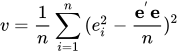
This is a modified version of the Breusch-Pagan test, which is less sensitive to the assumption of normality than the original test (Greene 1993, p. 395).
The statements in the following example produce the output in Figure 41:
proc model data=schools;
   parms const inc inc2;

   exp = const + inc * income + inc2 * income * income;
   incsq = income * income;

   fit exp / white breusch=(1 income incsq);
run;
Figure 41: Output for Heteroscedasticity Tests
| Heteroscedasticity Test | |||||
|---|---|---|---|---|---|
| Equation | Test | Statistic | DF | Pr > ChiSq | Variables |
| exp | White's Test | 21.16 | 4 | 0.0003 | Cross of all vars |
| Breusch-Pagan | 15.83 | 2 | 0.0004 | 1, income, incsq | |
Correcting for Heteroscedasticity
There are two methods for improving the efficiency of the parameter estimation in the presence of heteroscedastic errors. If the error variance relationships are known, weighted regression can be used or an error model can be estimated. For more information about error model estimation, see the section Error Covariance Structure Specification. If the error variance relationship is unknown, GMM estimation can be used.
Weighted Regression
The WEIGHT statement can be used to correct for the heteroscedasticity. Consider the following model, which has a heteroscedastic error term:

The data for this model are generated with the following SAS statements:
data test;
   do t=1 to 25;
      y = 250 * (exp( -0.2 * t ) - exp( -0.8 * t )) +
          sqrt( 9 / t ) * rannor(1);
      output;
   end;
run;
If this model is estimated with OLS, as shown in the following statements, the estimates shown in Figure 42 are obtained for the parameters:
proc model data=test;
   parms b1 0.1 b2 0.9;
   y = 250 * ( exp( -b1 * t ) - exp( -b2 * t ) );
   fit y;
run;
Figure 42: Unweighted OLS Estimates
| Nonlinear OLS Parameter Estimates | ||||
|---|---|---|---|---|
| Parameter | Estimate | Approx Std Err | t Value | Approx Pr > |t| |
| b1 | 0.200977 | 0.00101 | 198.60 | <.0001 |
| b2 | 0.826236 | 0.00853 | 96.82 | <.0001 |
If both sides of the model equation are multiplied by  , the model has a homoscedastic error term. This multiplication or weighting is done through the WEIGHT statement. The WEIGHT statement variable operates on the squared residuals as

so that the WEIGHT statement variable represents the square of the model multiplier. The following PROC MODEL statements corrects the heteroscedasticity with a WEIGHT statement:
proc model data=test;
   parms b1 0.1 b2 0.9;
   y = 250 * ( exp( -b1 * t ) - exp( -b2 * t ) );
   fit y;
   weight t;
run;
Note that the WEIGHT statement follows the FIT statement. The weighted estimates are shown in Figure 43.
Figure 43: Weighted OLS Estimates
| Nonlinear OLS Parameter Estimates | ||||
|---|---|---|---|---|
| Parameter | Estimate | Approx Std Err | t Value | Approx Pr > |t| |
| b1 | 0.200503 | 0.000844 | 237.53 | <.0001 |
| b2 | 0.816701 | 0.0139 | 58.71 | <.0001 |
The weighted OLS estimates are identical to the output produced by the following PROC MODEL example:
proc model data=test;
   parms b1 0.1 b2 0.9;
   y = 250 * ( exp( -b1 * t ) - exp( -b2 * t ) );
  _weight_ = t;
   fit y;
run;
If the WEIGHT statement is used in conjunction with the _WEIGHT_ variable, the two values are multiplied together to obtain the weight used.
The WEIGHT statement and the _WEIGHT_ variable operate on all the residuals in a system of equations. If a subset of the equations needs to be weighted, the residuals for each equation can be modified through the RESID. variable for each equation. The following example demonstrates the use of the RESID. variable to make a homoscedastic error term:
proc model data=test;
   parms b1 0.1 b2 0.9;
   y = 250 * ( exp( -b1 * t ) - exp( -b2 * t ) );
   resid.y = resid.y * sqrt(t);
   fit y;
run;
These statements produce estimates of the parameters and standard errors that are identical to the weighted OLS estimates. The reassignment of the RESID.Y variable must be done after Y is assigned; otherwise it would have no effect. Also, note that the residual (RESID.Y) is multiplied by . Here the multiplier is acting on the residual before it is squared.
GMM Estimation
If the form of the heteroscedasticity is unknown, generalized method of moments estimation (GMM) can be used. The following PROC MODEL statements use GMM to estimate the example model used in the preceding section:
proc model data=test;
   parms b1 0.1 b2 0.9;
   y = 250 * ( exp( -b1 * t ) - exp( -b2 * t ) );
   fit y / gmm;
   instruments b1 b2;
run;
GMM is an instrumental method, so instrument variables must be provided.
GMM estimation generates estimates for the parameters shown in Figure 44.
Figure 44: GMM Estimation for Heteroscedasticity
| Nonlinear GMM Parameter Estimates | ||||
|---|---|---|---|---|
| Parameter | Estimate | Approx Std Err | t Value | Approx Pr > |t| |
| b1 | 0.200487 | 0.000800 | 250.69 | <.0001 |
| b2 | 0.822148 | 0.0148 | 55.39 | <.0001 |
Heteroscedasticity-Consistent Covariance Matrix Estimation
Homoscedasticity is required for ordinary least squares regression estimates to be efficient. A nonconstant error variance, heteroscedasticity, causes the OLS estimates to be inefficient, and the usual OLS covariance matrix,  , is generally invalid:

When the variance of the errors of a classical linear model

is not constant across observations (heteroscedastic), so that  for some
  , the OLS estimator

is unbiased but it is inefficient. Models that take into account the changing variance can make more efficient use of the data. When the variances,  , are known, generalized least squares (GLS) can be used and the estimator

where
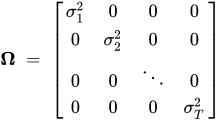
is unbiased and efficient. However, GLS is unavailable when the variances,  , are unknown.
To solve this problem White (1980) proposed a heteroscedastic consistent-covariance matrix estimator (HCCME)

that is consistent as well as unbiased, where
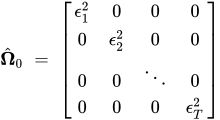
and  .
.
This estimator is considered somewhat unreliable in finite samples. Therefore, Davidson and MacKinnon (1993) propose three different modifications to estimating  . The first solution is to simply multiply
  by
by  , where n is the number of observations and df is the number of explanatory variables, so that
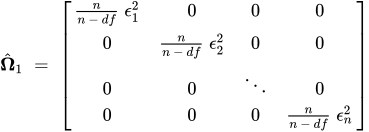
The second solution is to define
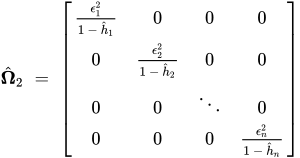
where  .
.
The third solution, called the "jackknife," is to define
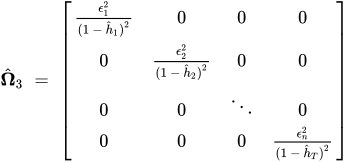
MacKinnon and White (1985) investigated these three modified HCCMEs, including the original HCCME, based on finite-sample performance of pseudo-t statistics. The original HCCME performed the worst. The first modification performed better. The second modification performed even better than the first, and the third modification performed the best. They concluded that the original HCCME should never be used in finite sample estimation, and that the second and third modifications should be used over the first modification if the diagonals of are available.
Seemingly Unrelated Regression HCCME
Extending the discussion to systems of g equations, the HCCME for SUR estimation is

where  is a
is a  matrix with the first g rows representing the first observation, the next g rows representing the second observation, and so on.
  is now a
  block diagonal matrix with typical block
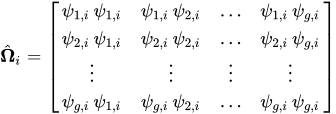
where

or
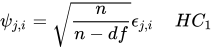
or

or

Two- and Three-Stage Least Squares HCCME
For two- and three-stage least squares, the HCCME for a g equation system is
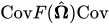
where

is the normal covariance matrix without the  matrix and

where  is a
is a  matrix with the jth equations regressors in the appropriate columns and zeros everywhere else.
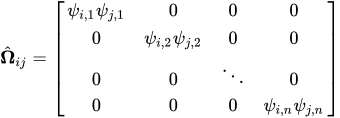
For 2SLS  when
when  . The
. The  used in is computed by using the parameter estimates obtained from the instrumental variables estimation.
The leverage value for the ith equation used in the HCCME=2 and HCCME=3 methods is computed as conditional on the first stage as

for 2SLS and

for 3SLS.