AUTOREG Procedure
HETERO Statement
HETERO variables / options;
The HETERO statement specifies variables that are related to the heteroscedasticity of the residuals and the way these variables are used to model the error variance of the regression.
The heteroscedastic regression model supported by the HETERO statement is

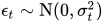


The HETERO statement specifies a model for the conditional variance  . The vector
  is composed of the variables listed in the HETERO statement,
  is a parameter vector, and
  is a link function that depends on the value of the LINK= option. In the printed output,
  represents the estimate of sigma, while
  -
-  are the estimates of parameters in the
  vector.
The keyword XBETA can be used in the variables list to refer to the model predicted value  . If XBETA is specified in the variables list, other variables in the HETERO statement will be ignored. In addition, XBETA cannot be specified in the GARCH process.
For heteroscedastic regression models without GARCH effects, the errors  are assumed to be uncorrelated—the heteroscedasticity models specified by the HETERO statement cannot be combined with an autoregressive model for the errors. Thus, when a HETERO statement is used, the NLAG= option cannot be specified unless the GARCH= option is also specified.
You can specify the following options in the HETERO statement.
- COEF=value
-
imposes constraints on the estimated parameters
of the heteroscedasticity model. You can specify the following values: - NONNEG
specifies that the estimated heteroscedasticity parameters
must be nonnegative. - UNIT
constrains all heteroscedasticity parameters
to equal 1. - UNREST
specifies unrestricted estimation of
. - ZERO
constrains all heteroscedasticity parameters
to equal 0.
If you specify the GARCH= option in the MODEL statement, then by default COEF=NONNEG. If you do not specify the GARCH= option in the MODEL statement, then by default COEF=UNREST.
- LINK=value
-
specifies the functional form of the heteroscedasticity model. By default, LINK=EXP. If you specify a GARCH model in the HETERO statement, the model is estimated using LINK=LINEAR only. For more information, see the section Using the HETERO Statement with GARCH Models. You can specify the following values:
- EXP
-
specifies the exponential link function. The following model is estimated when you specify LINK=EXP:

- LINEAR
-
specifies the linear function; that is, the HETERO statement variables predict the error variance linearly. The following model is estimated when you specify LINK=LINEAR:

- SQUARE
-
specifies the square link function. The following model is estimated when you specify LINK=SQUARE:

- NOCONST
-
specifies that the heteroscedasticity model does not include the unit term for the LINK=SQUARE and LINK=LINEAR options. For example, the following model is estimated when you specify the options LINK=SQUARE NOCONST:

- STD=value
-
imposes constraints on the estimated standard deviation
 of the heteroscedasticity model. You can specify the following values:
 - NONNEG
specifies that the estimated standard deviation parameter
must be nonnegative. - UNIT
constrains the standard deviation parameter
to equal 1. - UNREST
specifies unrestricted estimation of
.
By default, STD=UNREST.
- TEST=LM
-
produces a Lagrange multiplier test for heteroscedasticity. The null hypothesis is homoscedasticity; the alternative hypothesis is heteroscedasticity of the form specified by the HETERO statement. The power of the test depends on the variables specified in the HETERO statement.
The test may give different results depending on the functional form specified by the LINK= option. However, in many cases the test does not depend on the LINK= option. The test is invariant to the form of
when  and
and  . (The condition is satisfied except when the NOCONST option is specified with LINK=SQUARE or LINK=LINEAR.)