AUTOREG Procedure
GARCH Models
Consider the series  , which follows the GARCH process. The conditional distribution of the series Y for time t is written

where  denotes all available information at time
  . The conditional variance
  is
is
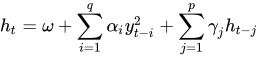
where


The GARCH model reduces to the ARCH
 process when
  . At least one of the ARCH parameters must be nonzero (
 ). The GARCH regression model can be written


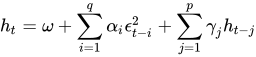
where  .
.
In addition, you can consider the model with disturbances following an autoregressive process and with the GARCH errors. The AR -GARCH regression model is denoted


GARCH Estimation with Nelson-Cao Inequality Constraints
The GARCH model is written in ARCH( ) form as
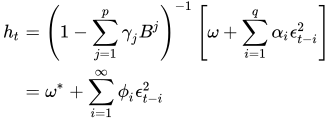
where B is a backshift operator. Therefore,  if
if  and
and  . Assume that the roots of the following polynomial equation are inside the unit circle,

where  and Z is a complex scalar.
 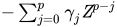 and
and  do not share common factors. Under these conditions,
  ,
,  , and these coefficients of the ARCH() process are well defined.
Define  . The coefficient
  is written
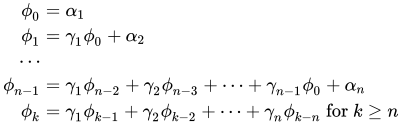
where  for
for  and
and  for
for  .
.
Nelson and Cao (1992) proposed the finite inequality constraints for GARCH and GARCH
 cases. However, it is not straightforward to derive the finite inequality constraints for the general GARCH model.
For the GARCH model, the nonlinear inequality constraints are
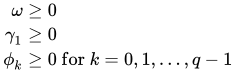
For the GARCH model, the nonlinear inequality constraints are
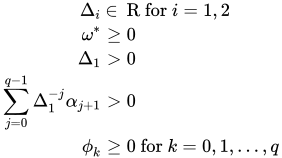
where  and
and  are the roots of
  .
.
For the GARCH model with  , only
  nonlinear inequality constraints (
 for
for  to max(
 )) are imposed, together with the in-sample positivity constraints of the conditional variance
  .
.
IGARCH and Stationary GARCH Model
The condition  implies that the GARCH process is weakly stationary since the mean, variance, and autocovariance are finite and constant over time. When the GARCH process is stationary, the unconditional variance of
  is computed as

where  and is the GARCH conditional variance.
Sometimes the multistep forecasts of the variance do not approach the unconditional variance when the model is integrated in variance; that is,  .
.
The unconditional variance does not exist for the IGARCH model. However, it is interesting that the IGARCH model can be strongly stationary even though it is not weakly stationary. For more information, see Nelson (1990).
EGARCH Model
The EGARCH model was proposed by Nelson (1991). Nelson and Cao (1992) argue that the nonnegativity constraints in the linear GARCH model are too restrictive. The GARCH model imposes the nonnegative constraints on the parameters,  and
and  , while there are no restrictions on these parameters in the EGARCH model. In the EGARCH model, the conditional variance,
  , is an asymmetric function of lagged disturbances
  ,
,

where


The coefficient of the second term in  is set to be 1 (
 =1) in our formulation. Note that
  if
if  . The properties of the EGARCH model are summarized as follows:
The function
is linear in  with slope coefficient
  if is positive while is linear in with slope coefficient
  if is negative.
 Suppose that
 . Large innovations increase the conditional variance if
  and decrease the conditional variance if
  .
. Suppose that
 . The innovation in variance, , is positive if the innovations are less than
  . Therefore, the negative innovations in returns,
  , cause the innovation to the conditional variance to be positive if
  is much less than 1.
The unconditional variance does not exist for the EGARCH model.
QGARCH, TGARCH, and PGARCH Models
As shown in many empirical studies, positive and negative innovations have different impacts on future volatility. There is a long list of variations of GARCH models that consider the asymmetricity. Three typical variations are the quadratic GARCH (QGARCH) model (Engle and Ng 1993), the threshold GARCH (TGARCH) model (Glosten, Jaganathan, and Runkle 1993; Zakoian 1994), and the power GARCH (PGARCH) model (Ding, Granger, and Engle 1993). For more information about the asymmetric GARCH models, see Engle and Ng (1993).
In the QGARCH model, the lagged errors’ centers are shifted from zero to some constant values:

In the TGARCH model, there is an extra slope coefficient for each lagged squared error,

where the indicator function  is one if
  ; otherwise, it is zero.
The PGARCH model not only considers the asymmetric effect but also provides another way to model the long memory property in the volatility,

where  and
and  .
.
Note that the implemented TGARCH model is also well known as GJR-GARCH (Glosten, Jaganathan, and Runkle 1993), which is similar to the threshold GARCH model proposed by Zakoian (1994) but not exactly the same. In Zakoian’s model, the conditional standard deviation is a linear function of the past values of the white noise. Zakoian’s version can be regarded as a special case of the PGARCH model when  . The unconditional variance does not exist for the QGARCH, TGARCH, and PGARCH models.
Using the HETERO Statement with GARCH Models
The HETERO statement can be combined with the GARCH= option in the MODEL statement to include input variables in the GARCH conditional variance model. For example, the GARCH variance model with two dummy input variables,
 D1 and D2, is

The following statements estimate this GARCH model:
proc autoreg data=one;
   model y = x z / garch=(p=1,q=1);
   hetero d1 d2;
run;
The parameters for the variables D1 and D2 can be constrained using the COEF= option. For example, the constraints  are imposed by the following statements:
proc autoreg data=one;
   model y = x z / garch=(p=1,q=1);
   hetero d1 d2 / coef=unit;
run;
For the EGARCH model, the input variables enter  . For example, the EGARCH model with two dummy input variables,
 D1 and D2, is

where
The following statements estimate the EGARCH model:
proc autoreg data=one;
   model y = x z / garch=(p=1,q=1,type=egarch);
   hetero d1 d2;
run;
For the PGARCH model, the input variables enter  . For example, the PGARCH model with two dummy input variables,
 D1 and D2, is

The following statements estimate the PGARCH model:
proc autoreg data=one;
   model y = x z / garch=(p=1,q=1,type=pgarch);
   hetero d1 d2;
run;
GARCH-in-Mean
The GARCH-M model has the added regressor that is the conditional standard deviation,

where follows the ARCH or GARCH process.
Maximum Likelihood Estimation
The family of GARCH models are estimated using the maximum likelihood method. The log-likelihood function is computed from the product of all conditional densities of the prediction errors.
When  is assumed to have a standard normal distribution (
 ), the log-likelihood function is given by
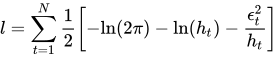
where  and is the conditional variance. When the GARCH-M model is estimated,
  . When there are no regressors, the residuals
  are denoted as or
  .
.
If has the standardized Student’s t distribution, the log-likelihood function for the conditional t distribution is

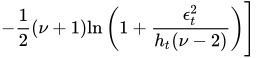
where  is the gamma function and
  is the degree of freedom (
 ). Under the conditional t distribution, the additional parameter
  is estimated. The log-likelihood function for the conditional t distribution converges to the log-likelihood function of the conditional normal GARCH model as
  .
.
The likelihood function is maximized via either the dual quasi-Newton or the trust region algorithm. The default is the dual quasi-Newton algorithm. The starting values for the regression parameters  are obtained from the OLS estimates. When there are autoregressive parameters in the model, the initial values are obtained from the Yule-Walker estimates. The starting value
  is used for the GARCH process parameters. Computation of the conditional variance sequence
  requires values for
  and
and 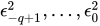 . For the GARCH(p,q) model,
 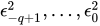 are set to the mean square error from the OLS estimation if no autoregressive model is specified, and set to the mean square error from the Yule-Walker estimation if an autoregressive model is specified. Values for
  are then set equal to the expected conditional variance,
  ), which you compute by setting
  to the initializing MSE for . For the GARCH(1,1) model, this gives
  .
.
The variance-covariance matrix is computed using the Hessian matrix. The dual quasi-Newton method approximates the Hessian matrix while the
quasi-Newton method gets an approximation of the inverse of Hessian. The trust region method uses the Hessian matrix obtained using numerical differentiation. When there are active constraints, that is,  , the variance-covariance matrix is given by

where  and
and  . Therefore, the variance-covariance matrix without active constraints reduces to
 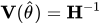 .
.