VARMAX Procedure
Parameter Estimation and Testing on Restrictions
In the previous example, the VARX(1,0) model is written as

with
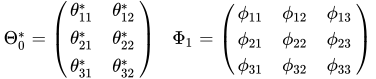
In Figure 25 of the preceding section, you can see several insignificant parameters. For example, the coefficients XL0_1_2, AR1_1_2, and AR1_3_2 are insignificant.
The following statements restrict the coefficients of  for the VARX(1,0) model:
/*--- Models with Restrictions and Tests ---*/

proc varmax data=grunfeld;
   model y1-y3 = x1 x2 / p=1 print=(estimates);
   restrict XL(0,1,2)=0, AR(1,1,2)=0, AR(1,3,2)=0;
run;
The output in Figure 26 shows that three parameters  ,
,  , and
, and  are replaced by the restricted values, zeros, and their standard errors are also zeros to indicate that the parameters are fixed to these values.
Figure 26: Parameter Estimation with Restrictions
| Model Parameter Estimates | ||||||
|---|---|---|---|---|---|---|
| Equation | Parameter | Estimate | Standard Error |
t Value | Pr > |t| | Variable |
| y1 | CONST1 | -2.16781 | 13.13755 | -0.17 | 0.8715 | 1 |
| XL0_1_1 | 1.67592 | 0.40792 | 4.11 | 0.0012 | x1(t) | |
| XL0_1_2 | 0.00000 | 0.00000 | x2(t) | |||
| AR1_1_1 | 0.27671 | 0.17606 | 1.57 | 0.1401 | y1(t-1) | |
| AR1_1_2 | 0.00000 | 0.00000 | y2(t-1) | |||
| AR1_1_3 | 0.01747 | 0.03519 | 0.50 | 0.6279 | y3(t-1) | |
| y2 | CONST2 | 768.14598 | 224.12735 | 3.43 | 0.0045 | 1 |
| XL0_2_1 | -6.30880 | 4.85729 | -1.30 | 0.2166 | x1(t) | |
| XL0_2_2 | 2.65308 | 0.43840 | 6.05 | 0.0001 | x2(t) | |
| AR1_2_1 | -2.16968 | 1.83550 | -1.18 | 0.2584 | y1(t-1) | |
| AR1_2_2 | 0.10945 | 0.11751 | 0.93 | 0.3686 | y2(t-1) | |
| AR1_2_3 | -0.93053 | 0.41478 | -2.24 | 0.0429 | y3(t-1) | |
| y3 | CONST3 | -19.88165 | 7.69575 | -2.58 | 0.0227 | 1 |
| XL0_3_1 | -0.03576 | 0.20079 | -0.18 | 0.8614 | x1(t) | |
| XL0_3_2 | -0.00919 | 0.01747 | -0.53 | 0.6076 | x2(t) | |
| AR1_3_1 | 0.96398 | 0.06907 | 13.96 | 0.0001 | y1(t-1) | |
| AR1_3_2 | 0.00000 | 0.00000 | y2(t-1) | |||
| AR1_3_3 | 0.93412 | 0.01473 | 63.41 | 0.0001 | y3(t-1) | |
The output in Figure 27 shows the estimates of the Lagrangian parameters and their significance. Based on the p-values associated with the Lagrangian parameters, you cannot reject the null hypotheses  ,
,  , and
, and  with the 0.05 significance level.
Figure 27: RESTRICT Statement Results
| Testing of the Restricted Parameters | |||||
|---|---|---|---|---|---|
| Parameter | Estimate | Standard Error |
t Value | Pr > |t| | Equation |
| Restrict0 | 1.74969 | 21.44026 | 0.08 | 0.9353 | XL0_1_2 = 0 |
| Restrict1 | 30.36254 | 70.74347 | 0.43 | 0.6700 | AR1_1_2 = 0 |
| Restrict2 | 55.42191 | 164.03075 | 0.34 | 0.7371 | AR1_3_2 = 0 |
The TEST statement in the following example tests  and for the VARX(1,0) model:
proc varmax data=grunfeld;
   model y1-y3 = x1 x2 / p=1;
   test AR(1,3,1)=0;
   test XL(0,1,2)=0, AR(1,1,2)=0, AR(1,3,2)=0;
run;
The output in Figure 28 shows that the first column in the output is the index corresponding to each TEST statement. You can reject the hypothesis test at the 0.05 significance level, but you cannot reject the joint hypothesis test at the 0.05 significance level.
Figure 28: TEST Statement Results
| Testing of the Parameters | |||
|---|---|---|---|
| Test | DF | Chi-Square | Pr > ChiSq |
| 1 | 1 | 150.31 | <.0001 |
| 2 | 3 | 0.34 | 0.9522 |