VARMAX Procedure

Multivariate GARCH Modeling

Stochastic volatility modeling is important in many areas, particularly in finance. To study the volatility of time series, GARCH models are widely used because they provide a good approach to conditional variance modeling.

BEKK Representation

Engle and Kroner (1995) propose a general multivariate GARCH model and call it a BEKK representation. Let script upper F left-parenthesis t minus 1 right-parenthesis be the sigma field generated by the past values of bold-italic epsilon Subscript t, and let upper H Subscript t be the conditional covariance matrix of the k-dimensional random vector bold-italic epsilon Subscript t. Let upper H Subscript t be measurable with respect to script upper F left-parenthesis t minus 1 right-parenthesis; then the multivariate GARCH model can be written as

StartLayout 1st Row 1st Column bold-italic epsilon Subscript t Baseline vertical-bar script upper F left-parenthesis t minus 1 right-parenthesis 2nd Column tilde 3rd Column upper N left-parenthesis 0 comma upper H Subscript t Baseline right-parenthesis 2nd Row 1st Column upper H Subscript t 2nd Column equals 3rd Column upper C plus sigma-summation Underscript i equals 1 Overscript q Endscripts upper A prime Subscript i Baseline bold-italic epsilon Subscript t minus i Baseline bold-italic epsilon prime Subscript t minus i Baseline upper A Subscript i plus sigma-summation Underscript i equals 1 Overscript p Endscripts upper G prime Subscript i Baseline upper H Subscript t minus i Baseline upper G Subscript i EndLayout

where C, upper A Subscript i, and upper G Subscript i are k times k parameter matrices.

Consider the bivariate GARCH(1,1) model

StartLayout 1st Row 1st Column upper H Subscript t 2nd Column equals 3rd Column Start 2 By 2 Matrix 1st Row 1st Column c 11 2nd Column c 12 2nd Row 1st Column c 12 2nd Column c 22 EndMatrix plus Start 2 By 2 Matrix 1st Row 1st Column a 11 2nd Column a 12 2nd Row 1st Column a 21 2nd Column a 22 EndMatrix prime Start 2 By 2 Matrix 1st Row 1st Column epsilon Subscript 1 comma t minus 1 Superscript 2 2nd Column epsilon Subscript 1 comma t minus 1 Baseline epsilon Subscript 2 comma t minus 1 2nd Row 1st Column epsilon Subscript 2 comma t minus 1 Baseline epsilon Subscript 1 comma t minus 1 2nd Column epsilon Subscript 2 comma t minus 1 Superscript 2 EndMatrix Start 2 By 2 Matrix 1st Row 1st Column a 11 2nd Column a 12 2nd Row 1st Column a 21 2nd Column a 22 EndMatrix 2nd Row 1st Column Blank 2nd Column Blank 3rd Column plus Start 2 By 2 Matrix 1st Row 1st Column g 11 2nd Column g 12 2nd Row 1st Column g 21 2nd Column g 22 EndMatrix prime upper H Subscript t minus 1 Baseline Start 2 By 2 Matrix 1st Row 1st Column g 11 2nd Column g 12 2nd Row 1st Column g 21 2nd Column g 22 EndMatrix EndLayout

or, representing the univariate model,
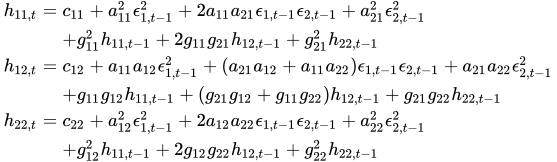
StartLayout 1st Row 1st Column h Subscript 11 comma t 2nd Column equals 3rd Column c 11 plus a 11 squared epsilon Subscript 1 comma t minus 1 Superscript 2 plus 2 a 11 a 21 epsilon Subscript 1 comma t minus 1 Baseline epsilon Subscript 2 comma t minus 1 plus a 21 squared epsilon Subscript 2 comma t minus 1 Superscript 2 2nd Row 1st Column Blank 2nd Column Blank 3rd Column plus g 11 squared h Subscript 11 comma t minus 1 plus 2 g 11 g 21 h Subscript 12 comma t minus 1 plus g 21 squared h Subscript 22 comma t minus 1 3rd Row 1st Column h Subscript 12 comma t 2nd Column equals 3rd Column c 12 plus a 11 a 12 epsilon Subscript 1 comma t minus 1 Superscript 2 plus left-parenthesis a 21 a 12 plus a 11 a 22 right-parenthesis epsilon Subscript 1 comma t minus 1 Baseline epsilon Subscript 2 comma t minus 1 plus a 21 a 22 epsilon Subscript 2 comma t minus 1 Superscript 2 4th Row 1st Column Blank 2nd Column Blank 3rd Column plus g 11 g 12 h Subscript 11 comma t minus 1 plus left-parenthesis g 21 g 12 plus g 11 g 22 right-parenthesis h Subscript 12 comma t minus 1 plus g 21 g 22 h Subscript 22 comma t minus 1 5th Row 1st Column h Subscript 22 comma t 2nd Column equals 3rd Column c 22 plus a 12 squared epsilon Subscript 1 comma t minus 1 Superscript 2 plus 2 a 12 a 22 epsilon Subscript 1 comma t minus 1 Baseline epsilon Subscript 2 comma t minus 1 plus a 22 squared epsilon Subscript 2 comma t minus 1 Superscript 2 6th Row 1st Column Blank 2nd Column Blank 3rd Column plus g 12 squared h Subscript 11 comma t minus 1 plus 2 g 12 g 22 h Subscript 12 comma t minus 1 plus g 22 squared h Subscript 22 comma t minus 1 EndLayout

For the BEKK representation of the bivariate GARCH(1,1) model, the SAS statements are

model y1 y2;
garch q=1 p=1 form=bekk;

The multistep forecast of the conditional covariance matrix, upper H Subscript t plus h vertical-bar t Baseline comma h equals 1 comma 2 comma ellipsis comma is obtained recursively through the formula


StartLayout 1st Row 1st Column upper H Subscript t plus h vertical-bar t 2nd Column equals 3rd Column upper C plus sigma-summation Underscript i equals 1 Overscript h minus 1 Endscripts upper A prime Subscript i Baseline upper H Subscript t plus h minus i vertical-bar t Baseline upper A Subscript i plus sigma-summation Underscript i equals h Overscript q Endscripts upper A prime Subscript i Baseline bold-italic epsilon Subscript t plus h minus i Baseline bold-italic epsilon prime Subscript t plus h minus i Baseline upper A Subscript i plus sigma-summation Underscript i equals 1 Overscript p Endscripts upper G prime Subscript i Baseline upper H Subscript t plus h minus i vertical-bar t Baseline upper G Subscript i EndLayout

where upper H Subscript s vertical-bar t Baseline equals upper H Subscript s for s less-than-or-equal-to t.

CCC Representation

Bollerslev (1990) proposes a multivariate GARCH model with time-varying conditional variances and covariances but constant conditional correlations.

The conditional covariance matrix upper H Subscript t consists of

StartLayout 1st Row  upper H Subscript t Baseline equals upper D Subscript t Baseline upper S upper D Subscript t EndLayout

where upper D Subscript t is a k times k stochastic diagonal matrix with element sigma Subscript i comma t and S is a k times k time-invariant correlation matrix with the typical element s Subscript i j.

The element of upper H Subscript t is

StartLayout 1st Row 1st Column h Subscript i j comma t 2nd Column equals 3rd Column s Subscript i j Baseline sigma Subscript i comma t Baseline sigma Subscript j comma t Baseline i comma j equals 1 comma ellipsis comma k EndLayout

Note that h Subscript i i comma t Baseline equals sigma Subscript i comma t Superscript 2 Baseline comma i equals 1 comma ellipsis comma k.

If you specify CORRCONSTANT=EXPECT, the element s Subscript i j of the time-invariant correlation matrix S is
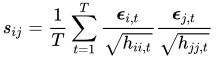
StartLayout 1st Row  s Subscript i j Baseline equals StartFraction 1 Over upper T EndFraction sigma-summation Underscript t equals 1 Overscript upper T Endscripts StartFraction bold-italic epsilon Subscript i comma t Baseline Over StartRoot h Subscript i i comma t Baseline EndRoot EndFraction StartFraction bold-italic epsilon Subscript j comma t Baseline Over StartRoot h Subscript j j comma t Baseline EndRoot EndFraction EndLayout

where T is the sample size.

By default, or when you specify SUBFORM=GARCH, sigma Subscript i comma t Superscript 2 follows a univariate GARCH process,

StartLayout 1st Row 1st Column sigma Subscript i comma t Superscript 2 2nd Column equals 3rd Column c Subscript i Baseline plus sigma-summation Underscript l equals 1 Overscript q Endscripts a Subscript i i comma l Baseline bold-italic epsilon Subscript i comma t minus l Superscript 2 Baseline plus sigma-summation Underscript l equals 1 Overscript p Endscripts g Subscript i i comma l Baseline sigma Subscript i comma t minus 1 Superscript 2 Baseline i equals 1 comma ellipsis comma k EndLayout

As shown in many empirical studies, positive and negative innovations have different impacts on future volatility. There is a long list of variations of univariate GARCH models that consider the asymmetricity. Four typical variations follow:

  • exponential GARCH (EGARCH) model (Nelson and Cao 1992)

  • quadratic GARCH (QGARCH) model (Engle and Ng 1993)

  • threshold GARCH (TGARCH) model (Glosten, Jaganathan, and Runkle 1993; Zakoian 1994)

  • power GARCH (PGARCH) model (Ding, Granger, and Engle 1993)

For more information about the asymmetric GARCH models, see Engle and Ng (1993). You can choose the type of GARCH model of interest by specifying the SUBFORM= option.

The EGARCH model was proposed by Nelson (1991). Nelson and Cao (1992) argue that the nonnegativity constraints in the GARCH model are too restrictive. The GARCH model, implicitly or explicitly, imposes the nonnegative constraints on the parameters, whereas these parameters have no restrictions in the EGARCH model. In the EGARCH model, the conditional variance is an asymmetric function of lagged disturbances,

StartLayout 1st Row 1st Column ln left-parenthesis sigma Subscript i comma t Superscript 2 Baseline right-parenthesis 2nd Column equals 3rd Column c Subscript i Baseline plus sigma-summation Underscript l equals 1 Overscript q Endscripts a Subscript i i comma l Baseline left-parenthesis b Subscript i i comma l Baseline StartFraction bold-italic epsilon Subscript i comma t minus l Baseline Over sigma Subscript i comma t minus l Baseline EndFraction plus StartAbsoluteValue StartFraction bold-italic epsilon Subscript i comma t minus l Baseline Over sigma Subscript i comma t minus l Baseline EndFraction EndAbsoluteValue minus StartRoot StartFraction 2 Over pi EndFraction EndRoot right-parenthesis plus sigma-summation Underscript l equals 1 Overscript p Endscripts g Subscript i i comma l Baseline ln left-parenthesis sigma Subscript i comma t minus l Superscript 2 Baseline right-parenthesis i equals 1 comma ellipsis comma k EndLayout

In the QGARCH model, the lagged errors’ centers are shifted from zero to some constant values,

StartLayout 1st Row 1st Column sigma Subscript i comma t Superscript 2 2nd Column equals 3rd Column c Subscript i Baseline plus sigma-summation Underscript l equals 1 Overscript q Endscripts a Subscript i i comma l Baseline left-parenthesis bold-italic epsilon Subscript i comma t minus l Baseline minus b Subscript i i comma l Baseline right-parenthesis squared plus sigma-summation Underscript l equals 1 Overscript p Endscripts g Subscript i i comma l Baseline sigma Subscript i comma t minus 1 Superscript 2 Baseline i equals 1 comma ellipsis comma k EndLayout

In the TGARCH model, each lagged squared error has an extra slope coefficient,

StartLayout 1st Row 1st Column sigma Subscript i comma t Superscript 2 2nd Column equals 3rd Column c Subscript i Baseline plus sigma-summation Underscript l equals 1 Overscript q Endscripts left-parenthesis a Subscript i i comma l Baseline plus 1 Subscript bold-italic epsilon Sub Subscript i comma t minus l Subscript less-than 0 Baseline b Subscript i i comma l Baseline right-parenthesis bold-italic epsilon Subscript i comma t minus l Superscript 2 Baseline plus sigma-summation Underscript l equals 1 Overscript p Endscripts g Subscript i i comma l Baseline sigma Subscript i comma t minus 1 Superscript 2 Baseline i equals 1 comma ellipsis comma k EndLayout

where the indicator function 1 Subscript bold-italic epsilon Sub Subscript i comma t Subscript less-than 0 is one if bold-italic epsilon Subscript i comma t Baseline less-than 0 and zero otherwise.

The PGARCH model not only considers the asymmetric effect but also provides a way to model the long memory property in the volatility,

StartLayout 1st Row  sigma Subscript i comma t Superscript 2 lamda Super Subscript i Superscript Baseline equals c Subscript i Baseline plus sigma-summation Underscript l equals 1 Overscript q Endscripts a Subscript i i comma l Baseline left-parenthesis StartAbsoluteValue bold-italic epsilon Subscript i comma t minus l Baseline EndAbsoluteValue minus b Subscript i i comma l Baseline bold-italic epsilon Subscript i comma t minus l Baseline right-parenthesis Superscript 2 lamda Super Subscript i Superscript Baseline plus sigma-summation Underscript l equals 1 Overscript p Endscripts g Subscript i i comma l Baseline sigma Subscript i comma t minus 1 Superscript 2 lamda Super Subscript i Superscript Baseline i equals 1 comma ellipsis comma k EndLayout

where lamda Subscript i Baseline greater-than 0 and StartAbsoluteValue b Subscript i i comma l Baseline EndAbsoluteValue less-than-or-equal-to 1 comma l equals 1 comma ellipsis comma q comma i equals 1 comma ellipsis comma k.

Note that the implemented TGARCH model is also well known as GJR-GARCH (Glosten, Jaganathan, and Runkle 1993), which is similar to the threshold GARCH model proposed by Zakoian (1994) but not exactly the same. In Zakoian’s model, the conditional standard deviation is a linear function of the past values of the white noise. Zakoian’s model can be regarded as a special case of the PGARCH model when lamda Subscript i Baseline equals 1 slash 2.

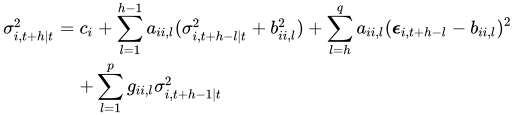
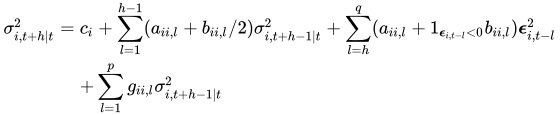
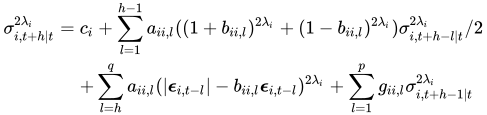
The following formulas are recursively implemented to obtain the multistep forecast of conditional error variance sigma Subscript i comma t plus h vertical-bar t Superscript 2 Baseline comma i equals 1 comma ellipsis comma k and h equals 1 comma 2 comma ellipsis:

  • for the GARCH(p, q) model:

    StartLayout 1st Row 1st Column sigma Subscript i comma t plus h vertical-bar t Superscript 2 2nd Column equals 3rd Column c Subscript i Baseline plus sigma-summation Underscript l equals 1 Overscript h minus 1 Endscripts a Subscript i i comma l Baseline sigma Subscript i comma t plus h minus l vertical-bar t Superscript 2 plus sigma-summation Underscript l equals h Overscript q Endscripts a Subscript i i comma l Baseline bold-italic epsilon Subscript i comma t plus h minus l Superscript 2 plus sigma-summation Underscript l equals 1 Overscript p Endscripts g Subscript i i comma l Baseline sigma Subscript i comma t plus h minus 1 vertical-bar t Superscript 2 EndLayout
  • for the EGARCH(p, q) model:

    StartLayout 1st Row 1st Column ln left-parenthesis sigma Subscript i comma t plus h vertical-bar t Superscript 2 Baseline right-parenthesis 2nd Column equals 3rd Column c Subscript i Baseline plus sigma-summation Underscript l equals h Overscript q Endscripts a Subscript i i comma l Baseline left-parenthesis b Subscript i i comma l Baseline StartFraction bold-italic epsilon Subscript i comma t plus h minus l Baseline Over sigma Subscript i comma t plus h minus l Baseline EndFraction plus StartAbsoluteValue StartFraction bold-italic epsilon Subscript i comma t plus h minus l Baseline Over sigma Subscript i comma t plus h minus l Baseline EndFraction EndAbsoluteValue minus StartRoot StartFraction 2 Over pi EndFraction EndRoot right-parenthesis plus sigma-summation Underscript l equals 1 Overscript p Endscripts g Subscript i i comma l Baseline ln left-parenthesis sigma Subscript i comma t plus h minus l vertical-bar t Superscript 2 Baseline right-parenthesis EndLayout
  • for the QGARCH(p, q) model:

    StartLayout 1st Row 1st Column sigma Subscript i comma t plus h vertical-bar t Superscript 2 2nd Column equals 3rd Column c Subscript i Baseline plus sigma-summation Underscript l equals 1 Overscript h minus 1 Endscripts a Subscript i i comma l Baseline left-parenthesis sigma Subscript i comma t plus h minus l vertical-bar t Superscript 2 Baseline plus b Subscript i i comma l Superscript 2 Baseline right-parenthesis plus sigma-summation Underscript l equals h Overscript q Endscripts a Subscript i i comma l Baseline left-parenthesis bold-italic epsilon Subscript i comma t plus h minus l Baseline minus b Subscript i i comma l Baseline right-parenthesis squared 2nd Row 1st Column Blank 2nd Column Blank 3rd Column plus sigma-summation Underscript l equals 1 Overscript p Endscripts g Subscript i i comma l Baseline sigma Subscript i comma t plus h minus 1 vertical-bar t Superscript 2 EndLayout
  • for the TGARCH(p, q) model:

    StartLayout 1st Row 1st Column sigma Subscript i comma t plus h vertical-bar t Superscript 2 2nd Column equals 3rd Column c Subscript i Baseline plus sigma-summation Underscript l equals 1 Overscript h minus 1 Endscripts left-parenthesis a Subscript i i comma l Baseline plus b Subscript i i comma l Baseline slash 2 right-parenthesis sigma Subscript i comma t plus h minus 1 vertical-bar t Superscript 2 plus sigma-summation Underscript l equals h Overscript q Endscripts left-parenthesis a Subscript i i comma l Baseline plus 1 Subscript bold-italic epsilon Sub Subscript i comma t minus l Subscript less-than 0 Baseline b Subscript i i comma l Baseline right-parenthesis bold-italic epsilon Subscript i comma t minus l Superscript 2 2nd Row 1st Column Blank 2nd Column Blank 3rd Column plus sigma-summation Underscript l equals 1 Overscript p Endscripts g Subscript i i comma l Baseline sigma Subscript i comma t plus h minus 1 vertical-bar t Superscript 2 EndLayout
  • for the PGARCH(p, q) model:

    StartLayout 1st Row 1st Column sigma Subscript i comma t plus h vertical-bar t Superscript 2 lamda Super Subscript i 2nd Column equals 3rd Column c Subscript i Baseline plus sigma-summation Underscript l equals 1 Overscript h minus 1 Endscripts a Subscript i i comma l Baseline left-parenthesis left-parenthesis 1 plus b Subscript i i comma l Baseline right-parenthesis Superscript 2 lamda Super Subscript i Superscript Baseline plus left-parenthesis 1 minus b Subscript i i comma l Baseline right-parenthesis Superscript 2 lamda Super Subscript i Superscript Baseline right-parenthesis sigma Subscript i comma t plus h minus l vertical-bar t Superscript 2 lamda Super Subscript i slash 2 2nd Row 1st Column Blank 2nd Column Blank 3rd Column plus sigma-summation Underscript l equals h Overscript q Endscripts a Subscript i i comma l Baseline left-parenthesis StartAbsoluteValue bold-italic epsilon Subscript i comma t minus l Baseline EndAbsoluteValue minus b Subscript i i comma l Baseline bold-italic epsilon Subscript i comma t minus l Baseline right-parenthesis Superscript 2 lamda Super Subscript i plus sigma-summation Underscript l equals 1 Overscript p Endscripts g Subscript i i comma l Baseline sigma Subscript i comma t plus h minus 1 vertical-bar t Superscript 2 lamda Super Subscript i EndLayout

In the preceding equations, sigma Subscript i comma s vertical-bar t Baseline equals sigma Subscript i comma s for s less-than-or-equal-to t. Then, the multistep forecast of conditional covariance matrix upper H Subscript t plus h vertical-bar t Baseline comma h equals 1 comma 2 comma ellipsis, is calculated by

StartLayout 1st Row  upper H Subscript t plus h vertical-bar t Baseline equals upper D Subscript t plus h vertical-bar t Baseline upper S upper D Subscript t plus h vertical-bar t EndLayout

where upper D Subscript t plus h vertical-bar t is the diagonal matrix with element sigma Subscript i comma t plus h vertical-bar t Baseline comma i equals 1 comma ellipsis comma k.

DCC Representation

Engle (2002) proposes a parsimonious parametric multivariate GARCH model that has time-varying conditional covariances and correlations.

The conditional covariance matrix upper H Subscript t consists of

StartLayout 1st Row  upper H Subscript t Baseline equals upper D Subscript t Baseline normal upper Gamma Subscript t Baseline upper D Subscript t EndLayout

where upper D Subscript t is a k times k stochastic diagonal matrix with the element sigma Subscript i comma t and normal upper Gamma Subscript t is a k times k time-varying matrix with the typical element rho Subscript i j comma t.

The element of upper H Subscript t is

StartLayout 1st Row 1st Column h Subscript i j comma t 2nd Column equals 3rd Column rho Subscript i j comma t Baseline sigma Subscript i comma t Baseline sigma Subscript j comma t Baseline i comma j equals 1 comma ellipsis comma k EndLayout

Note that h Subscript i i comma t Baseline equals sigma Subscript i comma t Superscript 2 Baseline comma i equals 1 comma ellipsis comma k.

As in the CCC GARCH model, you can choose the type of GARCH model of interest by specifying the SUBFORM= option.

In the GARCH model,

StartLayout 1st Row 1st Column sigma Subscript i comma t Superscript 2 2nd Column equals 3rd Column c Subscript i Baseline plus sigma-summation Underscript l equals 1 Overscript q Endscripts a Subscript i i comma l Baseline bold-italic epsilon Subscript i comma t minus l Superscript 2 Baseline plus sigma-summation Underscript l equals 1 Overscript p Endscripts g Subscript i i comma l Baseline sigma Subscript i comma t minus 1 Superscript 2 Baseline i equals 1 comma ellipsis comma k EndLayout

In the EGARCH model, the conditional variance is an asymmetric function of lagged disturbances,

StartLayout 1st Row 1st Column ln left-parenthesis sigma Subscript i comma t Superscript 2 Baseline right-parenthesis 2nd Column equals 3rd Column c Subscript i Baseline plus sigma-summation Underscript l equals 1 Overscript q Endscripts a Subscript i i comma l Baseline left-parenthesis b Subscript i i comma l Baseline StartFraction bold-italic epsilon Subscript i comma t minus l Baseline Over sigma Subscript i comma t minus l Baseline EndFraction plus StartAbsoluteValue StartFraction bold-italic epsilon Subscript i comma t minus l Baseline Over sigma Subscript i comma t minus l Baseline EndFraction EndAbsoluteValue minus StartRoot StartFraction 2 Over pi EndFraction EndRoot right-parenthesis plus sigma-summation Underscript l equals 1 Overscript p Endscripts g Subscript i i comma l Baseline ln left-parenthesis sigma Subscript i comma t minus l Superscript 2 Baseline right-parenthesis i equals 1 comma ellipsis comma k EndLayout

In the QGARCH model, the lagged errors’ centers are shifted from zero to some constant values,

StartLayout 1st Row 1st Column sigma Subscript i comma t Superscript 2 2nd Column equals 3rd Column c Subscript i Baseline plus sigma-summation Underscript l equals 1 Overscript q Endscripts a Subscript i i comma l Baseline left-parenthesis bold-italic epsilon Subscript i comma t minus l Baseline minus b Subscript i i comma l Baseline right-parenthesis squared plus sigma-summation Underscript l equals 1 Overscript p Endscripts g Subscript i i comma l Baseline sigma Subscript i comma t minus 1 Superscript 2 Baseline i equals 1 comma ellipsis comma k EndLayout

In the TGARCH model, each lagged squared error has an extra slope coefficient,

StartLayout 1st Row 1st Column sigma Subscript i comma t Superscript 2 2nd Column equals 3rd Column c Subscript i Baseline plus sigma-summation Underscript l equals 1 Overscript q Endscripts left-parenthesis a Subscript i i comma l Baseline plus 1 Subscript bold-italic epsilon Sub Subscript i comma t minus l Subscript less-than 0 Baseline b Subscript i i comma l Baseline right-parenthesis bold-italic epsilon Subscript i comma t minus l Superscript 2 Baseline plus sigma-summation Underscript l equals 1 Overscript p Endscripts g Subscript i i comma l Baseline sigma Subscript i comma t minus 1 Superscript 2 Baseline i equals 1 comma ellipsis comma k EndLayout

where the indicator function 1 Subscript bold-italic epsilon Sub Subscript i comma t Subscript less-than 0 is one if bold-italic epsilon Subscript i comma t Baseline less-than 0 and zero otherwise.

The PGARCH model not only considers the asymmetric effect but also provides another way to model the long memory property in the volatility,

StartLayout 1st Row  sigma Subscript i comma t Superscript 2 lamda Super Subscript i Superscript Baseline equals c Subscript i Baseline plus sigma-summation Underscript l equals 1 Overscript q Endscripts a Subscript i i comma l Baseline left-parenthesis StartAbsoluteValue bold-italic epsilon Subscript i comma t minus l Baseline EndAbsoluteValue minus b Subscript i i comma l Baseline bold-italic epsilon Subscript i comma t minus l Baseline right-parenthesis Superscript 2 lamda Super Subscript i Superscript Baseline plus sigma-summation Underscript l equals 1 Overscript p Endscripts g Subscript i i comma l Baseline sigma Subscript i comma t minus 1 Superscript 2 lamda Super Subscript i Superscript Baseline i equals 1 comma ellipsis comma k EndLayout

where lamda Subscript i Baseline greater-than 0 and StartAbsoluteValue b Subscript i i comma l Baseline EndAbsoluteValue less-than-or-equal-to 1 comma l equals 1 comma ellipsis comma q semicolon i equals 1 comma ellipsis comma k.

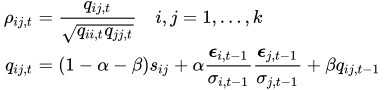
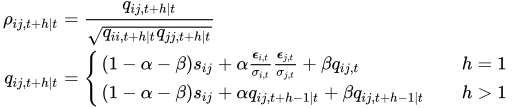
The conditional correlation estimator rho Subscript i j comma t is

StartLayout 1st Row 1st Column rho Subscript i j comma t 2nd Column equals 3rd Column StartFraction q Subscript i j comma t Baseline Over StartRoot q Subscript i i comma t Baseline q Subscript j j comma t Baseline EndRoot EndFraction i comma j equals 1 comma ellipsis comma k 2nd Row 1st Column q Subscript i j comma t 2nd Column equals 3rd Column left-parenthesis 1 minus alpha minus beta right-parenthesis s Subscript i j plus alpha StartFraction bold-italic epsilon Subscript i comma t minus 1 Baseline Over sigma Subscript i comma t minus 1 Baseline EndFraction StartFraction bold-italic epsilon Subscript j comma t minus 1 Baseline Over sigma Subscript j comma t minus 1 Baseline EndFraction plus beta q Subscript i j comma t minus 1 EndLayout

where s Subscript i j is the element of S, the unconditional correlation matrix.

If you specify CORRCONSTANT=EXPECT, the element s Subscript i j of the unconditional correlation matrix S is
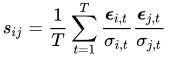
StartLayout 1st Row  s Subscript i j Baseline equals StartFraction 1 Over upper T EndFraction sigma-summation Underscript t equals 1 Overscript upper T Endscripts StartFraction bold-italic epsilon Subscript i comma t Baseline Over sigma Subscript i comma t Baseline EndFraction StartFraction bold-italic epsilon Subscript j comma t Baseline Over sigma Subscript j comma t Baseline EndFraction EndLayout

where T is the sample size.

As shown in the CCC GARCH models, the following formulas are recursively implemented to obtain the multistep forecast of conditional error variance sigma Subscript i comma t plus h vertical-bar t Superscript 2 Baseline comma i equals 1 comma ellipsis comma k and h equals 1 comma 2 comma ellipsis:

  • for the GARCH(p, q) model:

    StartLayout 1st Row 1st Column sigma Subscript i comma t plus h vertical-bar t Superscript 2 2nd Column equals 3rd Column c Subscript i Baseline plus sigma-summation Underscript l equals 1 Overscript h minus 1 Endscripts a Subscript i i comma l Baseline sigma Subscript i comma t plus h minus l vertical-bar t Superscript 2 plus sigma-summation Underscript l equals h Overscript q Endscripts a Subscript i i comma l Baseline bold-italic epsilon Subscript i comma t plus h minus l Superscript 2 plus sigma-summation Underscript l equals 1 Overscript p Endscripts g Subscript i i comma l Baseline sigma Subscript i comma t plus h minus 1 vertical-bar t Superscript 2 EndLayout
  • for the EGARCH(p, q) model:

    StartLayout 1st Row 1st Column ln left-parenthesis sigma Subscript i comma t plus h vertical-bar t Superscript 2 Baseline right-parenthesis 2nd Column equals 3rd Column c Subscript i Baseline plus sigma-summation Underscript l equals h Overscript q Endscripts a Subscript i i comma l Baseline left-parenthesis b Subscript i i comma l Baseline StartFraction bold-italic epsilon Subscript i comma t plus h minus l Baseline Over sigma Subscript i comma t plus h minus l Baseline EndFraction plus StartAbsoluteValue StartFraction bold-italic epsilon Subscript i comma t plus h minus l Baseline Over sigma Subscript i comma t plus h minus l Baseline EndFraction EndAbsoluteValue minus StartRoot StartFraction 2 Over pi EndFraction EndRoot right-parenthesis plus sigma-summation Underscript l equals 1 Overscript p Endscripts g Subscript i i comma l Baseline ln left-parenthesis sigma Subscript i comma t plus h minus l vertical-bar t Superscript 2 Baseline right-parenthesis EndLayout
  • for the QGARCH(p, q) model:

    StartLayout 1st Row 1st Column sigma Subscript i comma t plus h vertical-bar t Superscript 2 2nd Column equals 3rd Column c Subscript i Baseline plus sigma-summation Underscript l equals 1 Overscript h minus 1 Endscripts a Subscript i i comma l Baseline left-parenthesis sigma Subscript i comma t plus h minus l vertical-bar t Superscript 2 Baseline plus b Subscript i i comma l Superscript 2 Baseline right-parenthesis plus sigma-summation Underscript l equals h Overscript q Endscripts a Subscript i i comma l Baseline left-parenthesis bold-italic epsilon Subscript i comma t plus h minus l Baseline minus b Subscript i i comma l Baseline right-parenthesis squared 2nd Row 1st Column Blank 2nd Column Blank 3rd Column plus sigma-summation Underscript l equals 1 Overscript p Endscripts g Subscript i i comma l Baseline sigma Subscript i comma t plus h minus 1 vertical-bar t Superscript 2 EndLayout
  • for the TGARCH(p, q) model:

    StartLayout 1st Row 1st Column sigma Subscript i comma t plus h vertical-bar t Superscript 2 2nd Column equals 3rd Column c Subscript i Baseline plus sigma-summation Underscript l equals 1 Overscript h minus 1 Endscripts left-parenthesis a Subscript i i comma l Baseline plus b Subscript i i comma l Baseline slash 2 right-parenthesis sigma Subscript i comma t plus h minus 1 vertical-bar t Superscript 2 plus sigma-summation Underscript l equals h Overscript q Endscripts left-parenthesis a Subscript i i comma l Baseline plus 1 Subscript bold-italic epsilon Sub Subscript i comma t minus l Subscript less-than 0 Baseline b Subscript i i comma l Baseline right-parenthesis bold-italic epsilon Subscript i comma t minus l Superscript 2 2nd Row 1st Column Blank 2nd Column Blank 3rd Column plus sigma-summation Underscript l equals 1 Overscript p Endscripts g Subscript i i comma l Baseline sigma Subscript i comma t plus h minus 1 vertical-bar t Superscript 2 EndLayout
  • for the PGARCH(p, q) model:

    StartLayout 1st Row 1st Column sigma Subscript i comma t plus h vertical-bar t Superscript 2 lamda Super Subscript i 2nd Column equals 3rd Column c Subscript i Baseline plus sigma-summation Underscript l equals 1 Overscript h minus 1 Endscripts a Subscript i i comma l Baseline left-parenthesis left-parenthesis 1 plus b Subscript i i comma l Baseline right-parenthesis Superscript 2 lamda Super Subscript i Superscript Baseline plus left-parenthesis 1 minus b Subscript i i comma l Baseline right-parenthesis Superscript 2 lamda Super Subscript i Superscript Baseline right-parenthesis sigma Subscript i comma t plus h minus l vertical-bar t Superscript 2 lamda Super Subscript i slash 2 2nd Row 1st Column Blank 2nd Column Blank 3rd Column plus sigma-summation Underscript l equals h Overscript q Endscripts a Subscript i i comma l Baseline left-parenthesis StartAbsoluteValue bold-italic epsilon Subscript i comma t minus l Baseline EndAbsoluteValue minus b Subscript i i comma l Baseline bold-italic epsilon Subscript i comma t minus l Baseline right-parenthesis Superscript 2 lamda Super Subscript i plus sigma-summation Underscript l equals 1 Overscript p Endscripts g Subscript i i comma l Baseline sigma Subscript i comma t plus h minus 1 vertical-bar t Superscript 2 lamda Super Subscript i EndLayout

In the preceding equations, sigma Subscript i comma s vertical-bar t Baseline equals sigma Subscript i comma s for s less-than-or-equal-to t. Then, the multistep forecast of conditional covariance matrix upper H Subscript t plus h vertical-bar t Baseline comma h equals 1 comma 2 comma ellipsis, is calculated by

StartLayout 1st Row  upper H Subscript t plus h vertical-bar t Baseline equals upper D Subscript t plus h vertical-bar t Baseline normal upper Gamma Subscript t plus h vertical-bar t Baseline upper D Subscript t plus h vertical-bar t EndLayout

where upper D Subscript t plus h vertical-bar t is the diagonal matrix with element sigma Subscript i comma t plus h vertical-bar t Baseline comma i equals 1 comma ellipsis comma k, and normal upper Gamma Subscript t plus h vertical-bar t is the matrix with element rho Subscript i j comma t plus h vertical-bar t Baseline comma i comma j equals 1 comma ellipsis comma k,

StartLayout 1st Row 1st Column rho Subscript i j comma t plus h vertical-bar t 2nd Column equals 3rd Column StartFraction q Subscript i j comma t plus h vertical-bar t Baseline Over StartRoot q Subscript i i comma t plus h vertical-bar t Baseline q Subscript j j comma t plus h vertical-bar t Baseline EndRoot EndFraction 2nd Row 1st Column q Subscript i j comma t plus h vertical-bar t 2nd Column equals 3rd Column StartLayout Enlarged left-brace 1st Row 1st Column left-parenthesis 1 minus alpha minus beta right-parenthesis s Subscript i j plus alpha StartFraction bold-italic epsilon Subscript i comma t Baseline Over sigma Subscript i comma t Baseline EndFraction StartFraction bold-italic epsilon Subscript j comma t Baseline Over sigma Subscript j comma t Baseline EndFraction plus beta q Subscript i j comma t 2nd Column h equals 1 2nd Row 1st Column left-parenthesis 1 minus alpha minus beta right-parenthesis s Subscript i j plus alpha q Subscript i j comma t plus h minus 1 vertical-bar t plus beta q Subscript i j comma t plus h minus 1 vertical-bar t 2nd Column h greater-than 1 EndLayout EndLayout

Estimation of GARCH Model

The log-likelihood function of the multivariate GARCH model is written without a constant term as
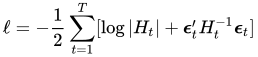
StartLayout 1st Row  script l equals minus one-half sigma-summation Underscript t equals 1 Overscript upper T Endscripts left-bracket log StartAbsoluteValue upper H Subscript t Baseline EndAbsoluteValue plus bold-italic epsilon prime Subscript t Baseline upper H Subscript t Superscript negative 1 Baseline bold-italic epsilon Subscript t Baseline right-bracket EndLayout

where bold-italic epsilon Subscript t is calculated from the first-moment model (that is, the VARMAX model or VEC-ARMA model). The log-likelihood function is maximized by an iterative numerical method such as quasi-Newton optimization. The starting values for the regression parameters are obtained from the least squares estimates. The covariance of bold-italic epsilon Subscript t is used as the starting value for the GARCH constant parameters, and the starting values for the other GARCH parameters are either 10 Superscript negative 6 or 10 Superscript negative 3, depending on the GARCH model’s representation.

Prediction of Endogenous (Dependent) Variables

In multivariate GARCH models, the optimal (minimum MSE) l-step-ahead forecast of endogenous variables bold y Subscript t plus l vertical-bar t uses the same formula as shown in the section Forecasting. However, the exogenous (independent) variables, if present, are always assumed to be nonstochastic (deterministic); that is, to predict the endogenous variables, you must specify the future values of the exogenous variables. The prediction error of the optimal l-step-ahead forecast is bold e Subscript t plus l vertical-bar t Baseline equals bold y Subscript t plus l Baseline minus bold y Subscript t plus l vertical-bar t Baseline equals sigma-summation Underscript j equals 0 Overscript l minus 1 Endscripts normal upper Psi Subscript j Baseline bold-italic epsilon Subscript t plus l minus j, with zero mean and covariance matrix,


normal upper Sigma Subscript t Baseline left-parenthesis l right-parenthesis equals normal upper C normal o normal v left-parenthesis bold e Subscript t plus l vertical-bar t Baseline right-parenthesis equals sigma-summation Underscript j equals 0 Overscript l minus 1 Endscripts normal upper Psi Subscript j Baseline upper H Subscript t plus l minus j vertical-bar t Baseline normal upper Psi prime Subscript j

where upper H Subscript t plus h vertical-bar t Baseline comma h equals 1 comma ellipsis comma l comma is the h-step-ahead forecast of the conditional covariance matrix. As emphasized by the subscript t, normal upper Sigma Subscript t Baseline left-parenthesis l right-parenthesis is time-dependent. In the OUT= data set, the forecast standard errors and prediction intervals are constructed according to normal upper Sigma Subscript t Baseline left-parenthesis l right-parenthesis. If you specify the COVPE option, the prediction error covariances that are output in the CovPredictError and CovPredictErrorbyVar ODS tables are based on the time-independent formula
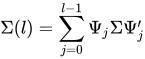
normal upper Sigma left-parenthesis l right-parenthesis equals sigma-summation Underscript j equals 0 Overscript l minus 1 Endscripts normal upper Psi Subscript j Baseline normal upper Sigma normal upper Psi prime Subscript j

where normal upper Sigma is the unconditional covariance matrix of innovations. The decomposition of the prediction error covariances is also based on normal upper Sigma left-parenthesis l right-parenthesis.

Covariance Stationarity

Define the multivariate GARCH process as
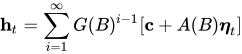
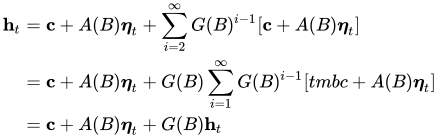
bold h Subscript t Baseline equals sigma-summation Underscript i equals 1 Overscript normal infinity Endscripts upper G left-parenthesis upper B right-parenthesis Superscript i minus 1 Baseline left-bracket bold c plus upper A left-parenthesis upper B right-parenthesis bold-italic eta Subscript t Baseline right-bracket

where bold h Subscript t Baseline equals vec left-parenthesis upper H Subscript t Baseline right-parenthesis, bold c equals vec left-parenthesis upper C 0 right-parenthesis, and bold-italic eta Subscript t Baseline equals vec left-parenthesis bold-italic epsilon Subscript t Baseline bold-italic epsilon prime Subscript t right-parenthesis. This representation is equivalent to a GARCH(p comma q) model by the following algebra:

StartLayout 1st Row 1st Column bold h Subscript t 2nd Column equals 3rd Column bold c plus upper A left-parenthesis upper B right-parenthesis bold-italic eta Subscript t plus sigma-summation Underscript i equals 2 Overscript normal infinity Endscripts upper G left-parenthesis upper B right-parenthesis Superscript i minus 1 Baseline left-bracket bold c plus upper A left-parenthesis upper B right-parenthesis bold-italic eta Subscript t Baseline right-bracket 2nd Row 1st Column Blank 2nd Column equals 3rd Column bold c plus upper A left-parenthesis upper B right-parenthesis bold-italic eta Subscript t plus upper G left-parenthesis upper B right-parenthesis sigma-summation Underscript i equals 1 Overscript normal infinity Endscripts upper G left-parenthesis upper B right-parenthesis Superscript i minus 1 Baseline left-bracket t m b c plus upper A left-parenthesis upper B right-parenthesis bold-italic eta Subscript t Baseline right-bracket 3rd Row 1st Column Blank 2nd Column equals 3rd Column bold c plus upper A left-parenthesis upper B right-parenthesis bold-italic eta Subscript t plus upper G left-parenthesis upper B right-parenthesis bold h Subscript t EndLayout

Defining upper A left-parenthesis upper B right-parenthesis equals sigma-summation Underscript i equals 1 Overscript q Endscripts left-parenthesis upper A Subscript i Baseline circled-times upper A Subscript i Baseline right-parenthesis prime upper B Superscript i and upper G left-parenthesis upper B right-parenthesis equals sigma-summation Underscript i equals 1 Overscript p Endscripts left-parenthesis upper G Subscript i Baseline circled-times upper G Subscript i Baseline right-parenthesis prime upper B Superscript i gives a BEKK representation.

The necessary and sufficient conditions for covariance stationarity of the multivariate GARCH process are that all the eigenvalues of upper A left-parenthesis 1 right-parenthesis plus upper G left-parenthesis 1 right-parenthesis are less than 1 in modulus.

An Example of a VAR(1)–ARCH(1) Model

The following DATA step simulates a bivariate vector time series to provide test data for the multivariate GARCH model:

data garch;
   retain seed 16587;
   esq1 = 0; esq2 = 0;
   ly1 = 0;  ly2 = 0;
   do i = 1 to 1000;
      ht = 6.25 + 0.5*esq1;
      call rannor(seed,ehat);
      e1 = sqrt(ht)*ehat;
      ht = 1.25 + 0.7*esq2;
      call rannor(seed,ehat);
      e2 = sqrt(ht)*ehat;
      y1 = 2 + 1.2*ly1 - 0.5*ly2 + e1;
      y2 = 4 + 0.6*ly1 + 0.3*ly2 + e2;
      if i>500 then output;
      esq1 = e1*e1; esq2 = e2*e2;
      ly1 = y1;  ly2 = y2;
   end;
   keep y1 y2;
run;

The following statements fit a VAR(1)–ARCH(1) model to the data. For a VAR-ARCH model, you specify the order of the autoregressive model with the P=1 option in the MODEL statement and the Q=1 option in the GARCH statement. In order to produce the initial and final values of parameters, the TECH=QN option is specified in the NLOPTIONS statement.

proc varmax data=garch;
   model y1 y2 / p=1
         print=(roots estimates diagnose);
   garch q=1;
   nloptions tech=qn;
run;

Figure 81 through Figure 85 show the details of this example. Figure 81 shows the initial values of parameters.

Figure 81: Start Parameter Estimates for the VAR(1)–ARCH(1) Model

The VARMAX Procedure

Optimization Start
Parameter Estimates
N Parameter Estimate Gradient
Objective
Function
1 CONST1 2.249575 0.000082533
2 CONST2 3.902673 0.000401
3 AR1_1_1 1.231775 0.000105
4 AR1_2_1 0.576890 -0.004811
5 AR1_1_2 -0.528405 0.000617
6 AR1_2_2 0.343714 0.001811
7 GCHC1_1 9.929763 0.151293
8 GCHC1_2 0.193163 -0.014305
9 GCHC2_2 4.063245 0.370333
10 ACH1_1_1 0.001000 -0.667182
11 ACH1_2_1 0 -0.068905
12 ACH1_1_2 0 -0.734486
13 ACH1_2_2 0.001000 -3.127035


Figure 82 shows the final parameter estimates.

Figure 82: Results of Parameter Estimates for the VAR(1)–ARCH(1) Model

The VARMAX Procedure

Optimization Results
Parameter Estimates
N Parameter Estimate Gradient
Objective
Function
1 CONST1 2.156865 0.000246
2 CONST2 4.048879 0.000105
3 AR1_1_1 1.224620 -0.001957
4 AR1_2_1 0.609651 0.000173
5 AR1_1_2 -0.534248 -0.000468
6 AR1_2_2 0.302599 -0.000375
7 GCHC1_1 8.238625 -0.000056090
8 GCHC1_2 -0.231183 -0.000021724
9 GCHC2_2 1.565459 0.000110
10 ACH1_1_1 0.374255 -0.000419
11 ACH1_2_1 0.035883 -0.000606
12 ACH1_1_2 0.057461 0.001636
13 ACH1_2_2 0.717897 -0.000149


Figure 83 shows the conditional variance by using the BEKK representation of the ARCH(1) model. The ARCH parameters are estimated as follows by the vectorized parameter matrices:
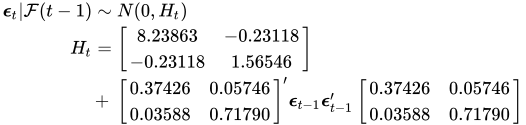
StartLayout 1st Row 1st Column bold-italic epsilon Subscript t Baseline vertical-bar script upper F left-parenthesis t minus 1 right-parenthesis 2nd Column tilde 3rd Column upper N left-parenthesis 0 comma upper H Subscript t Baseline right-parenthesis 2nd Row 1st Column upper H Subscript t 2nd Column equals 3rd Column Start 2 By 2 Matrix 1st Row 1st Column 8.23863 2nd Column negative 0.23118 2nd Row 1st Column negative 0.23118 2nd Column 1.56546 EndMatrix 3rd Row 1st Column Blank 2nd Column plus 3rd Column Start 2 By 2 Matrix 1st Row 1st Column 0.37426 2nd Column 0.05746 2nd Row 1st Column 0.03588 2nd Column 0.71790 EndMatrix prime bold-italic epsilon Subscript t minus 1 Baseline bold-italic epsilon prime Subscript t minus 1 Baseline Start 2 By 2 Matrix 1st Row 1st Column 0.37426 2nd Column 0.05746 2nd Row 1st Column 0.03588 2nd Column 0.71790 EndMatrix EndLayout

Figure 83: ARCH(1) Parameter Estimates for the VAR(1)–ARCH(1) Model

The VARMAX Procedure

Type of Model VAR(1)-ARCH(1)
Estimation Method Maximum Likelihood Estimation
Representation Type BEKK

GARCH Model Parameter Estimates
Parameter Estimate Standard
Error
t Value Pr > |t|
GCHC1_1 8.23863 0.72663 11.34 0.0001
GCHC1_2 -0.23118 0.21434 -1.08 0.2813
GCHC2_2 1.56546 0.19407 8.07 0.0001
ACH1_1_1 0.37426 0.07502 4.99 0.0001
ACH1_2_1 0.03588 0.06974 0.51 0.6071
ACH1_1_2 0.05746 0.02597 2.21 0.0274
ACH1_2_2 0.71790 0.06895 10.41 0.0001


Figure 84 shows the AR parameter estimates and their significance.

The fitted VAR(1) model with the previous conditional covariance ARCH model is written as follows:

bold y Subscript t Baseline equals StartBinomialOrMatrix 2.15687 Choose 4.04888 EndBinomialOrMatrix plus Start 2 By 2 Matrix 1st Row 1st Column 1.22462 2nd Column negative 0.53425 2nd Row 1st Column 0.60965 2nd Column 0.30260 EndMatrix bold y Subscript t minus 1 Baseline plus bold-italic epsilon Subscript t

Figure 84: VAR(1) Parameter Estimates for the VAR(1)–ARCH(1) Model

Model Parameter Estimates
Equation Parameter Estimate Standard
Error
t Value Pr > |t| Variable
y1 CONST1 2.15687 0.21717 9.93 0.0001 1
  AR1_1_1 1.22462 0.02542 48.17 0.0001 y1(t-1)
  AR1_1_2 -0.53425 0.02807 -19.03 0.0001 y2(t-1)
y2 CONST2 4.04888 0.10663 37.97 0.0001 1
  AR1_2_1 0.60965 0.01216 50.13 0.0001 y1(t-1)
  AR1_2_2 0.30260 0.01491 20.30 0.0001 y2(t-1)


Figure 85 shows the roots of the AR and ARCH characteristic polynomials. The eigenvalues have a modulus less than one.

Figure 85: Roots for the VAR(1)–ARCH(1) Model

Roots of AR Characteristic Polynomial
Index Real Imaginary Modulus Radian Degree
1 0.76361 0.33641 0.8344 0.4150 23.7762
2 0.76361 -0.33641 0.8344 -0.4150 -23.7762

Roots of GARCH Characteristic Polynomial
Index Real Imaginary Modulus Radian Degree
1 0.52388 0.00000 0.5239 0.0000 0.0000
2 0.26661 0.00000 0.2666 0.0000 0.0000
3 0.26661 0.00000 0.2666 0.0000 0.0000
4 0.13569 0.00000 0.1357 0.0000 0.0000


Last updated: June 19, 2025