VARMAX Procedure

Vector Error Correction Modeling

This section discusses the implication of cointegration for the autoregressive representation.

Consider the vector autoregressive process that has Gaussian errors defined by
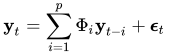
StartLayout 1st Row  bold y Subscript t Baseline equals sigma-summation Underscript i equals 1 Overscript p Endscripts normal upper Phi Subscript i Baseline bold y Subscript t minus i Baseline plus bold-italic epsilon Subscript t EndLayout

or

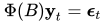
StartLayout 1st Row  normal upper Phi left-parenthesis upper B right-parenthesis bold y Subscript t Baseline equals bold-italic epsilon Subscript t EndLayout

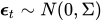
where the initial values, bold y Subscript negative p plus 1 Baseline comma ellipsis comma bold y 0, are fixed and bold-italic epsilon Subscript t Baseline tilde upper N left-parenthesis 0 comma normal upper Sigma right-parenthesis. The AR operator normal upper Phi left-parenthesis upper B right-parenthesis can be re-expressed as

normal upper Phi left-parenthesis upper B right-parenthesis equals normal upper Phi Superscript asterisk Baseline left-parenthesis upper B right-parenthesis left-parenthesis 1 minus upper B right-parenthesis plus normal upper Phi left-parenthesis 1 right-parenthesis upper B

where

normal upper Phi left-parenthesis 1 right-parenthesis equals upper I Subscript k Baseline minus normal upper Phi 1 minus normal upper Phi 2 minus midline-horizontal-ellipsis minus normal upper Phi Subscript p Baseline comma normal upper Phi Superscript asterisk Baseline left-parenthesis upper B right-parenthesis equals upper I Subscript k Baseline minus sigma-summation Underscript i equals 1 Overscript p minus 1 Endscripts normal upper Phi Subscript i Superscript asterisk Baseline upper B Superscript i Baseline comma normal upper Phi Subscript i Superscript asterisk Baseline equals minus sigma-summation Underscript j equals i plus 1 Overscript p Endscripts normal upper Phi Subscript j Baseline

The vector error correction model (VECM), also called the vector equilibrium correction model, is defined as

normal upper Phi Superscript asterisk Baseline left-parenthesis upper B right-parenthesis left-parenthesis 1 minus upper B right-parenthesis bold y Subscript t Baseline equals bold-italic alpha bold-italic beta prime bold y Subscript t minus 1 Baseline plus bold-italic epsilon Subscript t

or

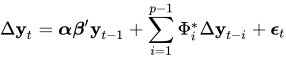
normal upper Delta bold y Subscript t Baseline equals bold-italic alpha bold-italic beta prime bold y Subscript t minus 1 Baseline plus sigma-summation Underscript i equals 1 Overscript p minus 1 Endscripts normal upper Phi Subscript i Superscript asterisk Baseline normal upper Delta bold y Subscript t minus i Baseline plus bold-italic epsilon Subscript t

where bold-italic alpha bold-italic beta Superscript prime Baseline equals minus normal upper Phi left-parenthesis 1 right-parenthesis.

Granger Representation Theorem

Engle and Granger (1987) define

normal upper Pi left-parenthesis z right-parenthesis identical-to left-parenthesis 1 minus z right-parenthesis upper I Subscript k Baseline minus bold-italic alpha bold-italic beta prime z minus sigma-summation Underscript i equals 1 Overscript p minus 1 Endscripts normal upper Phi Subscript i Superscript asterisk Baseline left-parenthesis 1 minus z right-parenthesis z Superscript i

and the following assumptions hold:

  1. StartAbsoluteValue normal upper Pi left-parenthesis z right-parenthesis EndAbsoluteValue equals 0 right double arrow StartAbsoluteValue z EndAbsoluteValue greater-than 1 or z equals 1.

  2. The number of unit roots, z equals 1, is exactly k minus r.

  3. bold-italic alpha and bold-italic beta are k times r matrices, and their ranks are both r.

Then y Subscript t has the representation

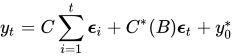
y Subscript t Baseline equals upper C sigma-summation Underscript i equals 1 Overscript t Endscripts bold-italic epsilon Subscript i Baseline plus upper C Superscript asterisk Baseline left-parenthesis upper B right-parenthesis bold-italic epsilon Subscript t Baseline plus y 0 Superscript asterisk

where the Granger representation coefficient, C, is

upper C equals bold-italic beta Subscript up-tack Baseline left-bracket bold-italic alpha prime Subscript up-tack Baseline normal upper Phi left-parenthesis 1 right-parenthesis bold-italic beta Subscript up-tack Baseline right-bracket Superscript negative 1 Baseline bold-italic alpha prime Subscript up-tack

where the full-rank k times left-parenthesis k minus r right-parenthesis matrix bold-italic beta Subscript up-tack is orthogonal to bold-italic beta and the full-rank k times left-parenthesis k minus r right-parenthesis matrix bold-italic alpha Subscript up-tack is orthogonal to bold-italic alpha. upper C Superscript asterisk Baseline left-parenthesis upper B right-parenthesis bold-italic epsilon Subscript t Baseline equals sigma-summation Underscript j equals 1 Overscript normal infinity Endscripts upper C Subscript j Superscript asterisk Baseline bold-italic epsilon Subscript t minus j is an upper I left-parenthesis 0 right-parenthesis process, and y 0 Superscript asterisk depends on the initial values.

The Granger representation coefficient C can be defined only when the left-parenthesis k minus r right-parenthesis times left-parenthesis k minus r right-parenthesis matrix bold-italic alpha prime Subscript up-tack Baseline normal upper Phi left-parenthesis 1 right-parenthesis bold-italic beta Subscript up-tack is invertible.

One motivation for the VECM(p) form is to consider the relation bold-italic beta prime bold y Subscript t Baseline equals bold c as defining the underlying economic relations. Assume that agents react to the disequilibrium error bold-italic beta prime bold y Subscript t minus bold c through the adjustment coefficient bold-italic alpha to restore equilibrium. The cointegrating vector, bold-italic beta, is sometimes called the long-run parameter.

Consider a vector error correction model that has a deterministic term, upper D Subscript t, which can contain a constant, a linear trend, and seasonal dummy variables. Exogenous variables can also be included in the model. The model has the form

StartLayout 1st Row  normal upper Delta bold y Subscript t Baseline equals normal upper Pi bold y Subscript t minus 1 Baseline plus sigma-summation Underscript i equals 1 Overscript p minus 1 Endscripts normal upper Phi Subscript i Superscript asterisk Baseline normal upper Delta bold y Subscript t minus i Baseline plus upper A upper D Subscript t Baseline plus sigma-summation Underscript i equals 0 Overscript s Endscripts normal upper Theta Subscript i Superscript asterisk Baseline bold x Subscript t minus i Baseline plus bold-italic epsilon Subscript t EndLayout

where normal upper Pi equals bold-italic alpha bold-italic beta prime.

The alternative vector error correction representation considers the error correction term at lag t minus p and is written as

normal upper Delta bold y Subscript t Baseline equals sigma-summation Underscript i equals 1 Overscript p minus 1 Endscripts normal upper Phi Subscript i Superscript normal ♯ Baseline normal upper Delta bold y Subscript t minus i Baseline plus normal upper Pi Superscript normal ♯ Baseline bold y Subscript t minus p Baseline plus upper A upper D Subscript t Baseline plus sigma-summation Underscript i equals 0 Overscript s Endscripts normal upper Theta Subscript i Superscript asterisk Baseline bold x Subscript t minus i Baseline plus bold-italic epsilon Subscript t

If the matrix normal upper Pi has a full rank (r equals k), all components of bold y Subscript t are upper I left-parenthesis 0 right-parenthesis. On the other hand, bold y Subscript t are stationary in difference if normal r normal a normal n normal k left-parenthesis normal upper Pi right-parenthesis equals 0. When the rank of the matrix normal upper Pi is r less-than k, there are k minus r linear combinations that are nonstationary and r stationary cointegrating relations. Note that the linearly independent vector bold z Subscript t Baseline equals bold-italic beta prime bold y Subscript t is stationary and this transformation is not unique unless r equals 1. There does not exist a unique cointegrating matrix bold-italic beta because the coefficient matrix normal upper Pi can also be decomposed as

StartLayout 1st Row  normal upper Pi equals bold-italic alpha upper M upper M Superscript negative 1 Baseline bold-italic beta Superscript prime Baseline equals bold-italic alpha Superscript asterisk Baseline bold-italic beta Superscript asterisk prime EndLayout

where M is an r times r nonsingular matrix.

Test for Cointegration

The cointegration rank test determines the linearly independent columns of normal upper Pi. Johansen and Juselius proposed the cointegration rank test by using the reduced rank regression (Johansen 1988, 1995b; Johansen and Juselius 1990).

Different Specifications of Deterministic Trends

When you construct the VECM(p) form from the VAR(p) model, the deterministic terms in the VECM(p) form can differ from those in the VAR(p) model. When there are deterministic cointegrated relationships among variables, deterministic terms in the VAR(p) model are not present in the VECM(p) form. On the other hand, if there are stochastic cointegrated relationships in the VAR(p) model, deterministic terms appear in the VECM(p) form via the error correction term or as an independent term in the VECM(p) form. There are five different specifications of deterministic trends in the VECM(p) form.

  • Case 1: There is no separate drift in the VECM(p) form.
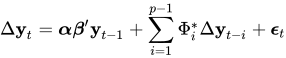
    normal upper Delta bold y Subscript t Baseline equals bold-italic alpha bold-italic beta prime bold y Subscript t minus 1 Baseline plus sigma-summation Underscript i equals 1 Overscript p minus 1 Endscripts normal upper Phi Subscript i Superscript asterisk Baseline normal upper Delta bold y Subscript t minus i Baseline plus bold-italic epsilon Subscript t
  • Case 2: There is no separate drift in the VECM(p) form, but a constant enters only via the error correction term.

    normal upper Delta bold y Subscript t Baseline equals bold-italic alpha left-parenthesis bold-italic beta prime comma bold-italic beta 0 right-parenthesis left-parenthesis bold y prime Subscript t minus 1 Baseline comma 1 right-parenthesis Superscript prime Baseline plus sigma-summation Underscript i equals 1 Overscript p minus 1 Endscripts normal upper Phi Subscript i Superscript asterisk Baseline normal upper Delta bold y Subscript t minus i Baseline plus bold-italic epsilon Subscript t
  • Case 3: There is a separate drift and no separate linear trend in the VECM(p) form.

    normal upper Delta bold y Subscript t Baseline equals bold-italic alpha bold-italic beta prime bold y Subscript t minus 1 Baseline plus sigma-summation Underscript i equals 1 Overscript p minus 1 Endscripts normal upper Phi Subscript i Superscript asterisk Baseline normal upper Delta bold y Subscript t minus i Baseline plus bold-italic delta 0 plus bold-italic epsilon Subscript t
  • Case 4: There is a separate drift and no separate linear trend in the VECM(p) form, but a linear trend enters only via the error correction term.

    normal upper Delta bold y Subscript t Baseline equals bold-italic alpha left-parenthesis bold-italic beta prime comma bold-italic beta 1 right-parenthesis left-parenthesis bold y prime Subscript t minus 1 Baseline comma t right-parenthesis Superscript prime Baseline plus sigma-summation Underscript i equals 1 Overscript p minus 1 Endscripts normal upper Phi Subscript i Superscript asterisk Baseline normal upper Delta bold y Subscript t minus i Baseline plus bold-italic delta 0 plus bold-italic epsilon Subscript t
  • Case 5: There is a separate linear trend in the VECM(p) form.

    normal upper Delta bold y Subscript t Baseline equals bold-italic alpha bold-italic beta prime bold y Subscript t minus 1 Baseline plus sigma-summation Underscript i equals 1 Overscript p minus 1 Endscripts normal upper Phi Subscript i Superscript asterisk Baseline normal upper Delta bold y Subscript t minus i Baseline plus bold-italic delta 0 plus bold-italic delta 1 t plus bold-italic epsilon Subscript t

First, focus on Cases 1, 3, and 5 to test the null hypothesis that there are at most r cointegrating vectors. Let
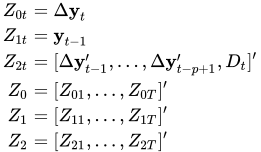
StartLayout 1st Row 1st Column upper Z Subscript 0 t 2nd Column equals 3rd Column normal upper Delta bold y Subscript t 2nd Row 1st Column upper Z Subscript 1 t 2nd Column equals 3rd Column bold y Subscript t minus 1 3rd Row 1st Column upper Z Subscript 2 t 2nd Column equals 3rd Column left-bracket normal upper Delta bold y prime Subscript t minus 1 comma ellipsis comma normal upper Delta bold y prime Subscript t minus p plus 1 comma upper D Subscript t Baseline right-bracket prime 4th Row 1st Column upper Z 0 2nd Column equals 3rd Column left-bracket upper Z 01 comma ellipsis comma upper Z Subscript 0 upper T Baseline right-bracket prime 5th Row 1st Column upper Z 1 2nd Column equals 3rd Column left-bracket upper Z 11 comma ellipsis comma upper Z Subscript 1 upper T Baseline right-bracket prime 6th Row 1st Column upper Z 2 2nd Column equals 3rd Column left-bracket upper Z 21 comma ellipsis comma upper Z Subscript 2 upper T Baseline right-bracket prime EndLayout

where upper D Subscript t can be empty for Case 1, 1 for Case 3, and left-parenthesis 1 comma t right-parenthesis for Case 5.

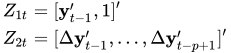
In Case 2, upper Z Subscript 1 t and upper Z Subscript 2 t are defined as

StartLayout 1st Row 1st Column upper Z Subscript 1 t 2nd Column equals 3rd Column left-bracket bold y prime Subscript t minus 1 Baseline comma 1 right-bracket prime 2nd Row 1st Column upper Z Subscript 2 t 2nd Column equals 3rd Column left-bracket normal upper Delta bold y prime Subscript t minus 1 comma ellipsis comma normal upper Delta bold y prime Subscript t minus p plus 1 right-bracket prime EndLayout

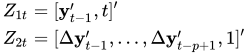
In Case 4, upper Z Subscript 1 t and upper Z Subscript 2 t are defined as

StartLayout 1st Row 1st Column upper Z Subscript 1 t 2nd Column equals 3rd Column left-bracket bold y prime Subscript t minus 1 Baseline comma t right-bracket prime 2nd Row 1st Column upper Z Subscript 2 t 2nd Column equals 3rd Column left-bracket normal upper Delta bold y prime Subscript t minus 1 comma ellipsis comma normal upper Delta bold y prime Subscript t minus p plus 1 comma 1 right-bracket prime EndLayout

Let normal upper Psi be the matrix of parameters consisting of normal upper Phi 1 Superscript asterisk, …, normal upper Phi Subscript p minus 1 Superscript asterisk, A, and normal upper Theta 0 Superscript asterisk, …, normal upper Theta Subscript s Superscript asterisk, where parameter A corresponds with the regressors upper D Subscript t. Then the VECM(p) form is rewritten in these variables as

upper Z Subscript 0 t Baseline equals bold-italic alpha bold-italic beta prime upper Z Subscript 1 t Baseline plus normal upper Psi upper Z Subscript 2 t Baseline plus bold-italic epsilon Subscript t

The log-likelihood function is given by
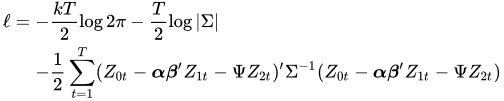
StartLayout 1st Row 1st Column script l 2nd Column equals 3rd Column minus StartFraction k upper T Over 2 EndFraction log 2 pi minus StartFraction upper T Over 2 EndFraction log StartAbsoluteValue normal upper Sigma EndAbsoluteValue 2nd Row 1st Column Blank 2nd Column Blank 3rd Column minus one-half sigma-summation Underscript t equals 1 Overscript upper T Endscripts left-parenthesis upper Z Subscript 0 t Baseline minus bold-italic alpha bold-italic beta prime upper Z Subscript 1 t Baseline minus normal upper Psi upper Z Subscript 2 t Baseline right-parenthesis prime normal upper Sigma Superscript negative 1 Baseline left-parenthesis upper Z Subscript 0 t Baseline minus bold-italic alpha bold-italic beta prime upper Z Subscript 1 t Baseline minus normal upper Psi upper Z Subscript 2 t Baseline right-parenthesis EndLayout

The residuals, upper R Subscript 0 t and upper R Subscript 1 t, are obtained by regressing upper Z Subscript 0 t and upper Z Subscript 1 t on upper Z Subscript 2 t, respectively. The regression equation of residuals is

upper R Subscript 0 t Baseline equals bold-italic alpha bold-italic beta prime upper R Subscript 1 t Baseline plus ModifyingAbove bold-italic epsilon With caret Subscript t

The crossproducts matrices are computed
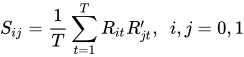
upper S Subscript i j Baseline equals StartFraction 1 Over upper T EndFraction sigma-summation Underscript t equals 1 Overscript upper T Endscripts upper R Subscript i t Baseline upper R Subscript j t Superscript prime Baseline comma i comma j equals 0 comma 1

Then the maximum likelihood estimator for bold-italic beta is obtained from the eigenvectors that correspond to the r largest eigenvalues of the following equation:

StartAbsoluteValue lamda upper S 11 minus upper S 10 upper S 00 Superscript negative 1 Baseline upper S 01 EndAbsoluteValue equals 0

The eigenvalues of the preceding equation are squared canonical correlations between upper R Subscript 0 t and upper R Subscript 1 t, and the eigenvectors that correspond to the r largest eigenvalues are the r linear combinations of bold y Subscript t minus 1, which have the largest squared partial correlations with the stationary process normal upper Delta bold y Subscript t after correcting for lags and deterministic terms. Such an analysis calls for a reduced rank regression of normal upper Delta bold y Subscript t on bold y Subscript t minus 1 corrected for left-parenthesis normal upper Delta bold y Subscript t minus 1 Baseline comma ellipsis comma normal upper Delta bold y Subscript t minus p plus 1 Baseline comma upper D Subscript t Baseline right-parenthesis, as discussed by Anderson (1951). Johansen (1988) suggests two test statistics to test the null hypothesis that there are at most r cointegrating vectors

upper H Subscript 0 Baseline colon lamda Subscript i Baseline equals 0 normal f normal o normal r i equals r plus 1 comma ellipsis comma k
Trace Test

The trace statistic for testing the null hypothesis that there are at most r cointegrating vectors is as follows:
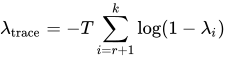
lamda Subscript normal t normal r normal a normal c normal e Baseline equals minus upper T sigma-summation Underscript i equals r plus 1 Overscript k Endscripts log left-parenthesis 1 minus lamda Subscript i Baseline right-parenthesis

The asymptotic distribution of this statistic is given by

normal t normal r StartSet integral Subscript 0 Superscript 1 Baseline left-parenthesis d upper W right-parenthesis upper W overTilde prime left-parenthesis integral Subscript 0 Superscript 1 Baseline upper W overTilde upper W overTilde prime d r right-parenthesis Superscript negative 1 Baseline integral Subscript 0 Superscript 1 Baseline upper W overTilde left-parenthesis d upper W right-parenthesis prime EndSet

where normal t normal r left-parenthesis upper A right-parenthesis is the trace of a matrix A, W is the k minus r dimensional Brownian motion, and upper W overTilde is the Brownian motion itself, or the de-meaned or detrended Brownian motion according to the different specifications of deterministic trends in the vector error correction model.

Maximum Eigenvalue Test

The maximum eigenvalue statistic for testing the null hypothesis that there are at most r cointegrating vectors is as follows:

lamda Subscript normal m normal a normal x Baseline equals minus upper T log left-parenthesis 1 minus lamda Subscript r plus 1 Baseline right-parenthesis

The asymptotic distribution of this statistic is given by

max left-brace integral Subscript 0 Superscript 1 Baseline left-parenthesis d upper W right-parenthesis upper W overTilde prime left-parenthesis integral Subscript 0 Superscript 1 Baseline upper W overTilde upper W overTilde prime d r right-parenthesis Superscript negative 1 Baseline integral Subscript 0 Superscript 1 Baseline upper W overTilde left-parenthesis d upper W right-parenthesis prime right-brace

where max left-parenthesis upper A right-parenthesis is the maximum eigenvalue of a matrix A. Osterwald-Lenum (1992) provided detailed tables of the critical values of these statistics.

The following statements use the JOHANSEN option to compute the Johansen cointegration rank trace test of integrated order 1:

proc varmax data=simul2;
   model y1 y2 / p=2 cointtest=(johansen=(normalize=y1));
run;

Figure 72 shows the output based on the model specified in the MODEL statement. An intercept term is assumed. In the "Cointegration Rank Test Using Trace" table, the column Drift in ECM indicates that there is no separate drift in the error correction model, and the column Drift in Process indicates that the process has a constant drift before differencing. The "Cointegration Rank Test Using Trace" table shows the trace statistics and p-values based on Case 3, and the "Cointegration Rank Test Using Trace under Restriction" table shows the trace statistics and p-values based on Case 2. For a specified significance level, such as 5%, the output indicates that the null hypothesis that the series are not cointegrated (H0: Rank = 0) can be rejected, because the p-values for both Case 2 and Case 3 are less than 0.05. The output also shows that the null hypothesis that the series are cointegrated with rank 1 (H0: Rank = 1) cannot be rejected for either Case 2 or Case 3, because the p-values for these tests are both greater than 0.05.

Figure 72: Cointegration Rank Test (COINTTEST=(JOHANSEN=) Option)

The VARMAX Procedure

Cointegration Rank Test Using Trace
H0:
Rank=r
H1:
Rank>r
Eigenvalue Trace Pr > Trace Drift in ECM Drift in Process
0 0 0.4644 61.7522 <.0001 Constant Linear
1 1 0.0056 0.5552 0.4559    

Cointegration Rank Test Using Trace Under Restriction
H0:
Rank=r
H1:
Rank>r
Eigenvalue Trace Pr > Trace Drift in ECM Drift in Process
0 0 0.5209 76.3788 <.0001 Constant Constant
1 1 0.0426 4.2680 0.3741    


Figure 73 shows which result, either Case 2 (the hypothesis H0) or Case 3 (the hypothesis H1), is appropriate depending on the significance level. Since the cointegration rank is chosen to be 1 by the result in Figure 72, look at the last row that corresponds to rank=1. Since the p-value is 0.054, the Case 2 cannot be rejected at the significance level 5%, but it can be rejected at the significance level 10%. For modeling of the two Case 2 and Case 3, see Figure 76 and Figure 77.

Figure 73: Cointegration Rank Test, Continued

Hypothesis of the Restriction
Hypothesis Drift in ECM Drift in Process
H0(Case 2) Constant Constant
H1(Case 3) Constant Linear

Hypothesis Test of the Restriction
Rank Eigenvalue Restricted
Eigenvalue
DF Chi-Square Pr > ChiSq
0 0.4644 0.5209 2 14.63 0.0007
1 0.0056 0.0426 1 3.71 0.0540


Figure 74 shows the estimates of long-run parameter (Beta) and adjustment coefficients (Alpha) based on Case 3.

Figure 74: Cointegration Rank Test, Continued

Beta
Variable 1 2
y1 1.00000 1.00000
y2 -2.04869 -0.02854

Alpha
Variable 1 2
y1 -0.46421 -0.00502
y2 0.17535 -0.01275


Using the NORMALIZE= option, the first row of the "Beta" table has 1. Considering that the cointegration rank is 1, the long-run relationship of the series is
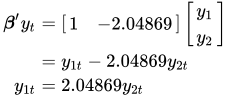
StartLayout 1st Row 1st Column bold-italic beta prime y Subscript t 2nd Column equals 3rd Column Start 1 By 2 Matrix 1st Row 1st Column 1 2nd Column negative 2.04869 EndMatrix StartBinomialOrMatrix y 1 Choose y 2 EndBinomialOrMatrix 2nd Row 1st Column Blank 2nd Column equals 3rd Column y Subscript 1 t Baseline minus 2.04869 y Subscript 2 t 3rd Row 1st Column y Subscript 1 t 2nd Column equals 3rd Column 2.04869 y Subscript 2 t EndLayout

Figure 75 shows the estimates of long-run parameter (Beta) and adjustment coefficients (Alpha) based on Case 2.

Figure 75: Cointegration Rank Test, Continued

Beta Under Restriction
Variable 1 2
y1 1.00000 1.00000
y2 -2.04366 -2.75773
1 6.75919 101.37051

Alpha Under Restriction
Variable 1 2
y1 -0.48015 0.01091
y2 0.12538 0.03722


Considering that the cointegration rank is 1, the long-run relationship of the series is
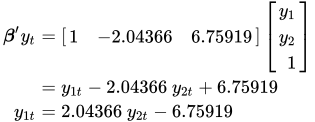
StartLayout 1st Row 1st Column bold-italic beta prime y Subscript t 2nd Column equals 3rd Column Start 1 By 3 Matrix 1st Row 1st Column 1 2nd Column negative 2.04366 3rd Column 6.75919 EndMatrix Start 3 By 1 Matrix 1st Row  y 1 2nd Row  y 2 3rd Row  1 EndMatrix 2nd Row 1st Column Blank 2nd Column equals 3rd Column y Subscript 1 t Baseline minus 2.04366 y Subscript 2 t Baseline plus 6.75919 3rd Row 1st Column y Subscript 1 t 2nd Column equals 3rd Column 2.04366 y Subscript 2 t Baseline minus 6.75919 EndLayout

Estimation of Vector Error Correction Model

The preceding log-likelihood function is maximized for
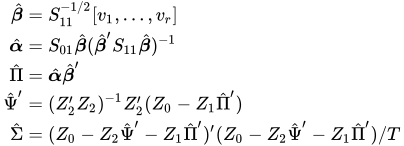
StartLayout 1st Row 1st Column ModifyingAbove bold-italic beta With caret 2nd Column equals 3rd Column upper S 11 Superscript negative 1 slash 2 Baseline left-bracket v 1 comma ellipsis comma v Subscript r Baseline right-bracket 2nd Row 1st Column ModifyingAbove bold-italic alpha With caret 2nd Column equals 3rd Column upper S 01 ModifyingAbove bold-italic beta With caret left-parenthesis ModifyingAbove bold-italic beta With caret prime upper S 11 ModifyingAbove bold-italic beta With caret right-parenthesis Superscript negative 1 3rd Row 1st Column ModifyingAbove normal upper Pi With caret 2nd Column equals 3rd Column ModifyingAbove bold-italic alpha With caret ModifyingAbove bold-italic beta With caret prime 4th Row 1st Column ModifyingAbove normal upper Psi With caret prime 2nd Column equals 3rd Column left-parenthesis upper Z prime 2 upper Z 2 right-parenthesis Superscript negative 1 Baseline upper Z prime 2 left-parenthesis upper Z 0 minus upper Z 1 ModifyingAbove normal upper Pi With caret prime right-parenthesis 5th Row 1st Column ModifyingAbove normal upper Sigma With caret 2nd Column equals 3rd Column left-parenthesis upper Z 0 minus upper Z 2 ModifyingAbove normal upper Psi With caret prime minus upper Z 1 ModifyingAbove normal upper Pi With caret prime right-parenthesis prime left-parenthesis upper Z 0 minus upper Z 2 ModifyingAbove normal upper Psi With caret prime minus upper Z 1 ModifyingAbove normal upper Pi With caret prime right-parenthesis slash upper T EndLayout

The estimators of the orthogonal complements of bold-italic alpha and bold-italic beta are

ModifyingAbove bold-italic beta With caret Subscript up-tack Baseline equals upper S 11 left-bracket v Subscript r plus 1 Baseline comma ellipsis comma v Subscript k Baseline right-bracket

and

ModifyingAbove bold-italic alpha With caret Subscript up-tack Baseline equals upper S 00 Superscript negative 1 Baseline upper S 01 left-bracket v Subscript r plus 1 Baseline comma ellipsis comma v Subscript k Baseline right-bracket

Let theta denote the parameter vector left-parenthesis normal v normal e normal c left-parenthesis bold-italic alpha comma normal upper Psi right-parenthesis Superscript prime Baseline comma normal v normal e normal c normal h left-parenthesis normal upper Sigma right-parenthesis Superscript prime Baseline right-parenthesis prime. The covariance of parameter estimates ModifyingAbove theta With caret is obtained as the inverse of the negative Hessian matrix upper H identical-to StartFraction partial-differential squared script l Over partial-differential theta partial-differential theta prime EndFraction. Because ModifyingAbove normal upper Pi With caret equals ModifyingAbove bold-italic alpha With caret ModifyingAbove bold-italic beta With caret prime, the variance of ModifyingAbove normal upper Pi With caret and the covariance between ModifyingAbove normal upper Pi With caret and ModifyingAbove theta With caret are calculated as follows:

normal c normal o normal v left-parenthesis normal v normal e normal c left-parenthesis ModifyingAbove normal upper Pi With caret right-parenthesis comma normal v normal e normal c left-parenthesis ModifyingAbove normal upper Pi With caret right-parenthesis right-parenthesis equals left-parenthesis ModifyingAbove bold-italic beta With caret circled-times upper I Subscript k Baseline right-parenthesis normal c normal o normal v left-parenthesis normal v normal e normal c left-parenthesis ModifyingAbove bold-italic alpha With caret right-parenthesis comma normal v normal e normal c left-parenthesis ModifyingAbove bold-italic alpha With caret right-parenthesis right-parenthesis left-parenthesis ModifyingAbove bold-italic beta With caret circled-times upper I Subscript k Baseline right-parenthesis prime
normal c normal o normal v left-parenthesis normal v normal e normal c left-parenthesis ModifyingAbove normal upper Pi With caret right-parenthesis comma ModifyingAbove theta With caret right-parenthesis equals left-parenthesis ModifyingAbove bold-italic beta With caret circled-times upper I Subscript k Baseline right-parenthesis normal c normal o normal v left-parenthesis normal v normal e normal c left-parenthesis ModifyingAbove bold-italic alpha With caret right-parenthesis comma ModifyingAbove theta With caret right-parenthesis

For Case 2 (Case 4), because the coefficient vector ModifyingAbove bold-italic delta With caret Subscript 0 (ModifyingAbove bold-italic delta With caret Subscript 1) for the constant term (the linear trend term) is the product of ModifyingAbove bold-italic alpha With caret and ModifyingAbove bold-italic beta With caret Subscript 0 (ModifyingAbove bold-italic beta With caret Subscript 1), the variance of ModifyingAbove bold-italic delta With caret Subscript 0 (ModifyingAbove bold-italic delta With caret Subscript 1) and the covariance between ModifyingAbove bold-italic delta With caret Subscript 0 (ModifyingAbove bold-italic delta With caret Subscript 1) and ModifyingAbove theta With caret are calculated as follows:

normal c normal o normal v left-parenthesis ModifyingAbove bold-italic delta With caret Subscript i Baseline comma ModifyingAbove bold-italic delta With caret Subscript i Baseline right-parenthesis equals left-parenthesis ModifyingAbove bold-italic beta With caret prime Subscript i Baseline circled-times upper I Subscript k Baseline right-parenthesis normal c normal o normal v left-parenthesis normal v normal e normal c left-parenthesis ModifyingAbove bold-italic alpha With caret right-parenthesis comma normal v normal e normal c left-parenthesis ModifyingAbove bold-italic alpha With caret right-parenthesis right-parenthesis left-parenthesis ModifyingAbove bold-italic beta With caret prime Subscript i Baseline circled-times upper I Subscript k Baseline right-parenthesis Superscript prime Baseline comma i equals 0 normal o normal r 1
normal c normal o normal v left-parenthesis ModifyingAbove bold-italic delta With caret Subscript i Baseline comma ModifyingAbove theta With caret right-parenthesis equals left-parenthesis ModifyingAbove bold-italic beta With caret prime Subscript i Baseline circled-times upper I Subscript k Baseline right-parenthesis normal c normal o normal v left-parenthesis normal v normal e normal c left-parenthesis ModifyingAbove bold-italic alpha With caret right-parenthesis comma ModifyingAbove theta With caret right-parenthesis comma i equals 0 normal o normal r 1

The following statements are examples of fitting the five different cases of the vector error correction models mentioned in the previous section.

For fitting Case 1,

model y1 y2 / p=2 noint;
cointeg rank=1 normalize=y1;

For fitting Case 2,

model y1 y2 / p=2;
cointeg rank=1 normalize=y1 ectrend;

For fitting Case 3,

model y1 y2 / p=2;
cointeg rank=1 normalize=y1;

For fitting Case 4,

model y1 y2 / p=2 trend=linear;
cointeg rank=1 normalize=y1 ectrend;

For fitting Case 5,

model y1 y2 / p=2 trend=linear;
cointeg rank=1 normalize=y1;

In the previous example, the output from the COINTTEST=(JOHANSEN) option shown in Figure 73 indicates that you can fit the model by using either Case 2 or Case 3 because the test of the restriction was not significant at the 0.05 level, but was significant at the 0.10 level. Following both models are fit to show the differences in the displayed output. Figure 76 is for Case 2, and Figure 77 is for Case 3.

For Case 2,

proc varmax data=simul2;
   model y1 y2 / p=2 print=(estimates);
   cointeg rank=1 normalize=y1 ectrend;
run;

Figure 76: Parameter Estimation with the ECTREND Option

The VARMAX Procedure

Parameter Alpha * Beta' Estimates
Variable y1 y2 1
y1 -0.48015 0.98126 -3.24543
y2 0.12538 -0.25624 0.84748

AR Coefficients of Differenced Lag
DIF Lag Variable y1 y2
1 y1 -0.72759 -0.77463
  y2 0.38982 -0.55173

Model Parameter Estimates
Equation Parameter Estimate Standard
Error
t Value Pr > |t| Variable
D_y1 CONST1 -3.24543 0.33022 -9.83 <.0001 1, EC
  AR1_1_1 -0.48015 0.04886 -9.83 <.0001 y1(t-1)
  AR1_1_2 0.98126 0.09984 9.83 <.0001 y2(t-1)
  AR2_1_1 -0.72759 0.04623 -15.74 <.0001 D_y1(t-1)
  AR2_1_2 -0.77463 0.04978 -15.56 <.0001 D_y2(t-1)
D_y2 CONST2 0.84748 0.35394 2.39 0.0187 1, EC
  AR1_2_1 0.12538 0.05236 2.39 0.0187 y1(t-1)
  AR1_2_2 -0.25624 0.10702 -2.39 0.0187 y2(t-1)
  AR2_2_1 0.38982 0.04955 7.87 <.0001 D_y1(t-1)
  AR2_2_2 -0.55173 0.05336 -10.34 <.0001 D_y2(t-1)


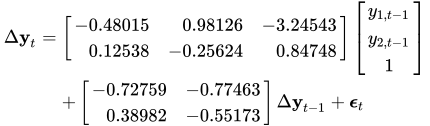
Figure 76 can be reported as follows:

StartLayout 1st Row 1st Column normal upper Delta bold y Subscript t 2nd Column equals 3rd Column Start 2 By 3 Matrix 1st Row 1st Column negative 0.48015 2nd Column 0.98126 3rd Column negative 3.24543 2nd Row 1st Column 0.12538 2nd Column negative 0.25624 3rd Column 0.84748 EndMatrix Start 3 By 1 Matrix 1st Row  y Subscript 1 comma t minus 1 2nd Row  y Subscript 2 comma t minus 1 3rd Row  1 EndMatrix 2nd Row 1st Column Blank 2nd Column Blank 3rd Column plus Start 2 By 2 Matrix 1st Row 1st Column negative 0.72759 2nd Column negative 0.77463 2nd Row 1st Column 0.38982 2nd Column negative 0.55173 EndMatrix normal upper Delta bold y Subscript t minus 1 plus bold-italic epsilon Subscript t EndLayout

The keyword "EC" in the "Model Parameter Estimates" table means that the ECTREND option is used for fitting the model.

For fitting Case 3,

proc varmax data=simul2;
   model y1 y2 / p=2 print=(estimates);
   cointeg rank=1 normalize=y1;
run;

Figure 77: Parameter Estimation without the ECTREND Option

The VARMAX Procedure

Parameter Alpha * Beta' Estimates
Variable y1 y2
y1 -0.46421 0.95103
y2 0.17535 -0.35923

AR Coefficients of Differenced Lag
DIF Lag Variable y1 y2
1 y1 -0.74052 -0.76305
  y2 0.34820 -0.51194

Model Parameter Estimates
Equation Parameter Estimate Standard
Error
t Value Pr > |t| Variable
D_y1 CONST1 -2.60825 1.32398 -1.97 0.0518 1
  AR1_1_1 -0.46421 0.05474 -8.48 <.0001 y1(t-1)
  AR1_1_2 0.95103 0.11215 8.48 <.0001 y2(t-1)
  AR2_1_1 -0.74052 0.05060 -14.63 <.0001 D_y1(t-1)
  AR2_1_2 -0.76305 0.05352 -14.26 <.0001 D_y2(t-1)
D_y2 CONST2 3.43005 1.39587 2.46 0.0159 1
  AR1_2_1 0.17535 0.05771 3.04 0.0031 y1(t-1)
  AR1_2_2 -0.35923 0.11824 -3.04 0.0031 y2(t-1)
  AR2_2_1 0.34820 0.05335 6.53 <.0001 D_y1(t-1)
  AR2_2_2 -0.51194 0.05643 -9.07 <.0001 D_y2(t-1)


Figure 77 can be reported as follows:

StartLayout 1st Row 1st Column normal upper Delta bold y Subscript t 2nd Column equals 3rd Column Start 2 By 2 Matrix 1st Row 1st Column negative 0.46421 2nd Column 0.95103 2nd Row 1st Column 0.17535 2nd Column negative 0.35293 EndMatrix bold y Subscript t minus 1 plus Start 2 By 2 Matrix 1st Row 1st Column negative 0.74052 2nd Column negative 0.76305 2nd Row 1st Column 0.34820 2nd Column negative 0.51194 EndMatrix normal upper Delta bold y Subscript t minus 1 2nd Row 1st Column Blank 2nd Column Blank 3rd Column plus StartBinomialOrMatrix negative 2.60825 Choose 3.43005 EndBinomialOrMatrix plus bold-italic epsilon Subscript t EndLayout

A Test for the Long-Run Relations

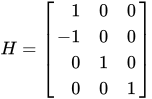
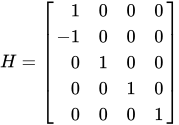
Consider the example with the variables m Subscript t log real money, y Subscript t log real income, i Subscript t Superscript d deposit interest rate, and i Subscript t Superscript b bond interest rate. It seems a natural hypothesis that in the long-run relation, money and income have equal coefficients with opposite signs. This can be formulated as the hypothesis that the cointegrated relation contains only m Subscript t and y Subscript t through m Subscript t Baseline minus y Subscript t. For the analysis, you can express these restrictions in the parameterization of bold upper H such that bold-italic beta equals upper H phi, where bold upper H is a known k times s matrix and psi is the s times r left-parenthesis r less-than-or-equal-to s less-than k right-parenthesis parameter matrix to be estimated. For this example, bold upper H is given by

upper H equals Start 4 By 3 Matrix 1st Row 1st Column 1 2nd Column 0 3rd Column 0 2nd Row 1st Column negative 1 2nd Column 0 3rd Column 0 3rd Row 1st Column 0 2nd Column 1 3rd Column 0 4th Row 1st Column 0 2nd Column 0 3rd Column 1 EndMatrix


Restriction upper H 0 colon bold-italic beta equals upper H phi

When the linear restriction bold-italic beta equals upper H phi is given, it implies that the same restrictions are imposed on all cointegrating vectors. You obtain the maximum likelihood estimator of bold-italic beta by reduced rank regression of normal upper Delta bold y Subscript t on upper H bold y Subscript t minus 1 corrected for left-parenthesis normal upper Delta bold y Subscript t minus 1 Baseline comma ellipsis comma normal upper Delta bold y Subscript t minus p plus 1 Baseline comma upper D Subscript t Baseline right-parenthesis, solving the following equation,

StartLayout 1st Row  StartAbsoluteValue rho upper H prime upper S 11 upper H minus upper H prime upper S 10 upper S 00 Superscript negative 1 Baseline upper S 01 upper H EndAbsoluteValue equals 0 EndLayout

for the eigenvalues 1 greater-than rho 1 greater-than midline-horizontal-ellipsis greater-than rho Subscript s Baseline greater-than 0 and eigenvectors left-parenthesis v 1 comma ellipsis comma v Subscript s Baseline right-parenthesis, upper S Subscript i j given in the preceding section. Then choose ModifyingAbove phi With caret equals left-parenthesis v 1 comma ellipsis comma v Subscript r Baseline right-parenthesis that corresponds to the r largest eigenvalues, and the ModifyingAbove bold-italic beta With caret is upper H ModifyingAbove phi With caret.

The test statistic for upper H 0 colon bold-italic beta equals upper H phi is given by

upper T sigma-summation Underscript i equals 1 Overscript r Endscripts log left-brace left-parenthesis 1 minus rho Subscript i Baseline right-parenthesis slash left-parenthesis 1 minus lamda Subscript i Baseline right-parenthesis right-brace right-arrow Overscript d Endscripts chi Subscript r left-parenthesis k minus s right-parenthesis Superscript 2

If the series has no deterministic trend, the constant term should be restricted by bold-italic alpha prime Subscript up-tack Baseline bold-italic delta 0 equals 0 as in Case 2. Then bold upper H is given by

upper H equals Start 5 By 4 Matrix 1st Row 1st Column 1 2nd Column 0 3rd Column 0 4th Column 0 2nd Row 1st Column negative 1 2nd Column 0 3rd Column 0 4th Column 0 3rd Row 1st Column 0 2nd Column 1 3rd Column 0 4th Column 0 4th Row 1st Column 0 2nd Column 0 3rd Column 1 4th Column 0 5th Row 1st Column 0 2nd Column 0 3rd Column 0 4th Column 1 EndMatrix

The following statements test that 2 beta 1 plus beta 2 equals 0:

proc varmax data=simul2;
   model y1 y2 / p=2;
   cointeg rank=1 h=(1,-2) normalize=y1;
run;

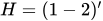
Figure 78 shows the results of testing upper H 0 colon 2 beta 1 plus beta 2 equals 0. The input bold upper H matrix is upper H equals left-parenthesis 1 minus 2 right-parenthesis prime. The adjustment coefficient is reestimated under the restriction, and the test indicates that you cannot reject the null hypothesis.

Figure 78: Testing of Linear Restriction (H= Option)

The VARMAX Procedure

Beta Under Restriction
Variable 1
y1 1.00000
y2 -2.00000

Alpha Under Restriction
Variable 1
y1 -0.47404
y2 0.17534

Hypothesis Test
Index Eigenvalue Restricted
Eigenvalue
DF Chi-Square Pr > ChiSq
1 0.4644 0.4616 1 0.51 0.4738


Test for the Weak Exogeneity and Restrictions of Alpha

Consider a vector error correction model:

normal upper Delta bold y Subscript t Baseline equals bold-italic alpha bold-italic beta prime bold y Subscript t minus 1 Baseline plus sigma-summation Underscript i equals 1 Overscript p minus 1 Endscripts normal upper Phi Subscript i Superscript asterisk Baseline normal upper Delta bold y Subscript t minus i Baseline plus upper A upper D Subscript t Baseline plus bold-italic epsilon Subscript t

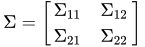
Divide the process bold y Subscript t into left-parenthesis bold y prime Subscript 1 t Baseline comma bold y prime Subscript 2 t right-parenthesis prime with dimension k 1 and k 2 and the normal upper Sigma into

StartLayout 1st Row  normal upper Sigma equals Start 2 By 2 Matrix 1st Row 1st Column normal upper Sigma 11 2nd Column normal upper Sigma 12 2nd Row 1st Column normal upper Sigma 21 2nd Column normal upper Sigma 22 EndMatrix EndLayout

Similarly, the parameters can be decomposed as follows:

StartLayout 1st Row  bold-italic alpha equals StartBinomialOrMatrix bold-italic alpha 1 Choose bold-italic alpha 2 EndBinomialOrMatrix normal upper Phi Subscript i Superscript asterisk Baseline equals StartBinomialOrMatrix normal upper Phi Subscript 1 i Superscript asterisk Baseline Choose normal upper Phi Subscript 2 i Superscript asterisk Baseline EndBinomialOrMatrix upper A equals StartBinomialOrMatrix upper A 1 Choose upper A 2 EndBinomialOrMatrix EndLayout

Then the VECM(p) form can be rewritten by using the decomposed parameters and processes:

StartLayout 1st Row  StartBinomialOrMatrix normal upper Delta bold y Subscript 1 t Baseline Choose normal upper Delta bold y Subscript 2 t Baseline EndBinomialOrMatrix equals StartBinomialOrMatrix bold-italic alpha 1 Choose bold-italic alpha 2 EndBinomialOrMatrix bold-italic beta prime bold y Subscript t minus 1 Baseline plus sigma-summation Underscript i equals 1 Overscript p minus 1 Endscripts StartBinomialOrMatrix normal upper Phi Subscript 1 i Superscript asterisk Baseline Choose normal upper Phi Subscript 2 i Superscript asterisk Baseline EndBinomialOrMatrix normal upper Delta bold y Subscript t minus i Baseline plus StartBinomialOrMatrix upper A 1 Choose upper A 2 EndBinomialOrMatrix upper D Subscript t Baseline plus StartBinomialOrMatrix bold-italic epsilon Subscript 1 t Baseline Choose bold-italic epsilon Subscript 2 t EndBinomialOrMatrix EndLayout

The conditional model for bold y Subscript 1 t given bold y Subscript 2 t is

StartLayout 1st Row 1st Column normal upper Delta bold y Subscript 1 t 2nd Column equals 3rd Column omega normal upper Delta bold y Subscript 2 t plus left-parenthesis alpha 1 minus omega alpha 2 right-parenthesis bold-italic beta prime bold y Subscript t minus 1 plus sigma-summation Underscript i equals 1 Overscript p minus 1 Endscripts left-parenthesis normal upper Phi Subscript 1 i Superscript asterisk Baseline minus omega normal upper Phi Subscript 2 i Superscript asterisk Baseline right-parenthesis normal upper Delta bold y Subscript t minus i 2nd Row 1st Column Blank 2nd Column Blank 3rd Column plus left-parenthesis upper A 1 minus omega upper A 2 right-parenthesis upper D Subscript t plus bold-italic epsilon Subscript 1 t minus omega bold-italic epsilon Subscript 2 t EndLayout

and the marginal model of bold y Subscript 2 t is

normal upper Delta bold y Subscript 2 t Baseline equals alpha 2 bold-italic beta prime bold y Subscript t minus 1 Baseline plus sigma-summation Underscript i equals 1 Overscript p minus 1 Endscripts normal upper Phi Subscript 2 i Superscript asterisk Baseline normal upper Delta bold y Subscript t minus i Baseline plus upper A 2 upper D Subscript t Baseline plus bold-italic epsilon Subscript 2 t

where omega equals normal upper Sigma 12 normal upper Sigma 22 Superscript negative 1.

The test of weak exogeneity of bold y Subscript 2 t for the parameters left-parenthesis alpha 1 comma bold-italic beta right-parenthesis determines whether alpha 2 equals 0. Weak exogeneity means that there is no information about bold-italic beta in the marginal model or that the variables bold y Subscript 2 t do not react to a disequilibrium.


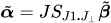
Restriction upper H 0 colon bold-italic alpha equals upper J psi

Consider the null hypothesis upper H 0 colon bold-italic alpha equals upper J psi, where J is a k times m matrix with r less-than-or-equal-to m less-than k.

From the previous residual regression equation

StartLayout 1st Row  upper R Subscript 0 t Baseline equals bold-italic alpha bold-italic beta prime upper R Subscript 1 t Baseline plus ModifyingAbove bold-italic epsilon With caret Subscript t Baseline equals upper J psi bold-italic beta prime upper R Subscript 1 t Baseline plus ModifyingAbove bold-italic epsilon With caret Subscript t EndLayout

you can obtain

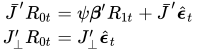
StartLayout 1st Row 1st Column upper J overbar prime upper R Subscript 0 t 2nd Column equals 3rd Column psi bold-italic beta prime upper R Subscript 1 t plus upper J overbar prime ModifyingAbove bold-italic epsilon With caret Subscript t 2nd Row 1st Column upper J prime Subscript up-tack Baseline upper R Subscript 0 t 2nd Column equals 3rd Column upper J prime Subscript up-tack Baseline ModifyingAbove bold-italic epsilon With caret Subscript t EndLayout

where upper J overbar equals upper J left-parenthesis upper J prime upper J right-parenthesis Superscript negative 1 and upper J Subscript up-tack is orthogonal to J such that upper J prime Subscript up-tack Baseline upper J equals 0.

Define

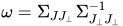
normal upper Sigma Subscript upper J upper J Sub Subscript up-tack Baseline equals upper J overbar prime normal upper Sigma upper J Subscript up-tack Baseline normal a normal n normal d normal upper Sigma Subscript upper J Sub Subscript up-tack Subscript upper J Sub Subscript up-tack Baseline equals upper J prime Subscript up-tack Baseline normal upper Sigma upper J Subscript up-tack

and let omega equals normal upper Sigma Subscript upper J upper J Sub Subscript up-tack Baseline normal upper Sigma Subscript upper J Sub Subscript up-tack Subscript upper J Sub Subscript up-tack Superscript negative 1. Then upper J overbar prime upper R Subscript 0 t can be written as

StartLayout 1st Row  upper J overbar prime upper R Subscript 0 t Baseline equals psi bold-italic beta prime upper R Subscript 1 t Baseline plus omega upper J prime Subscript up-tack Baseline upper R Subscript 0 t Baseline plus upper J overbar prime ModifyingAbove bold-italic epsilon With caret Subscript t Baseline minus omega upper J prime Subscript up-tack Baseline ModifyingAbove bold-italic epsilon With caret Subscript t EndLayout

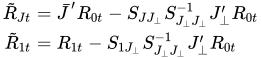
Using the marginal distribution of upper J prime Subscript up-tack Baseline upper R Subscript 0 t and the conditional distribution of upper J overbar prime upper R Subscript 0 t, the new residuals are computed as

StartLayout 1st Row 1st Column upper R overTilde Subscript upper J t 2nd Column equals 3rd Column upper J overbar prime upper R Subscript 0 t minus upper S Subscript upper J upper J Sub Subscript up-tack Baseline upper S Subscript upper J Sub Subscript up-tack Subscript upper J Sub Subscript up-tack Superscript negative 1 Baseline upper J prime Subscript up-tack Baseline upper R Subscript 0 t 2nd Row 1st Column upper R overTilde Subscript 1 t 2nd Column equals 3rd Column upper R Subscript 1 t Baseline minus upper S Subscript 1 upper J Sub Subscript up-tack Baseline upper S Subscript upper J Sub Subscript up-tack Subscript upper J Sub Subscript up-tack Superscript negative 1 Baseline upper J prime Subscript up-tack Baseline upper R Subscript 0 t EndLayout

where

upper S Subscript upper J upper J Sub Subscript up-tack Subscript Baseline equals upper J overbar prime upper S 00 upper J Subscript up-tack Baseline comma upper S Subscript upper J Sub Subscript up-tack Subscript upper J Sub Subscript up-tack Subscript Baseline equals upper J prime Subscript up-tack Baseline upper S 00 upper J Subscript up-tack Baseline comma normal a normal n normal d upper S Subscript upper J Sub Subscript up-tack Subscript 1 Baseline equals upper J prime Subscript up-tack Baseline upper S 01

In terms of upper R overTilde Subscript upper J t and upper R overTilde Subscript 1 t, the MLE of bold-italic beta is computed by using the reduced rank regression. Let

upper S Subscript i j bold period upper J Sub Subscript up-tack Subscript Baseline equals StartFraction 1 Over upper T EndFraction sigma-summation Underscript t equals 1 Overscript upper T Endscripts upper R overTilde Subscript i t Baseline upper R overTilde Subscript j t Superscript prime Baseline comma normal f normal o normal r i comma j equals 1 comma upper J

Under the null hypothesis upper H 0 colon bold-italic alpha equals upper J psi, the MLE bold-italic beta overTilde is computed by solving the equation

StartLayout 1st Row  StartAbsoluteValue rho upper S Subscript 11 bold period upper J Sub Subscript up-tack Subscript Baseline minus upper S Subscript 1 upper J bold period upper J Sub Subscript up-tack Subscript Baseline upper S Subscript upper J upper J bold period upper J Sub Subscript up-tack Subscript Superscript negative 1 Baseline upper S Subscript upper J Baseline 1 bold period upper J Sub Subscript up-tack Subscript Baseline EndAbsoluteValue equals 0 EndLayout

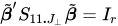
Then bold-italic beta overTilde equals left-parenthesis v 1 comma ellipsis comma v Subscript r Baseline right-parenthesis, where the eigenvectors correspond to the r largest eigenvalues and are normalized such that bold-italic beta overTilde prime upper S Subscript 11 bold period upper J Sub Subscript up-tack Subscript Baseline bold-italic beta overTilde equals upper I Subscript r; bold-italic alpha overTilde equals upper J upper S Subscript upper J Baseline 1 bold period upper J Sub Subscript up-tack Subscript Baseline bold-italic beta overTilde. The likelihood ratio test for upper H 0 colon bold-italic alpha equals upper J psi is
upper T sigma-summation Underscript i equals 1 Overscript r Endscripts log left-brace left-parenthesis 1 minus rho Subscript i Baseline right-parenthesis slash left-parenthesis 1 minus lamda Subscript i Baseline right-parenthesis right-brace right-arrow Overscript d Endscripts chi Subscript r left-parenthesis k minus m right-parenthesis Superscript 2

For more information, see Theorem 6.1 in Johansen and Juselius (1990).

The test of weak exogeneity of bold y Subscript 2 t is a special case of the test bold-italic alpha equals upper J psi, considering upper J equals left-parenthesis upper I Subscript k 1 Baseline comma 0 right-parenthesis prime. Consider the previous example with four variables ( m Subscript t Baseline comma y Subscript t Baseline comma i Subscript t Superscript b Baseline comma i Subscript t Superscript d ). If r equals 1, you formulate the weak exogeneity of (y Subscript t Baseline comma i Subscript t Superscript b Baseline comma i Subscript t Superscript d) for m Subscript t as upper J equals left-bracket 0 comma upper I 3 right-bracket prime and the weak exogeneity of i Subscript t Superscript d for (m Subscript t Baseline comma y Subscript t Baseline comma i Subscript t Superscript b) as upper J equals left-bracket upper I 3 comma 0 right-bracket prime.

The following statements test the weak exogeneity of other variables, assuming r equals 1:

proc varmax data=simul2;
   model y1 y2 / p=2;
   cointeg rank=1 exogeneity normalize=y1;
run;

Figure 79 shows that each variable is not the weak exogeneity of other variable.

Figure 79: Testing of Weak Exogeneity (EXOGENEITY Option)

The VARMAX Procedure

Testing Weak Exogeneity of
Each Variable
Variable DF Chi-Square Pr > ChiSq
y1 1 53.46 <.0001
y2 1 8.76 0.0031


General Tests and Restrictions on Parameters

The previous sections discuss some special forms of tests on bold-italic beta and bold-italic alpha, namely the long-run relations that are expressed in the form upper H 0 colon bold-italic beta equals bold upper H bold-italic phi, the weak exogeneity test, and the null hypotheses on bold-italic alpha in the form upper H 0 colon bold-italic alpha equals bold upper J bold-italic psi. In fact, with the help of the RESRICT and BOUND statements, you can estimate the models that have linear restrictions on any parameters to be estimated, which means that you can implement the likelihood ratio (LR) test for any linear relationship between the parameters.

The restricted error correction model must be estimated through numerical optimization. You might need to use the NLOPTIONS statement to try different options for the optimizer and the INITIAL statement to try different starting points. This is essentially important because the bold-italic alpha and bold-italic beta are usually not identifiable.

You can also use the TEST statement to apply the Wald test for any linear relationships between parameters that are not long-run. Even more, you can test the constraints on normal upper Pi left-parenthesis equals bold-italic alpha bold-italic beta prime right-parenthesis and bold-italic delta 0 left-parenthesis equals bold-italic alpha bold-italic beta 0 right-parenthesis in Case 2 or bold-italic delta 1 left-parenthesis equals bold-italic alpha bold-italic beta 1 right-parenthesis in Case 4 when the constant term or linear trend is restricted to the error correction term.

For more information and examples, see the section Analysis of Restricted Cointegrated Systems.

Forecasting of the VECM

Consider the cointegrated moving-average representation of the differenced process of bold y Subscript t

StartLayout 1st Row  normal upper Delta bold y Subscript t Baseline equals bold-italic delta plus normal upper Psi left-parenthesis upper B right-parenthesis bold-italic epsilon Subscript t EndLayout

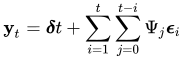
Assume that bold y 0 equals 0. The linear process bold y Subscript t can be written as

StartLayout 1st Row  bold y Subscript t Baseline equals bold-italic delta t plus sigma-summation Underscript i equals 1 Overscript t Endscripts sigma-summation Underscript j equals 0 Overscript t minus i Endscripts normal upper Psi Subscript j Baseline bold-italic epsilon Subscript i EndLayout

Therefore, for any l greater-than 0,

StartLayout 1st Row  bold y Subscript t plus l Baseline equals bold-italic delta left-parenthesis t plus l right-parenthesis plus sigma-summation Underscript i equals 1 Overscript t Endscripts sigma-summation Underscript j equals 0 Overscript t plus l minus i Endscripts normal upper Psi Subscript j Baseline bold-italic epsilon Subscript i Baseline plus sigma-summation Underscript i equals 1 Overscript l Endscripts sigma-summation Underscript j equals 0 Overscript l minus i Endscripts normal upper Psi Subscript j Baseline bold-italic epsilon Subscript t plus i EndLayout

The l-step-ahead forecast is derived from the preceding equation:
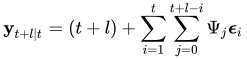
StartLayout 1st Row  bold y Subscript t plus l vertical-bar t Baseline equals left-parenthesis t plus l right-parenthesis plus sigma-summation Underscript i equals 1 Overscript t Endscripts sigma-summation Underscript j equals 0 Overscript t plus l minus i Endscripts normal upper Psi Subscript j Baseline bold-italic epsilon Subscript i EndLayout

Note that

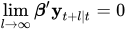
limit Underscript l right-arrow normal infinity Endscripts bold-italic beta prime bold y Subscript t plus l vertical-bar t Baseline equals 0

since limit Underscript l right-arrow normal infinity Endscripts sigma-summation Underscript j equals 0 Overscript t plus l minus i Endscripts normal upper Psi Subscript j Baseline equals normal upper Psi left-parenthesis 1 right-parenthesis and bold-italic beta prime normal upper Psi left-parenthesis 1 right-parenthesis equals 0. The long-run forecast of the cointegrated system shows that the cointegrated relationship holds, although there might exist some deviations from the equilibrium status in the short-run. The covariance matrix of the predict error bold e Subscript t plus l vertical-bar t Baseline equals bold y Subscript t plus l Baseline minus bold y Subscript t plus l vertical-bar t is

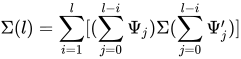
normal upper Sigma left-parenthesis l right-parenthesis equals sigma-summation Underscript i equals 1 Overscript l Endscripts left-bracket left-parenthesis sigma-summation Underscript j equals 0 Overscript l minus i Endscripts normal upper Psi Subscript j Baseline right-parenthesis normal upper Sigma left-parenthesis sigma-summation Underscript j equals 0 Overscript l minus i Endscripts normal upper Psi prime Subscript j right-parenthesis right-bracket

When the linear process is represented as a VECM(p) model, you can obtain

StartLayout 1st Row  normal upper Delta bold y Subscript t Baseline equals normal upper Pi bold y Subscript t minus 1 Baseline plus sigma-summation Underscript j equals 1 Overscript p minus 1 Endscripts normal upper Phi Subscript j Superscript asterisk Baseline normal upper Delta bold y Subscript t minus j Baseline plus bold-italic delta plus bold-italic epsilon Subscript t EndLayout

The transition equation is defined as

StartLayout 1st Row  bold z Subscript t Baseline equals upper F bold z Subscript t minus 1 Baseline plus bold e Subscript t EndLayout

where bold z Subscript t Baseline equals left-parenthesis bold y prime Subscript t minus 1 Baseline comma normal upper Delta bold y prime Subscript t comma normal upper Delta bold y prime Subscript t minus 1 comma ellipsis comma normal upper Delta bold y prime Subscript t minus p plus 2 right-parenthesis prime is a state vector and the transition matrix is
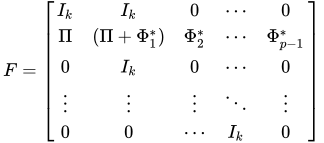
StartLayout 1st Row  upper F equals Start 5 By 5 Matrix 1st Row 1st Column upper I Subscript k Baseline 2nd Column upper I Subscript k Baseline 3rd Column 0 4th Column midline-horizontal-ellipsis 5th Column 0 2nd Row 1st Column normal upper Pi 2nd Column left-parenthesis normal upper Pi plus normal upper Phi 1 Superscript asterisk Baseline right-parenthesis 3rd Column normal upper Phi 2 Superscript asterisk Baseline 4th Column midline-horizontal-ellipsis 5th Column normal upper Phi Subscript p minus 1 Superscript asterisk Baseline 3rd Row 1st Column 0 2nd Column upper I Subscript k Baseline 3rd Column 0 4th Column midline-horizontal-ellipsis 5th Column 0 4th Row 1st Column vertical-ellipsis 2nd Column vertical-ellipsis 3rd Column vertical-ellipsis 4th Column down-right-diagonal-ellipsis 5th Column vertical-ellipsis 5th Row 1st Column 0 2nd Column 0 3rd Column midline-horizontal-ellipsis 4th Column upper I Subscript k Baseline 5th Column 0 EndMatrix EndLayout

where 0 is a k times k zero matrix. The observation equation can be written

bold y Subscript t Baseline equals bold-italic delta t plus upper H bold z Subscript t

where upper H equals left-bracket upper I Subscript k Baseline comma upper I Subscript k Baseline comma 0 comma ellipsis comma 0 right-bracket.

The l-step-ahead forecast is computed as

StartLayout 1st Row  bold y Subscript t plus l vertical-bar t Baseline equals bold-italic delta left-parenthesis t plus l right-parenthesis plus upper H upper F Superscript l Baseline bold z Subscript t EndLayout

Cointegration with Exogenous Variables

The error correction model with exogenous variables can be written as follows:

StartLayout 1st Row  normal upper Delta bold y Subscript t Baseline equals bold-italic alpha bold-italic beta prime bold y Subscript t minus 1 Baseline plus sigma-summation Underscript i equals 1 Overscript p minus 1 Endscripts normal upper Phi Subscript i Superscript asterisk Baseline normal upper Delta bold y Subscript t minus i Baseline plus upper A upper D Subscript t Baseline plus sigma-summation Underscript i equals 0 Overscript s Endscripts normal upper Theta Subscript i Superscript asterisk Baseline bold x Subscript t minus i Baseline plus bold-italic epsilon Subscript t EndLayout

The following statements demonstrate how to fit VECMX(p comma s), where p equals 2 and s equals 1 from the P=2 and XLAG=1 options:

proc varmax data=simul3;
   model y1 y2 = x1 / p=2 xlag=1;
   cointeg rank=1;
run;

The following statements demonstrate how to BVECMX(2,1):

proc varmax data=simul3;
   model y1 y2 = x1 / p=2 xlag=1
                      prior=(lambda=0.9 theta=0.1);
   cointeg rank=1;
run;
Last updated: June 19, 2025