VARMAX Procedure

Cointegration

This section briefly introduces the concepts of cointegration (Johansen 1995a).

Definition 1.

(Engle and Granger 1987): If a series y Subscript t with no deterministic components can be represented by a stationary and invertible ARMA process after differencing d times, the series is integrated of order d, that is, y Subscript t Baseline tilde upper I left-parenthesis d right-parenthesis.

Definition 2.

(Engle and Granger 1987): If all elements of the vector bold y Subscript t are upper I left-parenthesis d right-parenthesis and there exists a cointegrating vector bold-italic beta not-equals 0 such that bold-italic beta prime bold y Subscript t Baseline tilde upper I left-parenthesis d minus b right-parenthesis for any b greater-than 0, the vector process is said to be cointegrated upper C upper I left-parenthesis d comma b right-parenthesis.

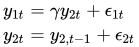
A simple example of a cointegrated process is the following bivariate system:
StartLayout 1st Row 1st Column y Subscript 1 t 2nd Column equals 3rd Column gamma y Subscript 2 t plus epsilon Subscript 1 t 2nd Row 1st Column y Subscript 2 t 2nd Column equals 3rd Column y Subscript 2 comma t minus 1 Baseline plus epsilon Subscript 2 t EndLayout

with epsilon Subscript 1 t and epsilon Subscript 2 t being uncorrelated white noise processes. In the second equation, y Subscript 2 t is a random walk, normal upper Delta y Subscript 2 t Baseline equals epsilon Subscript 2 t, normal upper Delta identical-to 1 minus upper B. Differencing the first equation results in

normal upper Delta y Subscript 1 t Baseline equals gamma normal upper Delta y Subscript 2 t Baseline plus normal upper Delta epsilon Subscript 1 t Baseline equals gamma epsilon Subscript 2 t Baseline plus epsilon Subscript 1 t Baseline minus epsilon Subscript 1 comma t minus 1

Thus, both y Subscript 1 t and y Subscript 2 t are upper I left-parenthesis 1 right-parenthesis processes, but the linear combination y Subscript 1 t Baseline minus gamma y Subscript 2 t is stationary. Hence bold y Subscript t Baseline equals left-parenthesis y Subscript 1 t Baseline comma y Subscript 2 t Baseline right-parenthesis prime is cointegrated with a cointegrating vector bold-italic beta equals left-parenthesis 1 comma negative gamma right-parenthesis prime.

In general, if the vector process bold y Subscript t has k components, then there can be more than one cointegrating vector bold-italic beta prime. It is assumed that there are r linearly independent cointegrating vectors with r less-than k, which make the k times r matrix bold-italic beta. The rank of matrix bold-italic beta is r, which is called the cointegration rank of bold y Subscript t.

Common Trends

This section briefly discusses the implication of cointegration for the moving-average representation. Let bold y Subscript t be cointegrated upper C upper I left-parenthesis 1 comma 1 right-parenthesis, then normal upper Delta bold y Subscript t has the Wold representation:

StartLayout 1st Row  normal upper Delta bold y Subscript t Baseline equals bold-italic delta plus normal upper Psi left-parenthesis upper B right-parenthesis bold-italic epsilon Subscript t EndLayout

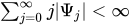
where bold-italic epsilon Subscript t is normal i normal i normal d left-parenthesis 0 comma normal upper Sigma right-parenthesis, normal upper Psi left-parenthesis upper B right-parenthesis equals sigma-summation Underscript j equals 0 Overscript normal infinity Endscripts normal upper Psi Subscript j Baseline upper B Superscript j with normal upper Psi 0 equals upper I Subscript k, and sigma-summation Underscript j equals 0 Overscript normal infinity Endscripts j StartAbsoluteValue normal upper Psi Subscript j Baseline EndAbsoluteValue less-than normal infinity.

Assume that bold-italic epsilon Subscript t Baseline equals 0 if t less-than-or-equal-to 0 and bold y 0 is a nonrandom initial value. Then the difference equation implies that

StartLayout 1st Row  bold y Subscript t Baseline equals bold y 0 plus bold-italic delta t plus normal upper Psi left-parenthesis 1 right-parenthesis sigma-summation Underscript i equals 0 Overscript t Endscripts bold-italic epsilon Subscript i Baseline plus normal upper Psi Superscript asterisk Baseline left-parenthesis upper B right-parenthesis bold-italic epsilon Subscript t EndLayout

where normal upper Psi Superscript asterisk Baseline left-parenthesis upper B right-parenthesis equals left-parenthesis 1 minus upper B right-parenthesis Superscript negative 1 Baseline left-parenthesis normal upper Psi left-parenthesis upper B right-parenthesis minus normal upper Psi left-parenthesis 1 right-parenthesis right-parenthesis and normal upper Psi Superscript asterisk Baseline left-parenthesis upper B right-parenthesis is absolutely summable.

Assume that the rank of normal upper Psi left-parenthesis 1 right-parenthesis is m equals k minus r. When the process bold y Subscript t is cointegrated, there is a cointegrating k times r matrix bold-italic beta such that bold-italic beta prime bold y Subscript t is stationary.

Premultiplying bold y Subscript t by bold-italic beta prime results in

bold-italic beta prime bold y Subscript t Baseline equals bold-italic beta prime bold y 0 plus bold-italic beta prime normal upper Psi Superscript asterisk Baseline left-parenthesis upper B right-parenthesis bold-italic epsilon Subscript t

because bold-italic beta prime normal upper Psi left-parenthesis 1 right-parenthesis equals 0 and bold-italic beta prime bold-italic delta equals 0.

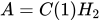
Stock and Watson (1988) showed that the cointegrated process bold y Subscript t has a common trends representation derived from the moving-average representation. Since the rank of normal upper Psi left-parenthesis 1 right-parenthesis is m equals k minus r, there is a k times r matrix upper H 1 with rank r such that normal upper Psi left-parenthesis 1 right-parenthesis upper H 1 equals 0. Let upper H 2 be a k times m matrix with rank m such that upper H prime 2 upper H 1 equals 0; then upper A equals upper C left-parenthesis 1 right-parenthesis upper H 2 has rank m. The upper H equals left-parenthesis upper H 1 comma upper H 2 right-parenthesis has rank k. By construction of bold upper H,

StartLayout 1st Row  normal upper Psi left-parenthesis 1 right-parenthesis upper H equals left-bracket 0 comma upper A right-bracket equals upper A upper S Subscript m EndLayout

where upper S Subscript m Baseline equals left-parenthesis 0 Subscript m times r Baseline comma upper I Subscript m Baseline right-parenthesis. Since bold-italic beta prime normal upper Psi left-parenthesis 1 right-parenthesis equals 0 and bold-italic beta prime bold-italic delta equals 0, bold-italic delta lies in the column space of normal upper Psi left-parenthesis 1 right-parenthesis and can be written

StartLayout 1st Row  bold-italic delta equals normal upper Psi left-parenthesis 1 right-parenthesis bold-italic delta overTilde EndLayout

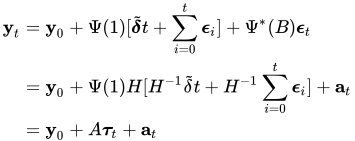
where bold-italic delta overTilde is a k-dimensional vector. The common trends representation is written as
StartLayout 1st Row 1st Column bold y Subscript t 2nd Column equals 3rd Column bold y 0 plus normal upper Psi left-parenthesis 1 right-parenthesis left-bracket bold-italic delta overTilde t plus sigma-summation Underscript i equals 0 Overscript t Endscripts bold-italic epsilon Subscript i Baseline right-bracket plus normal upper Psi Superscript asterisk Baseline left-parenthesis upper B right-parenthesis bold-italic epsilon Subscript t 2nd Row 1st Column Blank 2nd Column equals 3rd Column bold y 0 plus normal upper Psi left-parenthesis 1 right-parenthesis upper H left-bracket upper H Superscript negative 1 Baseline delta overTilde t plus upper H Superscript negative 1 Baseline sigma-summation Underscript i equals 0 Overscript t Endscripts bold-italic epsilon Subscript i Baseline right-bracket plus bold a Subscript t 3rd Row 1st Column Blank 2nd Column equals 3rd Column bold y 0 plus upper A bold-italic tau Subscript t plus bold a Subscript t EndLayout

and

bold-italic tau Subscript t Baseline equals pi plus bold-italic tau Subscript t minus 1 Baseline plus bold v Subscript t

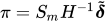
where bold a Subscript t Baseline equals normal upper Psi Superscript asterisk Baseline left-parenthesis upper B right-parenthesis bold-italic epsilon Subscript t, pi equals upper S Subscript m Baseline upper H Superscript negative 1 Baseline bold-italic delta overTilde, bold-italic tau Subscript t Baseline equals upper S Subscript m Baseline left-bracket upper H Superscript negative 1 Baseline bold-italic delta overTilde t plus upper H Superscript negative 1 Baseline sigma-summation Underscript i equals 0 Overscript t Endscripts bold-italic epsilon Subscript i Baseline right-bracket, and bold v Subscript t Baseline equals upper S Subscript m Baseline upper H Superscript negative 1 Baseline bold-italic epsilon Subscript t.

Stock and Watson showed that the common trends representation expresses bold y Subscript t as a linear combination of m random walks (bold-italic tau Subscript t) with drift pi plus upper I left-parenthesis 0 right-parenthesis components (bold a Subscript t Baseline right-parenthesis.

Test for the Common Trends

Stock and Watson (1988) proposed statistics for common trends testing. The null hypothesis is that the k-dimensional time series bold y Subscript t has m common stochastic trends, where m less-than-or-equal-to k and the alternative is that it has s common trends, where s less-than m . The test procedure of m versus s common stochastic trends is performed based on the first-order serial correlation matrix of bold y Subscript t. Let bold-italic beta Subscript up-tack be a k times m matrix orthogonal to the cointegrating matrix such that bold-italic beta Subscript up-tack Superscript prime Baseline bold-italic beta equals 0 and bold-italic beta Subscript up-tack Superscript Baseline bold-italic beta Subscript up-tack Superscript prime Baseline equals upper I Subscript m. Let bold z Subscript t Baseline equals bold-italic beta prime bold y Subscript t and bold w Subscript t Baseline equals bold-italic beta Subscript up-tack Superscript prime Baseline bold y Subscript t. Then

bold w Subscript t Baseline equals bold-italic beta prime Subscript up-tack Baseline bold y 0 plus bold-italic beta prime Subscript up-tack Baseline bold-italic delta t plus bold-italic beta prime Subscript up-tack Baseline normal upper Psi left-parenthesis 1 right-parenthesis sigma-summation Underscript i equals 0 Overscript t Endscripts bold-italic epsilon Subscript i Baseline plus bold-italic beta prime Subscript up-tack Baseline normal upper Psi Superscript asterisk Baseline left-parenthesis upper B right-parenthesis bold-italic epsilon Subscript t

Combining the expression of bold z Subscript t and bold w Subscript t,

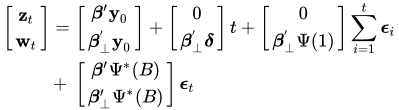
StartLayout 1st Row 1st Column StartBinomialOrMatrix bold z Subscript t Choose bold w Subscript t EndBinomialOrMatrix 2nd Column equals 3rd Column StartBinomialOrMatrix bold-italic beta prime bold y 0 Choose bold-italic beta Subscript up-tack Superscript prime Baseline bold y 0 EndBinomialOrMatrix plus StartBinomialOrMatrix 0 Choose bold-italic beta Subscript up-tack Superscript prime Baseline bold-italic delta EndBinomialOrMatrix t plus StartBinomialOrMatrix 0 Choose bold-italic beta Subscript up-tack Superscript prime Baseline normal upper Psi left-parenthesis 1 right-parenthesis EndBinomialOrMatrix sigma-summation Underscript i equals 1 Overscript t Endscripts bold-italic epsilon Subscript i 2nd Row 1st Column Blank 2nd Column plus 3rd Column StartBinomialOrMatrix bold-italic beta prime normal upper Psi Superscript asterisk Baseline left-parenthesis upper B right-parenthesis Choose bold-italic beta prime Subscript up-tack Baseline normal upper Psi Superscript asterisk Baseline left-parenthesis upper B right-parenthesis EndBinomialOrMatrix bold-italic epsilon Subscript t EndLayout

The Stock-Watson common trends test is performed based on the component bold w Subscript t by testing whether bold-italic beta Subscript up-tack Superscript prime Baseline normal upper Psi left-parenthesis 1 right-parenthesis has rank m against rank s.

The following statements perform the Stock-Watson test for common trends:

proc iml;
   sig = 100*i(2);
   phi = {-0.2 0.1, 0.5 0.2, 0.8 0.7, -0.4 0.6};
   call varmasim(y,phi) sigma=sig n=100 initial=0
                        seed=45876;
   cn = {'y1' 'y2'};
   create simul2 from y[colname=cn];
   append from y;
quit;

data simul2;
   set simul2;
   date = intnx( 'year', '01jan1900'd, _n_-1 );
   format date year4. ;
run;

proc varmax data=simul2;
   model y1 y2 / p=2 cointtest=(sw);
run;

In Figure 71, the first column is the null hypothesis that bold y Subscript t has m less-than-or-equal-to k common trends; the second column is the alternative hypothesis that bold y Subscript t has s less-than m common trends; the third column contains the eigenvalues used for the test statistics; the fourth column contains the test statistics using AR(p) filtering of the data. The table shows the output of the case p equals 2.

Figure 71: Common Trends Test (COINTTEST=(SW) Option)

The VARMAX Procedure

Common Trend Test
H0:
Rank=m
H1:
Rank=s
Eigenvalue Filter 5% Critical Value Lag
1 0 1.000906 0.09 -14.10 2
2 0 0.996763 -0.32 -8.80  
  1 0.648908 -35.11 -23.00  


The test statistic for testing for 2 versus 1 common trends is more negative (–35.1) than the critical value (–23.0). Therefore, the test rejects the null hypothesis, which means that the series has a single common trend.

Last updated: June 19, 2025