TIMESERIES Procedure
Singular Spectrum Analysis
Given a time series,  , for
, for  , and a window length,
 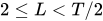 , singular spectrum analysis Golyandina, Nekrutkin, and Zhigljavsky (2001) decompose the time series into spectral groupings using the following steps:
Embedding Step
Using the time series, form a  trajectory matrix,
  , with elements
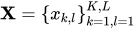
such that  for
for  and
and  and where
  . By definition
  , because
  .
.
Decomposition Step
Using the trajectory matrix, , apply singular value decomposition to the trajectory matrix

where  represents the
  matrix that contains the left-hand-side (LHS) eigenvectors, where
  represents the diagonal matrix that contains the singular values, and where
  represents the
  matrix that contains the right-hand-side (RHS) eigenvectors.
Therefore,
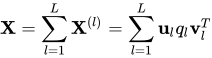
where  represents the principal component matrix,
  represents the
  left-hand-side (LHS) eigenvector,
  represents the singular value, and
  represents the
  right-hand-side (RHS) eigenvector associated with the lth window index.
Grouping Step
For each group index,  , define a group of window indices
  . Let
. Let

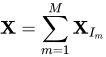
represent the grouped trajectory matrix for group  . If groupings represent a spectral partition,

then according to the singular value decomposition theory,
Averaging Step
For each group index, , compute the diagonal average of  ,
,
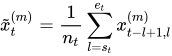
where

If the groupings represent a spectral partition, then by definition
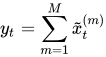
Hence, singular spectrum analysis additively decomposes the original time series, , into m component series  for .
for .
Computing W-Correlations
An important step in SSA is specifying the groups, for  . In order to automate the SSA grouping step, the weighted correlations (w-correlations) are computed.
 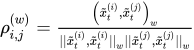 , where
 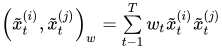 and
and  .
.
Specifying the Window Length
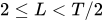
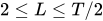
You can explicitly specify the maximum window length,  , by using the LENGTH= option, or you can implicitly specify the window length by using the INTERVAL= option in the ID statement or the SEASONALITY= option in the PROC TIMESERIES statement. Either way, the window length is reduced based on the accumulated time series length, T, to enforce the requirement that
  .
.
Specifying the Groups
The GROUPS=(numlist)…(numlist) option explicitly specifies the composition and number of groups,  , or you can use the THRESHOLDPCT= option in the SSA statement to implicitly specify the grouping. The THRESHOLDPCT= option is useful for removing noise or less dominant patterns from the accumulated time series.
Let  be the cumulative percentage singular value that is specified in the THRESHOLDPCT= option. Then the last group,
  , is determined by the smallest value such that

Using this rule, the last group,  , describes the least dominant patterns in the time series, and the size of the last group is at least one and is less than the window length,
  .
.
The magnitudes of the principal components that are plotted using the PLOT=SSA option and selected by the THRESHOLDPCT= option are based on the singular values that appear on the diagonal of . Alternatively, each principal component’s contribution to variation in the series can be quantified by using the squares of the singular values. The relative contributions of the principal components to variation in the series are included in the printed tabular output that is produced by the PRINT=SSA option.
Automatic Grouping
Besides specifying the groups explicitly, you can also use the GROUPS=AUTO(number) option to perform the automatic grouping. In this SSA automatic grouping, the following steps are performed:
Initially assume the maximal number of groups:
 .
. Diagonally average the groups as described previously:
for  .
. Compute the weighted correlations (w-correlations) between groups:
 .
. Choose the groups based on the w-correlations for which the absolute values are close to one. Or more formally,
such that  whenever
  .
.