SSM Procedure
Continuous-Time Cycle
The STATE statement option TYPE=CYCLE(CT) specifies a two-dimensional  , needed for defining a univariate continuous time cycle. In this case the nominal dimension, dim, must be 1. In particular,
  becomes one-dimensional, which is denoted by
  . This cycle can be used for any data type. As before, the parameters of the cycle are a damping factor
  ,
,  , and period
  . Unlike in the discrete-time cycle described in the section Multivariate Cycle, the period is not required to be larger than 2. Let
  , and let
  denote the difference between successive time points. In this case, the system matrices
  and
and  that govern depend on
  . They are as follows:
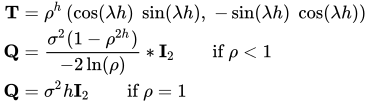
If  , the initial condition is nondiffuse:
 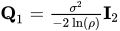 . For
. For  , the initial condition is fully diffuse.
The first element of corresponds to the needed cycle, and the second element is an auxiliary quantity. You can define a cycle term based on this state as follows:
  state cycleState(1) type=cycle(CT)  ...;
  component cycle = cycleState[1];
The CT option must be included in the use of TYPE=CYCLE.