SSM Procedure
Multivariate ARMA
You can specify a state vector that follows a multivariate autoregressive, moving average (VARMA) model by using the STATE statement option TYPE=VARMA. The autoregressive and moving average orders can be either 0 or 1 ( and
and  )—that is, only VAR(1), MA(1), and VARMA(1,1) models can be specified. The notation and the state space form of the VARMA model described here is taken from Reinsel (1997), which is a good reference for VARMA modeling.
A dim-dimensional vector process  follows a zero-mean, autoregressive order p, moving average order q (VARMA(p, q)) model if it satisfies the following matrix difference equation:
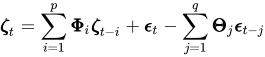
Here  and
and  are dim-dimensional square matrices and
  is a dim-dimensional, Gaussian, white noise sequence with covariance matrix
  . If autoregressive order p is 0, the term that involves
  is absent; similarly, if the moving average order q is 0, the term that involves is absent. Since AR and MA orders can be at most 1, the subscripts of and can be ignored in this discussion—when applicable, an AR coefficient matrix is denoted by
  and an MA coefficient matrix is denoted by
  . The unknown elements of
  , , and constitute the parameter vector that is associated with a VARMA state. The process defined by the VARMA difference equation is stationary and invertible (Reinsel 1997) if and only if the eigenvalues of and
  are strictly less than 1 in magnitude. By default, the SSM procedure imposes these stationarity and invertibility restrictions on and . However, you can specify to be an identity matrix, in which case the resulting process is nonstationary.
A VARMA model can be cast into a state space form. The state space form used by the SSM procedure is described in Reinsel (1997, pp. 52–53). The system matrices for the supported VARMA models are as follows:
The VAR(1) form is the simplest. In this case, the underlying state
 is the same as the VAR(1) process . Therefore,
  and
and  .
. -
Taking
equal to the zero matrix if  , the VARMA(1,1) and MA(1) cases can be treated together. In this case, the underlying state is 2*dim dimensional and the desired VARMA process corresponds to its first dim elements. Let
  . Then, in the blocked form,
Unless is restricted to be identity, the underlying state is stationary and the covariance of the initial condition is computed by

where  denotes the Kronecker product and the
  operation on a matrix creates a vector formed by vertically stacking the rows of that matrix. If is restricted to be identity, the initial condition is fully diffuse.