SSM Procedure
Trend Models for Regular Data
These models are applicable when the data type is either regular or regular with replication. A good reference for these models is Harvey (1989).
Random Walk Trend
This model provides a trend pattern in which the level of the curve changes with time. The rapidity of this change is inversely proportional to the disturbance variance  that governs the underlying state. It can be described as
  , where
  and the (one-dimensional) state
  follows a random walk:

Here  and
and  . The initial condition is fully diffuse. Note that if
  , the resulting trend is a fixed constant.
Local Linear Trend
This model provides a trend pattern in which both the level and the slope of the curve change with time. This variation in the level and the slope is controlled by two parameters:  controls the level variation, and
  controls the slope variation. If
  , the resulting trend is called an integrated random walk. If both and
  , then the resulting model is the deterministic linear time trend. Here
  ,
,  , and
, and  . The initial condition is fully diffuse.
Damped Local Linear Trend
This trend pattern is similar to the local linear trend pattern. However, in the DLL trend the slope follows a first-order autoregressive model, whereas in the LL trend the slope follows a random walk. The autoregressive parameter or the damping factor,  , must lie between 0.0 and 1.0, which implies that the long-run forecast according to this pattern has a slope that tends to 0. Here ,
  , and
, and  . The initial condition is partially diffuse with
  .
.
ARIMA Trend
This section describes the state space form for a component that follows an ARIMA(p,d,q) (P,D,Q)
 model. The notation for ARIMA models is explained in the TREND statement.
First the state space form for the stationary case—that is, when  and
and  , is explained. A number of alternate state space forms are possible in this case; the one described here is based on Jones (1980). With slight abuse of notation, let
  denote the effective autoregressive order, and let
  denote the effective moving average order of the model. Similarly, let be the effective autoregressive polynomial, and let
  be the effective moving average polynomial in the backshift operator with coefficients
  and
and  , obtained by multiplying the respective nonseasonal and seasonal factors. Then, a random sequence
  that follows an ARMA(p,q)(P,Q) model with a white noise sequence
  has a state space form with state vector of size
  . The system matrices are as follows:
  , and the transition matrix
  , in a blocked form, is given by
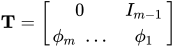
where  if
if  and
and  is an
is an  dimensional identity matrix. The covariance of the state disturbance matrix
  , where
  is the variance of the white noise sequence and the vector
  contains the first m values of the impulse response function—that is, the first m coefficients in the expansion of the ratio
  . The covariance matrix of the initial state,
  , is computed as

where  denotes the Kronecker product and the
  operation on a matrix creates a vector formed by vertically stacking the rows of that matrix.
A number of alternate state space forms are possible in the nonstationary case also. The form used by the SSM procedure utilizes the state space form for the stationary case as a building block. Suppose that a random sequence follows an ARIMA(p,d,q)(P,D,Q) model with a white noise sequence . As in the notation for the stationary case, with slight abuse of notation, let  denote the effective differencing order, and let
  be the effective differencing polynomial in the backshift operator with coefficients
  . It can be shown that has a state space form with state vector size
  . In what follows, the system matrices and related quantities in the nonstationary case are described in terms of similar entities in the stationary case. A superscript dagger (
 ) has been added to distinguish the entities from the nonstationary case.
  where the only nonzero value, 1, is at the index
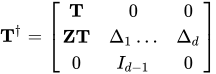
  , and the transition matrix,
  , in a blocked form, is given by
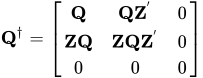
The state disturbance matrix  is given by
Finally, the initial state is partially diffuse: the first m elements are nondiffuse and the last d elements are diffuse. The covariance matrix of the first m elements is .