SSM Procedure
Smoothing Phase
After the filtering phase of KFS produces the one-step-ahead predictions of the response variables and the underlying state vectors, the smoothing phase of KFS produces the full-sample versions of these quantities—that is, rather than using the history up to  , the entire sample
  is used. The smoothing phase of KFS is a backward algorithm, which begins at
  and
and  and goes back toward
  and
and  . It produces the following quantities:
Table 8: KFS: Smoothing Phase
| Quantity | Description |
|---|---|
 |
Interpolated response value |
 |
Variance of the interpolated response value |
 |
Full-sample estimate of the state vector |
 |
Covariance of  |
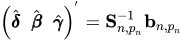 |
Full-sample estimates of  , ,  , and , and 
|
 |
Covariance of  |
Note that if  is not missing, then
  and
and  because
  is completely known, given . Therefore,
  provides nontrivial information only when is missing—in which case represents the best estimate of based on the available data. The full-sample estimates of components that are specified in the model equations are based on the corresponding linear combinations of . Similarly, their standard errors are computed by using appropriate functions of
  .
.
If the filtering process remains uninitialized until the end of the sample (that is, if  is not invertible), some linear combinations of , , and are not estimable. This, in turn, implies that some linear combinations of
  are also inestimable. These inestimable quantities are reported as missing. For more information about the estimability of the state effects, see Selukar (2010).