SSM Procedure
Filtering Pass
The filtering pass sequentially computes the quantities shown in Table 5 for  and
and  .
.
Table 5: KFS: Filtering Phase
| Quantity | Description |
|---|---|
 |
One-step-ahead prediction of the response values |
 |
One-step-ahead prediction residuals |
 |
Variance of the one-step-ahead prediction |
 |
One-step-ahead prediction of the state vector |
 |
Covariance of  |
 |
 -dimensional vector -dimensional vector |
 |
 -dimensional symmetric matrix -dimensional symmetric matrix |
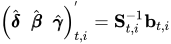 |
Estimates of  , ,  , and , and  by using the data up to by using the data up to  |
 |
Covariance of  |
 |
-dimensional symmetric matrix |
| needed in the marginal likelihood computation |
Here the notation  denotes the conditional expectation of
  given the history up to the index
  :
:  . Similarly
  denotes the corresponding conditional variance. The quantity
  is set to missing whenever
  is missing. Note that
  are one-step-ahead forecasts only when the model has only one response variable and the data are a time series; in all other cases it is more appropriate to call them one-measurement-ahead forecasts (since the next measurement might be at the same time point). Despite this, are called one-step-ahead predictions (and
  are called one-step-ahead residuals) throughout this document. In the diffuse case, the conditional expectations must be appropriately interpreted. The vector and the matrix contain some accumulated quantities that are needed for the estimation of , , and . Of course, when
  (the nondiffuse case), these quantities are not needed. In the diffuse case, because the matrix is sequentially accumulated (starting at
  ), it might not be invertible until some
  . The filtering process is called initialized after . In some situations, this initialization might not happen even after the entire sample is processed—that is, the filtering process remains uninitialized. This can happen if the regression variables are collinear or if the data are not sufficient to estimate the initial condition for some other reason. In the diffuse case if the marginal likelihood is to be computed (see the section Likelihood Computation and Model-Fitting Phase), an additional matrix (
 ) is computed at each step by sequential accumulation.
The filtering process is used for a variety of purposes. One important use of filtering is to compute the likelihood of the data. In the model-fitting phase, the unknown model parameters  are estimated by maximum likelihood. This requires repeated evaluation of the likelihood at different trial values of . After is estimated, it is treated as a known vector. The filtering process is used again with the fitted model in the forecasting phase, when the one-step-ahead forecasts and residuals based on the fitted model are provided. In addition, this filtering output is needed by the smoothing phase to produce the full-sample component estimates and for the structural break analysis.