SPECTRA Procedure
White Noise Test
PROC SPECTRA prints two test statistics for white noise when the WHITETEST option is specified: Fisher’s Kappa (Davis 1941; Fuller 1976) and Bartlett’s Kolmogorov-Smirnov statistic (Bartlett 1966; Fuller 1976; Durbin 1967).
If the time series is a sequence of independent random variables with mean 0 and variance  , then the periodogram,
  , will have the same expected value for all
  . For a time series with nonzero autocorrelation, each ordinate of the periodogram, , will have different expected values. The Fisher’s Kappa statistic tests whether the largest can be considered different from the mean of the . Critical values for the Fisher’s Kappa test can be found in Fuller 1976.
The Kolmogorov-Smirnov statistic reported by PROC SPECTRA has the same asymptotic distribution as Bartlett’s test (Durbin 1967). The Kolmogorov-Smirnov statistic compares the normalized cumulative periodogram with the cumulative distribution function of a uniform(0,1) random variable. The normalized cumulative periodogram,  , of the series is
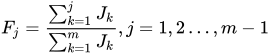
where  if n is even or
  if n is odd. The test statistic is the maximum absolute difference of the normalized cumulative periodogram and the uniform cumulative distribution function. Approximate p-values for Bartlett’s Kolmogorov-Smirnov test statistics are provided with the test statistics. Small p-values cause you to reject the null-hypothesis that the series is white noise.