SEVERITY Procedure
OUTPUT Statement
OUTPUT <OUT=SAS-data-set> output-options;
The OUTPUT statement specifies the data set to write the estimates of scoring functions and quantiles to. To specify the name of the output data set, use the following option:
To control the contents of the OUT= data set, specify the following output-options:
- COPYVARS=variable-list
-
specifies the names of the variables that you want to copy from the input DATA= data set to the OUT= data set. If you want to specify more than one name, then separate them by spaces.
If you specify the BY statement, then the BY variables are not automatically copied to the OUT= data set, so you must specify the BY variables in the COPYVARS= option.
- FUNCTIONS=(function<(arg)><=variable> <function<(arg)><=variable>> …)
-
specifies the scoring functions that you want to estimate. For each scoring function that you want to estimate, specify the suffix of the scoring function as the function. For each function that you specify in this option and for each distribution D that you specify in the DIST statement, the FCMP function D_function must be defined in the search path that you specify by using the CMPLIB= system option.
If you want to evaluate the scoring function at a specific value of the response variable, then specify a number arg, which is enclosed in parentheses immediately after the function. If you do not specify arg or if you specify a missing value as arg, then for each observation in the DATA= data set, PROC SEVERITY computes the value v by using the following table and evaluates the scoring function at v, where y, r, and l denote the values of the response variable, right-censoring limit, and left-censoring limit, respectively:
Right-Censored Left-Censored v No No y No Yes l Yes No r Yes Yes 
You can specify the suffix of the variable that contains the estimate of the scoring function by specifying a valid SAS name as a variable. If you do not specify a variable, then PROC SEVERITY uses function as the suffix of the variable name.
To illustrate the FUNCTIONS= option with an example, assume that you specify the following DIST and OUTPUT statements:
dist exp logn;
output out=score functions=(cdf pdf(1000)=f1000 mean);
Let both exponential (EXP) and lognormal (LOGN) distributions converge. If
 is the final estimate of the scale parameter of the exponential distribution, then PROC SEVERITY creates the following three scoring function variables for the exponential (EXP) distribution in the
 Work.Scoredata set:EXP_CDFcontains the CDF estimate
 , where
  denotes the CDF of the exponential distribution and v is the value that is determined by the preceding table.
 EXP_F1000contains the PDF estimate
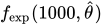 , where
  denotes the PDF of the exponential distribution.
 EXP_MEANcontains the mean of the exponential distribution for the scale parameter
.
Similarly, if
 and
and  are the final estimates of the log-scale and shape parameters of the lognormal distribution, respectively, then PROC SEVERITY creates the following three scoring function variables for the lognormal (LOGN) distribution in the
 Work.Scoredata set:LOGN_CDFcontains the CDF estimate
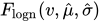 , where
  denotes the CDF of the lognormal distribution and v is the value that is determined by the preceding table.
 LOGN_F1000contains the probability density function (PDF) estimate
 , where
  denotes the PDF of the lognormal distribution.
 LOGN_MEANcontains the mean of the lognormal distribution for the parameters
and .
If you specify the SCALEMODEL statement, then the value of the scale parameter of a distribution depends on the values of the regression parameters. So it might be different for different observations. In this example, the values of
and might vary by observation, which might cause the values of the EXP_F1000,EXP_MEAN,LOGN_F1000, andLOGN_MEANvariables to vary by observation. The values of theEXP_CDFandLOGN_CDFvariables might vary not only because of the varying values of v but also because of the varying values of and . If you do not specify the SCALEMODEL statement, then the values of scoring functions for which you specify a nonmissing argument arg and scoring functions that do not depend on the response variable value do not vary by observation. In this example, the values of the
EXP_F1000,EXP_MEAN,LOGN_F1000, andLOGN_MEANvariables do not vary by observation.If a distribution does not converge, then the scoring function variables for that distribution contain missing values in all observations.
For more information about scoring functions, see the section Scoring Functions.
- QUANTILES=quantile-options
-
specifies the quantiles that you want to estimate. To use this option, for each distribution that you specify in the DIST statement, the FCMP function D_QUANTILE must be defined in the search path that you specify by using the CMPLIB= system option.
You can specify the following quantile-options:
-
CDF=CDF-values
POINTS=CDF-values specifies the CDF values at which you want to estimate the quantiles. CDF-values can be one or more numbers, separated by spaces. Each number must be in the interval (0,1).
- NAMES=variable-names
specifies the suffixes of the names of the variables for each of the quantile estimates. If you specify n (
 ) names in the variable-names option and k values in the CDF= option, and if
  , then PROC SEVERITY uses the n names to name the variables that correspond to the first n CDF values. For each of the remaining
  CDF values,
  (
( ), PROC SEVERITY creates a variable name
 Pt, wheretis the text representation of that is formed by retaining at most NDECIMAL= digits after the decimal point and replacing the decimal point with an underscore ('_').
 - NDECIMAL=number
specifies the number of digits to keep after the decimal point when PROC SEVERITY creates the name of the quantile estimate variable. If you do not specify this option, then the default value is 3.
For example, assume that you specify the following DIST and OUTPUT statements:
dist burr;
output out=score quantiles=(cdf=0.9 0.975 0.995 names=ninety var);
PROC SEVERITY creates three quantile estimate variables,
BURR_NINETY,BURR_VAR, andBURR_P99_5, in theWork.Scoredata set for the Burr distribution. These variables contain the estimates of , for p = 0.9, 0.975, and 0.995, respectively, where
  denotes the quantile function and ,
  , and
, and  denote the parameter estimates of the Burr distribution.
 If you specify the SCALEMODEL statement, then the quantile estimate might vary by observation, because the scale parameter of a distribution depends on the values of the regression parameters.
If you do not specify the SCALEMODEL statement, then the quantile estimates do not vary by observation, and if you do not specify any scoring functions in the FUNCTIONS= option whose estimates vary by observation, then the OUT= data set contains only one observation per BY group.
If a distribution does not converge, then the quantile estimate variables for that distribution contain missing values for all observations.
-
CDF=CDF-values
For more information about the variables and observations in the OUT= data set, see the section OUT= Data Set.