PANEL Procedure

Tests for Cross-Sectional Dependence

Breusch-Pagan LM Test

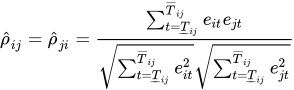
Breusch and Pagan (1980) propose a Lagrange multiplier (LM) statistic to test the null hypothesis of zero cross-sectional error correlations. Let e Subscript i t be the OLS estimate of the error term u Subscript i t under the null hypothesis. Then the pairwise cross-sectional correlations can be estimated by the sample counterparts ModifyingAbove rho With caret Subscript i j,

ModifyingAbove rho With caret Subscript i j Baseline equals ModifyingAbove rho With caret Subscript j i Baseline equals StartFraction sigma-summation Underscript t equals upper T underbar Subscript i j Baseline Overscript upper T overbar Subscript i j Baseline Endscripts e Subscript i t Baseline e Subscript j t Baseline Over StartRoot sigma-summation Underscript t equals upper T underbar Subscript i j Baseline Overscript upper T overbar Subscript i j Baseline Endscripts e Subscript i t Superscript 2 Baseline EndRoot StartRoot sigma-summation Underscript t equals upper T underbar Subscript i j Baseline Overscript upper T overbar Subscript i j Baseline Endscripts e Subscript j t Superscript 2 Baseline EndRoot EndFraction

where upper T underbar Subscript i j and upper T overbar Subscript i j are the lower bound and upper bound, respectively, which mark the overlap time periods for the cross sections i and j. If the panel is balanced, upper T underbar Subscript i j Baseline equals 1 and upper T overbar Subscript i j Baseline equals upper T. Let upper T Subscript i j denote the number of overlapped time periods (upper T Subscript i j Baseline equals upper T overbar Subscript i j Baseline minus upper T underbar Subscript i j Baseline plus 1). Then the Breusch-Pagan LM test statistic can be constructed as

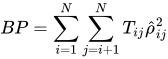
upper B upper P equals sigma-summation Underscript i equals 1 Overscript upper N Endscripts sigma-summation Underscript j equals i plus 1 Overscript upper N Endscripts upper T Subscript i j Baseline ModifyingAbove rho With caret Subscript i j Superscript 2

When N is fixed and upper T Subscript i j Baseline right-arrow normal infinity, upper B upper P right-arrow chi squared left-parenthesis upper N left-parenthesis upper N minus 1 right-parenthesis slash 2 right-parenthesis. So the test is not applicable as upper N right-arrow normal infinity.

Because ModifyingAbove rho With caret Subscript i j Superscript 2 Baseline comma i equals 1 comma ellipsis comma upper N minus 1 comma j equals i plus 1 comma ellipsis comma upper N, are asymptotically independent under the null hypothesis of zero cross-sectional correlation, upper T Subscript i j Baseline ModifyingAbove rho With caret Subscript i j Superscript 2 Baseline right-arrow chi squared left-parenthesis 1 right-parenthesis. Then the following modified Breusch-Pagan LM statistic can be considered to test for cross-sectional dependence:
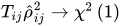

upper B upper P left-parenthesis normal s right-parenthesis equals StartRoot StartFraction 1 Over upper N left-parenthesis upper N minus 1 right-parenthesis EndFraction EndRoot sigma-summation Underscript i equals 1 Overscript upper N Endscripts sigma-summation Underscript j equals i plus 1 Overscript upper N Endscripts left-parenthesis upper T Subscript i j Baseline ModifyingAbove rho With caret Subscript i j Superscript 2 Baseline minus 1 right-parenthesis

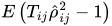
Under the null hypothesis, upper B upper P left-parenthesis normal s right-parenthesis right-arrow script upper N left-parenthesis 0 comma 1 right-parenthesis as upper T Subscript i j Baseline right-arrow normal infinity, and then upper N right-arrow normal infinity. But because upper E left-parenthesis upper T Subscript i j Baseline ModifyingAbove rho With caret Subscript i j Superscript 2 Baseline minus 1 right-parenthesis is not correctly centered at zero for finite upper T Subscript i j, the test is likely to exhibit substantial size distortion for large N and small upper T Subscript i j.

Pesaran CD and CDp Test

Pesaran (2004) proposes a cross-sectional dependence test that is also based on the pairwise correlation coefficients ModifyingAbove rho With caret Subscript i j,

upper C upper D equals StartRoot StartFraction 2 Over upper N left-parenthesis upper N minus 1 right-parenthesis EndFraction EndRoot sigma-summation Underscript i equals 1 Overscript upper N Endscripts sigma-summation Underscript j equals i plus 1 Overscript upper N Endscripts StartRoot upper T Subscript i j Baseline EndRoot ModifyingAbove rho With caret Subscript i j

The test statistic has a zero mean for fixed N and upper T Subscript i j under a wide class of panel data models, including stationary or unit root heterogeneous dynamic models that are subject to multiple breaks. For each i not-equals j, as upper T Subscript i j Baseline right-arrow normal infinity, StartRoot upper T Subscript i j Baseline EndRoot ModifyingAbove rho With caret Subscript i j Baseline long right double arrow script upper N left-parenthesis 0 comma 1 right-parenthesis. Therefore, for N and upper T Subscript i j tending to infinity in any order, upper C upper D long right double arrow script upper N left-parenthesis 0 comma 1 right-parenthesis.

To enhance the power against the alternative hypothesis of local dependence, Pesaran (2004) proposes the CD(p) test. Local dependence is defined with respect to a weight matrix, bold upper W equals left-parenthesis w Subscript i j Baseline right-parenthesis. Therefore, the test can be applied only if the cross-sectional units can be given an ordering that remains immutable over time. Under the alternative hypothesis of a pth-order local dependence, the CD statistic can be generalized to a local CD test, CD(p),

StartLayout 1st Row 1st Column upper C upper D left-parenthesis normal p right-parenthesis 2nd Column equals 3rd Column left-bracket StartFraction 2 Over p left-parenthesis 2 upper N minus p minus 1 right-parenthesis EndFraction right-bracket Superscript 1 slash 2 Baseline sigma-summation Underscript s equals 1 Overscript p Endscripts sigma-summation Underscript i equals s plus 1 Overscript upper N Endscripts StartRoot upper T Subscript i comma i minus s Baseline EndRoot ModifyingAbove rho With caret Subscript i comma i minus s 2nd Row 1st Column Blank 2nd Column equals 3rd Column left-bracket StartFraction 2 Over p left-parenthesis 2 upper N minus p minus 1 right-parenthesis EndFraction right-bracket Superscript 1 slash 2 Baseline sigma-summation Underscript s equals 1 Overscript p Endscripts sigma-summation Underscript i equals 1 Overscript upper N minus s Endscripts StartRoot upper T Subscript i comma i plus s Baseline EndRoot ModifyingAbove rho With caret Subscript i comma i plus s EndLayout

where p equals 1 comma ellipsis comma upper N minus 1. When p equals upper N minus 1, CD(p) reduces to the original CD test. Under the null hypothesis of zero cross-sectional dependence, the CD(p) statistic is centered at zero for fixed N and upper T Subscript i comma i minus s Baseline greater-than k plus 1, and upper C upper D left-parenthesis normal p right-parenthesis long right double arrow script upper N left-parenthesis 0 comma 1 right-parenthesis as upper N right-arrow normal infinity and upper T Subscript i comma i plus s Baseline right-arrow normal infinity.

Last updated: June 19, 2025