PANEL Procedure
R-Square
The R-square statistic is the proportion of variability in the dependent variable that is attributed to the independent variables. Because of the transformations that are used prior to fitting the final regression model, the conventional R-square measure is not appropriate for most models that the PANEL procedure supports. In random-effects models that use a GLS transform, PROC PANEL calculates the modified R-square statistic proposed by Buse (1973),
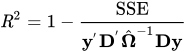
where  is the error sum of squares from the final model fit,
  represents the GLS transform, and
  for
for 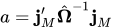 .
.
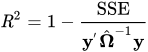
In GLS models that do not have an intercept, the alternate R-square measure, which is attributed to Theil (1961), is calculated as follows:
In fixed-effects models, the R-square measure is
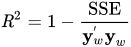
where  is the within-transformed dependent variable.
In the case of pooled OLS estimation, all three of the R-square formulas reduce to the usual R-square statistic for linear models.