PANEL Procedure
Linear Hypothesis Testing
Consider a linear hypothesis of the form  , where
  is
is  and
and  is
is  . The Wald test statistic is

where  is the estimated variance of
  .
.
In simple linear models, the Wald test statistic is equal to the F test statistic
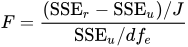
where  is the restricted error sum of squares,
  is the unrestricted error sum of squares, and
  is the unrestricted error degrees of freedom.
The F statistic represents a more direct comparison of the restricted model to the unrestricted model. Comparing error sums of squares is appealing in complex models for which restrictions are applied not only during the final regression but also during intermediate calculations.
The likelihood ratio (LR) test and the Lagrange multiplier (LM) test are derived from the F statistic. The LR test statistic is
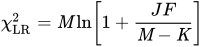
The LM test statistic is
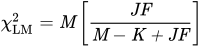
The distribution of these test statistics is  with J degrees of freedom. The three tests are asymptotically equivalent, but they possess different small-sample properties. For more information, see Greene (2000, p. 392) and Davidson and MacKinnon (1993, pp. 456–458).
Only the Wald is changed when a heteroscedasticity-corrected covariance matrix estimator (HCCME) is selected. The LR and LM tests are unchanged.