PANEL Procedure
Two-Way Fixed-Effects Model (FIXTWO Option)
You perform two-way fixed-effects estimation by specifying the FIXTWO option in the MODEL statement. The error specification for the two-way fixed-effects model is

where the  and
and  are nonrandom parameters to be estimated.
Estimation is similar to that for one-way fixed effects, for which a within transformation is used to convert the problem to OLS regression. For two-way models under the general case of unbalanced data, the within transformation is more complex.
Following Wansbeek and Kapteyn (1989) and Baltagi (2013, sec. 9.4), let  and
and  be versions of
  and
and  whose rows are sorted by time period, and by cross section within each time period. With the data sorted in this manner, define
  to be the
  design matrix for cross sections. Each row of contains a 1 in the column that corresponds to that observation’s cross section, and 0s in the remaining columns. Similarly, define
  to be the
  design matrix for time periods. In balanced data,
  and
and  .
.
Define the following:
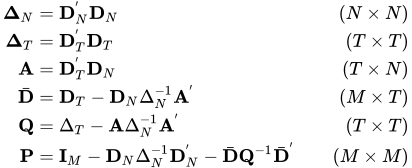
The matrix  provides the two-way within transformation. If the data are balanced, this amounts to transforming any data value
  to
to  .
.
Applying the two-way within transformation means that you can use OLS regression of  on
on  to obtain
  ,
,  , and fit statistics such as mean square error (MSE), provided that you adjust the error degrees of freedom to equal
  .
.
Define the residual vector  . Estimates of the time effects are
 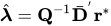 , and estimates of the cross-sectional effects are
  , where
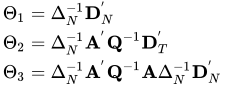
The full model that contains the intercept, N cross-sectional effects, and T time effects is overidentified, and simultaneous estimation of these quantities is not possible without restrictions. If you specify the PRINTFIXED option, the printed fixed effects reflect these restrictions.
If the model has an intercept, then the PRINTFIXED option output is parameterized as follows:
Intercept:

Cross section i:

Time period t:

If the model does not include an intercept, then the PRINTFIXED option output is parameterized as follows:
Cross section i:

Time period t:
Variance and covariance estimates for the intercept and printed fixed effects are obtained by the delta method, because each of these quantities is a linear transformation of and .