PANEL Procedure
Common Notation
This section presents notation that is common to all subsequent sections. Consider the panel regression:

The total number of observations is 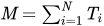 . For balanced data,
  for all
  . For unbalanced data, define T to be the number of unique time periods.
The exact representation of  and the underlying assumptions depend on the estimation method.
In matrix notation the model is

where  is a
is a  row vector of independent variables and
  is the
  vector of coefficients. Let
  and
and  be matrices that are formed by arranging the dependent and independent variables by cross section, and by time within each cross section. Let
  be the
  matrix augmented by a first column of ones, which corresponds to the intercept term
  .
.
Define the following utility matrices:
 is an identity matrix of dimension p.
  is a
is a  column vector of ones.
  is a matrix of ones of dimension p.
  .
. 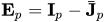 .
.
In the following sections, the panel data are assumed to be unbalanced unless otherwise indicated. If the data are balanced, the formulas reduce appropriately.