MODEL Procedure
Example 24.9 Circuit Estimation
(View the complete code for this example.)
Consider the nonlinear circuit shown in Output 24.9.1.
Output 24.9.1: Nonlinear Resistor Capacitor Circuit
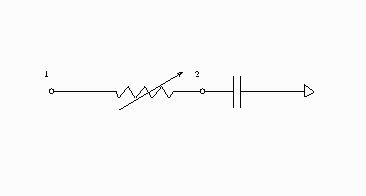
The theory of electric circuits is governed by Kirchhoff’s laws: the sum of the currents flowing to a node is zero, and the net voltage drop around a closed loop is zero. In addition to Kirchhoff’s laws, there are relationships between the current I through each element and the voltage drop V across the elements. For the circuit in Output 24.9.1, the relationships are

for the capacitor and

for the nonlinear resistor. The following differential equation describes the current at node 2 as a function of time and voltage for this circuit:

This equation can be written in the form

Consider the following data:
data circ;
   input v2 v1 time@@;
datalines;
-0.00007 0.0 0.0000000001 0.00912 0.5 0.0000000002
 0.03091 1.0 0.0000000003 0.06419 1.5 0.0000000004
 0.11019 2.0 0.0000000005 0.16398 2.5 0.0000000006
 0.23048 3.0 0.0000000007 0.30529 3.5 0.0000000008
 0.39394 4.0 0.0000000009 0.49121 4.5 0.0000000010
 0.59476 5.0 0.0000000011 0.70285 5.0 0.0000000012
 0.81315 5.0 0.0000000013 0.90929 5.0 0.0000000014
 1.01412 5.0 0.0000000015 1.11386 5.0 0.0000000016
 1.21106 5.0 0.0000000017 1.30237 5.0 0.0000000018
 1.40461 5.0 0.0000000019 1.48624 5.0 0.0000000020
 1.57894 5.0 0.0000000021 1.66471 5.0 0.0000000022
;
You can estimate the parameters in the preceding equation by using the following SAS statements:
title1 'Circuit Model Estimation Example';

proc model data=circ mintimestep=1.0e-23;
   parm R2 2000  R1 4000 C 5.0e-13;
   dert.v2 = (v1-v2)/((r1 + r2*(1-exp( -(v1-v2)))) * C);
   fit v2;
run;
The results of the estimation are shown in Output 24.9.2.
Output 24.9.2: Circuit Estimation
| Circuit Model Estimation Example |
| Nonlinear OLS Parameter Estimates | ||||
|---|---|---|---|---|
| Parameter | Estimate | Approx Std Err | t Value | Approx Pr > |t| |
| R2 | 3002.471 | 1517.1 | <------ | Biased |
| R1 | 4984.842 | 1466.8 | <------ | Biased |
| C | 5E-13 | 0 | <------ | Biased |
| Note: | The model was singular. Some estimates are marked 'Biased'. |
In this case, the model equation is such that there is linear dependency that causes biased results and inflated variances. The Jacobian matrix is singular or nearly singular, but eliminating one of the parameters is not a solution in this case.