MODEL Procedure
Limitations
There are limitations to the types of differential equations that can be solved or estimated. One type is an explosive differential equation (finite escape velocity) for which the following differential equation is an example:

If this differential equation is integrated too far in time,  exceeds the maximum value allowed on the computer, and the integration terminates.
Likewise, differential systems that are singular cannot be solved or estimated in general. For example, consider the following differential system:
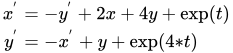
This system has an analytical solution, but an accurate numerical solution is very difficult to obtain. The reason is that  and
and  cannot be isolated on the left-hand side of the equation. If the equation is modified slightly to
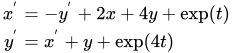
then the system is nonsingular, but the integration process could still fail or be extremely slow. If the MODEL procedure encounters either system, a warning message is issued.
This system can be rewritten as the following recursive system, which can be estimated and simulated successfully with the MODEL procedure:

Petzold (1982) mentions a class of differential algebraic equations that, when integrated numerically, could produce incorrect or misleading results. An example of such a system is
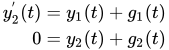
The analytical solution to this system depends on  and its derivatives at the current time only and not on its initial value or past history. You should avoid systems of this and other similar forms mentioned in Petzold (1982).