MODEL Procedure
Iteration History
The options ITPRINT, ITDETAILS, XPX, I, and ITALL specify a detailed listing of each iteration of the minimization process.
ITPRINT Option
The ITPRINT information is selected whenever any iteration information is requested.
The following information is displayed for each iteration:
- N
is the number of usable observations.
- Objective
is the corrected objective function value.
- Trace(S)
is the trace of the S matrix.
- subit
is the number of subiterations required to find a
 or a damping factor that reduces the objective function.
 - R
is the R convergence measure.
The estimates for the parameters at each iteration are also printed.
ITDETAILS Option
The additional values printed for the ITDETAILS option are as follows:
- Theta
is the angle in degrees between
 , the parameter change vector, and the negative gradient of the objective function.
 - Phi
is the directional derivative of the objective function in the
direction scaled by the objective function. - Stepsize
is the value of the damping factor used to reduce
if the Gauss-Newton method is used. - Lambda
is the value of
 if the Marquardt method is used.
 - Rank(XPX)
is the rank of the
 matrix (output if the projected Jacobian crossproducts matrix is singular).
The definitions of PPC and R are explained in the section Convergence Criteria. When the values of PPC are large, the parameter associated with the criteria is displayed in parentheses after the value.
XPX and I Options
The XPX and the I options select the printing of the augmented  matrix and the augmented matrix after a sweep operation (Goodnight 1979) has been performed on it. An example of the output from the following statements is shown in Figure 36:
proc model data=test2;
   y1 = a1 * x2 * x2 - exp( d1*x1);
   y2 = a2 * x1 * x1 + b2 * exp( d2*x2);
   fit y1 y2 / itall XPX I ;
run;
Figure 36: XPX and I Options Output
| Cross Products for System At OLS Iteration 0 | ||||||
|---|---|---|---|---|---|---|
| a1 | d1 | a2 | b2 | d2 | Residual | |
| a1 | 1839468 | -33818.35 | 0.0 | 0.00 | 0.000000 | 3879959 |
| d1 | -33818 | 1276.45 | 0.0 | 0.00 | 0.000000 | -76928 |
| a2 | 0 | 0.00 | 42925.0 | 1275.15 | 0.154739 | 470686 |
| b2 | 0 | 0.00 | 1275.2 | 50.01 | 0.003867 | 16055 |
| d2 | 0 | 0.00 | 0.2 | 0.00 | 0.000064 | 2 |
| Residual | 3879959 | -76928.14 | 470686.3 | 16055.07 | 2.329718 | 24576144 |
| XPX Inverse for System At OLS Iteration 0 | ||||||
|---|---|---|---|---|---|---|
| a1 | d1 | a2 | b2 | d2 | Residual | |
| a1 | 0.000001 | 0.000028 | 0.000000 | 0.0000 | 0.00 | 2 |
| d1 | 0.000028 | 0.001527 | 0.000000 | 0.0000 | 0.00 | -9 |
| a2 | 0.000000 | 0.000000 | 0.000097 | -0.0025 | -0.08 | 6 |
| b2 | 0.000000 | 0.000000 | -0.002455 | 0.0825 | 0.95 | 172 |
| d2 | 0.000000 | 0.000000 | -0.084915 | 0.9476 | 15746.71 | 11931 |
| Residual | 1.952150 | -8.546875 | 5.823969 | 171.6234 | 11930.89 | 10819902 |
The first matrix, labeled "Cross Products," for OLS estimation is
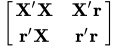
The column labeled Residual in the output is the vector  , which is the gradient of the objective function. The diagonal scalar value
  is the objective function uncorrected for degrees of freedom. The second matrix, labeled "XPX Inverse," is created through a sweep operation on the augmented matrix to get

Note that the residual column is the change vector used to update the parameter estimates at each iteration. The corner scalar element is used to compute the R convergence criteria.
ITALL Option
The ITALL option, in addition to causing the output of all of the preceding options, outputs the S matrix, the inverse of the S matrix, the CROSS matrix, and the swept CROSS matrix. An example of a portion of the CROSS matrix for the preceding example is shown in Figure 37.
Figure 37: ITALL Option Crossproducts Matrix Output
| Crossproducts Matrix At OLS Iteration 0 | ||||||||
|---|---|---|---|---|---|---|---|---|
| 1 | @PRED.y1/@a1 | @PRED.y1/@d1 | @PRED.y2/@a2 | @PRED.y2/@b2 | @PRED.y2/@d2 | RESID.y1 | RESID.y2 | |
| 1 | 50.00 | 6409 | -239.16 | 1275.0 | 50.00 | 0.003803 | 14700 | 16053 |
| @PRED.y1/@a1 | 6409.08 | 1839468 | -33818.35 | 187766.1 | 6409.88 | 0.813934 | 3879959 | 4065028 |
| @PRED.y1/@d1 | -239.16 | -33818 | 1276.45 | -7253.0 | -239.19 | -0.026177 | -76928 | -85084 |
| @PRED.y2/@a2 | 1275.00 | 187766 | -7253.00 | 42925.0 | 1275.15 | 0.154739 | 420583 | 470686 |
| @PRED.y2/@b2 | 50.00 | 6410 | -239.19 | 1275.2 | 50.01 | 0.003867 | 14702 | 16055 |
| @PRED.y2/@d2 | 0.00 | 1 | -0.03 | 0.2 | 0.00 | 0.000064 | 2 | 2 |
| RESID.y1 | 14699.97 | 3879959 | -76928.14 | 420582.9 | 14701.77 | 1.820356 | 11827102 | 12234106 |
| RESID.y2 | 16052.76 | 4065028 | -85083.68 | 470686.3 | 16055.07 | 2.329718 | 12234106 | 12749042 |