HPQLIM Procedure
PROC HPQLIM Statement
PROC HPQLIM options;
The PROC HPQLIM statement invokes the HPQLIM procedure. You can specify the following options.
Data Set Options
Output Data Set Options
Printing Options
Model Estimation Options
Optimization Control Options
PROC HPQLIM uses the nonlinear optimization (NLO) subsystem to perform nonlinear optimization tasks. You can specify the following options:
-
ABSCONV=r
ABSTOL=r specifies an absolute function value convergence criterion by which minimization stops when
 . The default value of r is the negative square root of the largest double-precision value, which serves only as a protection against overflows.
 -
ABSFCONV=r
ABSFTOL=r -
specifies an absolute function difference convergence criterion by which minimization stops when the function value has a small change in successive iterations:

The default value is
 .
. -
ABSGCONV=r
ABSGTOL=r -
specifies an absolute gradient convergence criterion. Optimization stops when the maximum absolute gradient element is small:
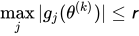
The default value is r=1E–5.
-
ABSXCONV=r
ABSXTOL=r -
specifies an absolute parameter convergence criterion. Optimization stops when the Euclidean distance between successive parameter vectors is small:

The default is 0.
-
FCONV=r
FTOL=r -
specifies a relative function convergence criterion. Optimization stops when a relative change of the function value in successive iterations is small:
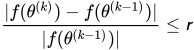
The default value is
 , where
  denotes the machine precision constant, which is the smallest double-precision floating-point number such that
  .
. -
GCONV=r
GTOL=r -
specifies a relative gradient convergence criterion. For all techniques except CONGRA, optimization stops when the normalized predicted function reduction is small:
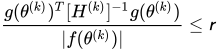
For the CONGRA technique (where a reliable Hessian estimate H is not available), the following criterion is used:

The default value is
 1E–8.
1E–8. -
MAXFUNC=i
MAXFU=i -
specifies the maximum number of function calls in the optimization process. The default is 1,000.
The optimization can terminate only after completing a full iteration. Therefore, the number of function calls that are actually performed can exceed the number of calls that are specified by this option.
-
MAXITER=i
MAXIT=i specifies the maximum number of iterations in the optimization process. The default is 200.
- MAXTIME=r
specifies an upper limit of r seconds of CPU time for the optimization process. The default value is the largest floating-point double representation of your computer. The time that is specified by this option is checked only once at the end of each iteration. Therefore, the actual running time can be much longer than r. The actual running time includes the remaining time needed to finish the iteration and the time needed to generate the output of the results.
Plotting Options
Global Plot Options
You can specify the following global-plot-options:
Plot Requests
You can specify the following plot-requests: