HPQLIM Procedure
Prior Distributions
The PRIOR statement specifies the prior distribution of the model parameters. You must specify one parameter or a list of parameters, a tilde  , and then a distribution with its parameters. You can specify multiple PRIOR statements to define independent priors. Parameters that are associated with a regressor variable are referred to by the name of the corresponding regressor variable.
You can specify the special keyword _REGRESSORS to consider all the regressors of a model. If multiple PRIOR statements affect the same parameter, the last PRIOR statement prevails. For example, in a regression with two regressors (X1, X2), the following statements imply that the prior on X1 is NORMAL(MEAN=0, VAR=1) and the prior on X2 is GAMMA(SHAPE=3, SCALE=4):
...
prior _Regressors ~ uniform(min=0, max=1);
prior X1 X2 ~ gamma(shape=3, scale=4);
prior X1 ~ normal(mean=0, var=1);
...
If a parameter is not associated with a PRIOR statement or if some of the prior hyperparameters are missing, then the default choices in Table 3 are considered.
Table 3: Default Values for Prior Distributions
| PRIOR Distribution |  |
 |
 |
 |
Parameters Default Choice |
|---|---|---|---|---|---|
| NORMAL |
MEAN=0 |
VAR=1E6 |
 |
 |
 |
| IGAMMA |
SHAPE=2.000001 |
SCALE=1 |
 |
|
 |
| GAMMA |
SHAPE=1 |
SCALE=1 |
 |
|
|
| UNIFORM | |
|
|||
| BETA |
SHAPE1=1 |
SHAPE2=1 |
|
|
|
| T |
LOCATION=0 |
DF=3 |
|
|
For density specification, see the section Standard Distributions.
Standard Distributions
Table 4 through Table 9 show all the distribution density functions that PROC HPQLIM recognizes. You specify these distribution densities in the PRIOR statement.
Table 4: Beta Distribution
| PRIOR statement | BETA(SHAPE1=a, SHAPE2=b, MIN=m, MAX=M) |
Note: Commonly  and and  . . |
|
| Density | 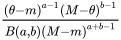 |
| Parameter restriction |  , ,  , , 
|
| Range | 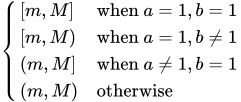 |
| Mean |  |
| Variance |  |
| Mode | 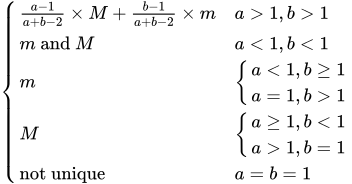 |
| Defaults | SHAPE1=SHAPE2=1,  , , 
|
Table 5: Gamma Distribution
| PRIOR statement | GAMMA(SHAPE=a, SCALE=b) |
| Density | 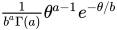
|
| Parameter restriction | 
|
| Range |  |
| Mean |  |
| Variance |  |
| Mode |  |
| Defaults | SHAPE=SCALE=1 |
Table 6: Inverse Gamma Distribution
| PRIOR statement | IGAMMA(SHAPE=a, SCALE=b) |
| Density | 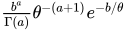
|
| Parameter restriction | 
|
| Range | 
|
| Mean | 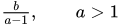 |
| Variance | 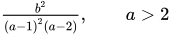 |
| Mode |  |
| Defaults | SHAPE=2.000001, SCALE=1 |
Table 7: Normal Distribution
| PRIOR statement | NORMAL(MEAN= , VAR= , VAR= ) ) |
| Density | 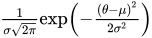
|
| Parameter restriction | 
|
| Range | 
|
| Mean | |
| Variance | |
| Mode | |
| Defaults | MEAN=0, VAR=1000000 |
Table 8: t Distribution
| PRIOR statement | T(LOCATION=, DF= ) ) |
| Density | 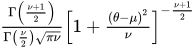
|
| Parameter restriction | 
|
| Range |
|
| Mean |  |
| Variance | 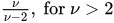 |
| Mode | |
| Defaults | LOCATION=0, DF=3 |
Table 9: Uniform Distribution
| PRIOR statement | UNIFORM(MIN=m, MAX=M) |
| Density | 
|
| Parameter restriction |
|
| Range | 
|
| Mean | 
|
| Variance |  |
| Mode | Not unique |
| Defaults | MIN , MAX , MAX
|