COPULA Procedure
Hierarchical Archimedean Copula (HAC)
Adopting the notations of Savu and Trede (2010), let L denote the total level of hierarchies and let D denote the dimension of the HAC. There are  distinct copulas at each level
  . These copulas are indexed by
  . At each level, there are also
  variables,
  and
and  . In the first step, all the variables at the lowest level are grouped into
  subsets, each subset being an ordinary multivariate Archimedean copula

where  is the generator of copula
  ,
,  denotes the variables that belong to copula , and the sum
  is the sum over each variable in the subset . The copulas can be different Archimedean copulas for
  . Then at the second level, the copulas that are derived in the first level are aggregated as if they are individual variables. Suppose there are
  copulas and
  variables,

where  denotes the generator of
  and
and  represents the subset of copulas in
  , that is aggregated for copula for
  . This structure continues until at level
  a single copula
  aggregates all the copulas at its previous level,
  .
.
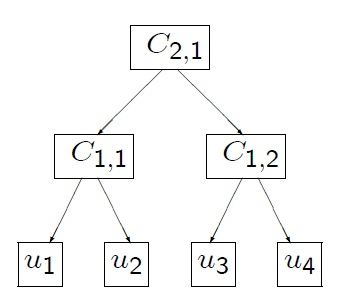
A four-dimensional example that has total levels  and a structure shown in Figure 5 is defined as follows:

Figure 5: Example Four-Dimensional Hierarchical Structure with Two Levels
Theorem 4.4 of McNeil (2008) states that the sufficient condition for a general hierarchical Archimedean structure to be a proper copula is that all appearing nodes of the form  have completely monotone derivatives. This condition places certain constraints on the copula parameters. In particular, if all the copulas in a hierarchical structure come from the Frank, Clayton, or Gumbel family, then
  for all j when
  . Intuitively, this means that rank correlation must be increasing as you move down the hierarchical structure.
The hierarchical Archimedean copulas available in the COPULA procedure are the hierarchical versions of the Clayton, Frank, and Gumbel copulas.
Simulation
A slightly modified version of the recursive algorithm from McNeil (2008) works for all valid hierarchical structures that have Clayton, Frank, or Gumbel generators:
Start at
, and generate a random variable V with the distribution function F with Laplace transform  .
. For
 , generate
  from its parent hierarchy. For
  , recursively call this algorithm with the proper inner generators that correspond to the copula family.
 Return
 .
.
Let  be the outer generator and
  the nested generator, and let
  and
and  be the respective generator parameters. Let v be a draw from distribution function F with Laplace transform
  . The inner copula generators
  and their corresponding Laplace transform distributions for the Clayton, Frank, and Gumbel family are summarized in Table 3.
Table 3: Inner Generators and Corresponding Distributions
| Copula Type |  |
Distribution with LT 
|
|---|---|---|
| Clayton |  |
Tiled stable |
| Gumbel | 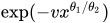 |
Stable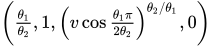
|
| Frank |  |
No closed form |
Note that when  , the inner generators for the Clayton and Gumbel family both simplify to the generator of the independence copula,
  . For more information about simulating from the distribution with the Laplace transform given by the inner generator for the Frank family, see Hofert (2011). For more information about how to simulate from a tilted stable distribution, see McNeil (2008).