COPULA Procedure

Archimedean Copulas

Overview of Archimedean Copulas

Let function phi colon left-bracket 0 comma 1 right-bracket right-arrow left-bracket 0 comma normal infinity right-parenthesis be a strict Archimedean copula generator function and suppose its inverse phi Superscript negative 1 is completely monotonic on left-bracket 0 comma normal infinity right-parenthesis. A strict generator is a decreasing function phi colon left-bracket 0 comma 1 right-bracket right-arrow left-bracket 0 comma normal infinity right-parenthesis that satisfies phi left-parenthesis 0 right-parenthesis equals normal infinity and phi left-parenthesis 1 right-parenthesis equals 0. A decreasing function f left-parenthesis t right-parenthesis colon left-bracket a comma b right-bracket right-arrow left-parenthesis negative normal infinity comma normal infinity right-parenthesis is completely monotonic if it satisfies



left-parenthesis negative 1 right-parenthesis Superscript k Baseline StartFraction d Superscript k Baseline Over d t Superscript k Baseline EndFraction f left-parenthesis t right-parenthesis greater-than-or-equal-to 0 comma k element-of double-struck upper N comma t element-of left-parenthesis a comma b right-parenthesis

An Archimedean copula is defined as follows:

upper C left-parenthesis u 1 comma u 2 comma ellipsis comma u Subscript m Baseline right-parenthesis equals phi Superscript negative 1 Baseline left-parenthesis phi left-parenthesis u 1 right-parenthesis plus midline-horizontal-ellipsis plus phi left-parenthesis u Subscript m Baseline right-parenthesis right-parenthesis

The Archimedean copulas available in the COPULA procedure are the Clayton copula, the Frank copula, and the Gumbel copula.


Clayton Copula

Let the generator function phi left-parenthesis u right-parenthesis equals theta Superscript negative 1 Baseline left-parenthesis u Superscript negative theta Baseline minus 1 right-parenthesis. A Clayton copula is defined as

upper C Subscript theta Baseline left-parenthesis u 1 comma u 2 comma ellipsis comma u Subscript m Baseline right-parenthesis equals left-bracket sigma-summation Underscript i equals 1 Overscript m Endscripts u Subscript i Superscript negative theta Baseline minus m plus 1 right-bracket Superscript negative 1 slash theta

with theta greater-than 0.

Frank Copula

Let the generator function be

phi left-parenthesis u right-parenthesis equals minus log left-bracket StartFraction exp left-parenthesis minus theta u right-parenthesis minus 1 Over exp left-parenthesis negative theta right-parenthesis minus 1 EndFraction right-bracket

A Frank copula is defined as

upper C Subscript theta Baseline left-parenthesis u 1 comma u 2 comma ellipsis comma u Subscript m Baseline right-parenthesis equals StartFraction 1 Over theta EndFraction log left-brace 1 plus StartFraction product Underscript i equals 1 Overscript m Endscripts left-bracket exp left-parenthesis minus theta u Subscript i Baseline right-parenthesis minus 1 right-bracket Over left-bracket exp left-parenthesis negative theta right-parenthesis minus 1 right-bracket Superscript m minus 1 Baseline EndFraction right-brace

with theta element-of left-parenthesis negative normal infinity comma normal infinity right-parenthesis minus StartSet 0 EndSet for m equals 2 and theta greater-than 0 for m greater-than-or-equal-to 3.

Gumbel Copula

Let the generator function phi left-parenthesis u right-parenthesis equals left-parenthesis minus log u right-parenthesis Superscript theta. A Gumbel copula is defined as

upper C Subscript theta Baseline left-parenthesis u 1 comma u 2 comma ellipsis comma u Subscript m Baseline right-parenthesis equals exp left-brace minus left-bracket sigma-summation Underscript i equals 1 Overscript m Endscripts left-parenthesis minus log u Subscript i Baseline right-parenthesis Superscript theta Baseline right-bracket Superscript 1 slash theta Baseline right-brace

with theta greater-than 1.

Simulation

Suppose the generator of the Archimedean copula is phi. Then the simulation method using the Laplace-Stieltjes transformation of the distribution function is given by Marshall and Olkin (1988) where ModifyingAbove upper F With tilde left-parenthesis t right-parenthesis equals integral Subscript 0 Superscript normal infinity Baseline e Superscript minus t x Baseline d upper F left-parenthesis x right-parenthesis:

  1. Generate a random variable V with the distribution function F such that ModifyingAbove upper F With tilde left-parenthesis t right-parenthesis equals phi Superscript negative 1 Baseline left-parenthesis t right-parenthesis.

  2. Draw samples from independent uniform random variables upper X 1 comma ellipsis comma upper X Subscript m Baseline.

  3. Return bold-italic upper U equals left-parenthesis upper F overTilde left-parenthesis minus log left-parenthesis upper X 1 right-parenthesis slash upper V right-parenthesis comma ellipsis comma upper F overTilde left-parenthesis minus log left-parenthesis upper X Subscript m Baseline right-parenthesis slash upper V right-parenthesis right-parenthesis Superscript upper T.

The Laplace-Stieltjes transformations are as follows:

  • For the Clayton copula, upper F overTilde equals left-parenthesis 1 plus t right-parenthesis Superscript negative 1 slash theta, and the distribution function F is associated with a Gamma random variable with shape parameter theta Superscript negative 1 and scale parameter one.

  • For the Gumbel copula, upper F overTilde equals exp left-parenthesis minus t Superscript 1 slash theta Baseline right-parenthesis, and F is the distribution function of the stable variable St left-parenthesis theta Superscript negative 1 Baseline comma 1 comma gamma comma 0 right-parenthesis with gamma equals left-bracket cosine left-parenthesis pi slash left-parenthesis 2 theta right-parenthesis right-parenthesis right-bracket Superscript theta.

  • For the Frank copula with theta greater-than 0, upper F overTilde equals minus log left-brace 1 minus exp left-parenthesis negative t right-parenthesis left-bracket 1 minus exp left-parenthesis negative theta right-parenthesis right-bracket right-brace slash theta, and upper F is a discrete probability function upper P left-parenthesis upper V equals k right-parenthesis equals left-parenthesis 1 minus exp left-parenthesis negative theta right-parenthesis right-parenthesis Superscript k Baseline slash left-parenthesis k theta right-parenthesis. This probability function is related to a logarithmic random variable with parameter value 1 minus e Superscript negative theta.

For more information about simulating a random variable from a stable distribution, see Theorem 1.19 in Nolan (2010). For more information about simulating a random variable from a logarithmic series, see Chapter 10.5 in Devroye (1986).

For a Frank copula with m equals 2 and theta less-than 0, the simulation can be done through conditional distributions as follows:

  1. Draw independent v 1 comma v 2 from a uniform distribution.

  2. Let u 1 equals v 1.

  3. Let u 2 equals minus StartFraction 1 Over theta EndFraction log left-parenthesis 1 plus StartFraction v 2 left-parenthesis 1 minus e Superscript negative theta Baseline right-parenthesis Over v 2 left-parenthesis e Superscript minus theta v 1 Baseline minus 1 right-parenthesis minus e Superscript minus theta v 1 Baseline EndFraction right-parenthesis.

Fitting

One method to estimate the parameters is to calibrate with Kendall’s tau. The relation between the parameter theta and Kendall’s tau is summarized in Calibration Estimation for the three Archimedean copulas.

Table 2: Calibration Using Kendall’s Tau

Copula Type tau Formula for theta
Clayton theta slash left-parenthesis theta plus 2 right-parenthesis 2 tau slash left-parenthesis 1 minus tau right-parenthesis
Gumbel 1 minus 1 slash theta 1 slash left-parenthesis 1 minus tau right-parenthesis
Frank 1 minus 4 theta Superscript negative 1 Baseline left-parenthesis 1 minus upper D 1 left-parenthesis theta right-parenthesis right-parenthesis No closed form


In Table 2, upper D 1 left-parenthesis theta right-parenthesis equals theta Superscript negative 1 Baseline integral Subscript 0 Superscript theta Baseline t slash left-parenthesis exp left-parenthesis t right-parenthesis minus 1 right-parenthesis d t for theta greater-than 0, and upper D 1 left-parenthesis theta right-parenthesis equals upper D 1 left-parenthesis theta right-parenthesis plus 0.5 theta for theta less-than 0. In addition, for the Frank copula, the formula for theta has no closed form. The numerical algorithm for root finding can be used to invert the function tau left-parenthesis theta right-parenthesis to obtain theta as a function of tau.

Alternatively, you can use the MLE or the CMLE method to estimate the parameter theta given the data bold u equals StartSet u Subscript i comma j Baseline EndSet and i equals 1 comma ellipsis comma n comma j equals 1 comma ellipsis comma m. The log-likelihood function for each type of Archimedean copula is provided in the following sections.

Fitting the Clayton Copula

For the Clayton copula, the log-likelihood function is as follows (Cherubini, Luciano, and Vecchiato 2004, Chapter 7):

StartLayout 1st Row 1st Column l 2nd Column equals n left-bracket m log left-parenthesis theta right-parenthesis plus log left-parenthesis normal upper Gamma left-parenthesis StartFraction 1 Over theta EndFraction plus m right-parenthesis right-parenthesis minus log left-parenthesis normal upper Gamma left-parenthesis StartFraction 1 Over theta EndFraction right-parenthesis right-parenthesis right-bracket minus left-parenthesis theta plus 1 right-parenthesis sigma-summation Underscript i comma j Endscripts log u Subscript i j Baseline 2nd Row 1st Column Blank 2nd Column minus left-parenthesis StartFraction 1 Over theta EndFraction plus m right-parenthesis sigma-summation Underscript i Endscripts log left-parenthesis sigma-summation Underscript j Endscripts u Subscript i j Superscript negative theta Baseline minus m plus 1 right-parenthesis EndLayout

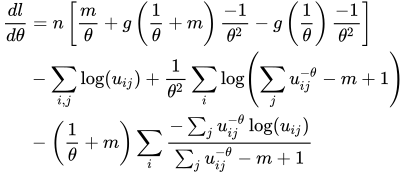
Let g left-parenthesis dot right-parenthesis be the derivative of log left-parenthesis normal upper Gamma left-parenthesis dot right-parenthesis right-parenthesis. Then the first-order derivative is

StartLayout 1st Row 1st Column StartFraction d l Over d theta EndFraction 2nd Column equals n left-bracket StartFraction m Over theta EndFraction plus g left-parenthesis StartFraction 1 Over theta EndFraction plus m right-parenthesis StartFraction negative 1 Over theta squared EndFraction minus g left-parenthesis StartFraction 1 Over theta EndFraction right-parenthesis StartFraction negative 1 Over theta squared EndFraction right-bracket 2nd Row 1st Column Blank 2nd Column minus sigma-summation Underscript i comma j Endscripts log left-parenthesis u Subscript i j Baseline right-parenthesis plus StartFraction 1 Over theta squared EndFraction sigma-summation Underscript i Endscripts log left-parenthesis sigma-summation Underscript j Endscripts u Subscript i j Superscript negative theta Baseline minus m plus 1 right-parenthesis 3rd Row 1st Column Blank 2nd Column minus left-parenthesis StartFraction 1 Over theta EndFraction plus m right-parenthesis sigma-summation Underscript i Endscripts StartFraction minus sigma-summation Underscript j Endscripts u Subscript i j Superscript negative theta Baseline log left-parenthesis u Subscript i j Baseline right-parenthesis Over sigma-summation Underscript j Endscripts u Subscript i j Superscript negative theta Baseline minus m plus 1 EndFraction EndLayout

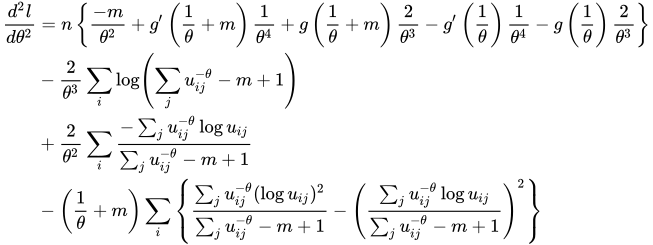
The second-order derivative is

StartLayout 1st Row 1st Column StartFraction d squared l Over d theta squared EndFraction 2nd Column equals n StartSet StartFraction negative m Over theta squared EndFraction plus g prime left-parenthesis StartFraction 1 Over theta EndFraction plus m right-parenthesis StartFraction 1 Over theta Superscript 4 Baseline EndFraction plus g left-parenthesis StartFraction 1 Over theta EndFraction plus m right-parenthesis StartFraction 2 Over theta cubed EndFraction minus g prime left-parenthesis StartFraction 1 Over theta EndFraction right-parenthesis StartFraction 1 Over theta Superscript 4 Baseline EndFraction minus g left-parenthesis StartFraction 1 Over theta EndFraction right-parenthesis StartFraction 2 Over theta cubed EndFraction EndSet 2nd Row 1st Column Blank 2nd Column minus StartFraction 2 Over theta cubed EndFraction sigma-summation Underscript i Endscripts log left-parenthesis sigma-summation Underscript j Endscripts u Subscript i j Superscript negative theta Baseline minus m plus 1 right-parenthesis 3rd Row 1st Column Blank 2nd Column plus StartFraction 2 Over theta squared EndFraction sigma-summation Underscript i Endscripts StartFraction minus sigma-summation Underscript j Endscripts u Subscript i j Superscript negative theta Baseline log u Subscript i j Baseline Over sigma-summation Underscript j Endscripts u Subscript i j Superscript negative theta Baseline minus m plus 1 EndFraction 4th Row 1st Column Blank 2nd Column minus left-parenthesis StartFraction 1 Over theta EndFraction plus m right-parenthesis sigma-summation Underscript i Endscripts StartSet StartFraction sigma-summation Underscript j Endscripts u Subscript i j Superscript negative theta Baseline left-parenthesis log u Subscript i j Baseline right-parenthesis squared Over sigma-summation Underscript j Endscripts u Subscript i j Superscript negative theta Baseline minus m plus 1 EndFraction minus left-parenthesis StartFraction sigma-summation Underscript j Endscripts u Subscript i j Superscript negative theta Baseline log u Subscript i j Baseline Over sigma-summation Underscript j Endscripts u Subscript i j Superscript negative theta Baseline minus m plus 1 EndFraction right-parenthesis squared EndSet EndLayout
Fitting the Gumbel Copula

A different parameterization alpha equals theta Superscript negative 1 is used for the following part, which is related to the fitting of the Gumbel copula. For the Gumbel copula, you need to compute phi Superscript minus 1 left-parenthesis m right-parenthesis. It turns out that for k equals 1 comma 2 comma ellipsis comma m,

phi Superscript minus 1 left-parenthesis k right-parenthesis Baseline left-parenthesis u right-parenthesis equals left-parenthesis negative 1 right-parenthesis Superscript k Baseline alpha exp left-parenthesis minus u Superscript alpha Baseline right-parenthesis u Superscript negative k plus alpha Baseline normal upper Psi Subscript k minus 1 Baseline left-parenthesis u Superscript alpha Baseline right-parenthesis

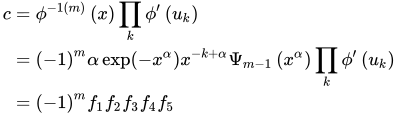
where normal upper Psi Subscript k minus 1 is a function that is described later. The copula density is given by
StartLayout 1st Row 1st Column c 2nd Column equals 3rd Column phi Superscript minus 1 left-parenthesis m right-parenthesis Baseline left-parenthesis x right-parenthesis product Underscript k Endscripts phi prime left-parenthesis u Subscript k Baseline right-parenthesis 2nd Row 1st Column Blank 2nd Column equals 3rd Column left-parenthesis negative 1 right-parenthesis Superscript m Baseline alpha exp left-parenthesis minus x Superscript alpha Baseline right-parenthesis x Superscript negative k plus alpha Baseline normal upper Psi Subscript m minus 1 Baseline left-parenthesis x Superscript alpha Baseline right-parenthesis product Underscript k Endscripts phi prime left-parenthesis u Subscript k Baseline right-parenthesis 3rd Row 1st Column Blank 2nd Column equals 3rd Column left-parenthesis negative 1 right-parenthesis Superscript m Baseline f 1 f 2 f 3 f 4 f 5 EndLayout

where x equals sigma-summation Underscript k Endscripts phi left-parenthesis u Subscript k Baseline right-parenthesis, f 1 equals alpha, f 2 equals exp left-parenthesis minus x Superscript alpha Baseline right-parenthesis,f 3 equals x Superscript negative k plus alpha,f 4 equals normal upper Psi Subscript m minus 1 Baseline left-parenthesis x Superscript alpha Baseline right-parenthesis, and f 5 equals left-parenthesis negative 1 right-parenthesis Superscript m Baseline product Underscript k Endscripts phi prime left-parenthesis u Subscript k Baseline right-parenthesis.

The log density is

StartLayout 1st Row 1st Column l 2nd Column equals 3rd Column log left-parenthesis c right-parenthesis 2nd Row 1st Column Blank 2nd Column equals 3rd Column log left-parenthesis f 1 right-parenthesis plus log left-parenthesis f 2 right-parenthesis plus log left-parenthesis f 3 right-parenthesis plus log left-parenthesis f 4 right-parenthesis plus log left-parenthesis left-parenthesis negative 1 right-parenthesis Superscript m Baseline f 5 right-parenthesis EndLayout

Now the first-order derivative of the log density has the decomposition

StartLayout 1st Row 1st Column StartFraction d l Over d alpha EndFraction 2nd Column equals 3rd Column StartFraction 1 Over c EndFraction StartFraction d c Over d alpha EndFraction equals sigma-summation Underscript j equals 1 Overscript 4 Endscripts StartFraction 1 Over f Subscript j Baseline EndFraction StartFraction d f Subscript j Baseline Over d alpha EndFraction plus StartFraction d sigma-summation Underscript k Endscripts log left-parenthesis minus phi prime left-parenthesis u Subscript k Baseline right-parenthesis right-parenthesis Over d alpha EndFraction EndLayout

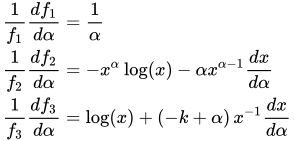
Some of the terms are given by

StartLayout 1st Row 1st Column StartFraction 1 Over f 1 EndFraction StartFraction d f 1 Over d alpha EndFraction 2nd Column equals 3rd Column StartFraction 1 Over alpha EndFraction 2nd Row 1st Column StartFraction 1 Over f 2 EndFraction StartFraction d f 2 Over d alpha EndFraction 2nd Column equals 3rd Column minus x Superscript alpha Baseline log left-parenthesis x right-parenthesis minus alpha x Superscript alpha minus 1 Baseline StartFraction d x Over d alpha EndFraction 3rd Row 1st Column StartFraction 1 Over f 3 EndFraction StartFraction d f 3 Over d alpha EndFraction 2nd Column equals 3rd Column log left-parenthesis x right-parenthesis plus left-parenthesis negative k plus alpha right-parenthesis x Superscript negative 1 Baseline StartFraction d x Over d alpha EndFraction EndLayout

where

StartFraction d x Over d alpha EndFraction equals sigma-summation left-parenthesis minus log u Subscript k Baseline right-parenthesis Superscript 1 slash alpha Baseline log left-parenthesis minus log u Subscript k Baseline right-parenthesis left-parenthesis StartFraction negative 1 Over alpha squared EndFraction right-parenthesis

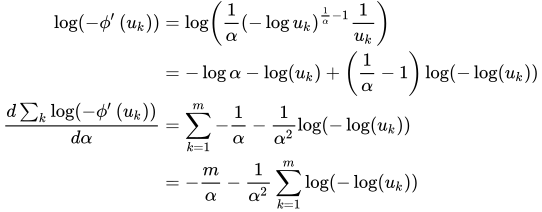
The last term in the derivative of the d l slash d alpha is

StartLayout 1st Row 1st Column log left-parenthesis minus phi prime left-parenthesis u Subscript k Baseline right-parenthesis right-parenthesis 2nd Column equals 3rd Column log left-parenthesis StartFraction 1 Over alpha EndFraction left-parenthesis minus log u Subscript k Baseline right-parenthesis Superscript StartFraction 1 Over alpha EndFraction minus 1 Baseline StartFraction 1 Over u Subscript k Baseline EndFraction right-parenthesis 2nd Row 1st Column Blank 2nd Column equals 3rd Column minus log alpha minus log left-parenthesis u Subscript k Baseline right-parenthesis plus left-parenthesis StartFraction 1 Over alpha EndFraction minus 1 right-parenthesis log left-parenthesis minus log left-parenthesis u Subscript k Baseline right-parenthesis right-parenthesis 3rd Row 1st Column StartFraction d sigma-summation Underscript k Endscripts log left-parenthesis minus phi prime left-parenthesis u Subscript k Baseline right-parenthesis right-parenthesis Over d alpha EndFraction 2nd Column equals 3rd Column sigma-summation Underscript k equals 1 Overscript m Endscripts minus StartFraction 1 Over alpha EndFraction minus StartFraction 1 Over alpha squared EndFraction log left-parenthesis minus log left-parenthesis u Subscript k Baseline right-parenthesis right-parenthesis 4th Row 1st Column Blank 2nd Column equals 3rd Column minus StartFraction m Over alpha EndFraction minus StartFraction 1 Over alpha squared EndFraction sigma-summation Underscript k equals 1 Overscript m Endscripts log left-parenthesis minus log left-parenthesis u Subscript k Baseline right-parenthesis right-parenthesis EndLayout

Now the only remaining term is f 4, which is related to normal upper Psi Subscript m minus 1. Wu, Valdez, and Sherris (2007) show that normal upper Psi Subscript k Baseline left-parenthesis x right-parenthesis satisfies a recursive equation

normal upper Psi Subscript k Baseline left-parenthesis x right-parenthesis equals left-bracket alpha left-parenthesis x minus 1 right-parenthesis plus k right-bracket normal upper Psi Subscript k minus 1 Baseline left-parenthesis x right-parenthesis minus alpha x normal upper Psi prime Subscript k minus 1 Baseline left-parenthesis x right-parenthesis

with normal upper Psi 0 left-parenthesis x right-parenthesis equals 1.

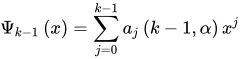
The preceding equation implies that normal upper Psi Subscript k minus 1 Baseline left-parenthesis x right-parenthesis is a polynomial of x and therefore can be represented as
normal upper Psi Subscript k minus 1 Baseline left-parenthesis x right-parenthesis equals sigma-summation Underscript j equals 0 Overscript k minus 1 Endscripts a Subscript j Baseline left-parenthesis k minus 1 comma alpha right-parenthesis x Superscript j

In addition, its coefficient, denoted by a Subscript j Baseline left-parenthesis k minus 1 comma alpha right-parenthesis, is a polynomial of alpha. For simplicity, use the notation a Subscript j Baseline left-parenthesis alpha right-parenthesis identical-to a Subscript j Baseline left-parenthesis m minus 1 comma alpha right-parenthesis. Therefore,

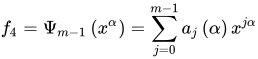
f 4 equals normal upper Psi Subscript m minus 1 Baseline left-parenthesis x Superscript alpha Baseline right-parenthesis equals sigma-summation Underscript j equals 0 Overscript m minus 1 Endscripts a Subscript j Baseline left-parenthesis alpha right-parenthesis x Superscript j alpha
StartLayout 1st Row 1st Column StartFraction d f 4 Over d alpha EndFraction 2nd Column equals StartFraction d normal upper Psi Subscript m minus 1 Baseline left-parenthesis x Superscript alpha Baseline right-parenthesis Over d alpha EndFraction 2nd Row 1st Column Blank 2nd Column equals sigma-summation Underscript j equals 0 Overscript m minus 1 Endscripts left-bracket StartFraction d a Subscript j Baseline left-parenthesis alpha right-parenthesis Over d alpha EndFraction x Superscript j alpha Baseline plus a Subscript j Baseline left-parenthesis alpha right-parenthesis x Superscript j alpha Baseline log left-parenthesis x right-parenthesis j plus a Subscript j Baseline left-parenthesis alpha right-parenthesis left-parenthesis j alpha right-parenthesis x Superscript j alpha minus 1 Baseline StartFraction d x Over d alpha EndFraction right-bracket EndLayout
Fitting the Frank Copula

For the Frank copula,

phi Superscript minus 1 left-parenthesis k right-parenthesis Baseline left-parenthesis u right-parenthesis equals minus StartFraction 1 Over theta EndFraction normal upper Psi Subscript k minus 1 Baseline left-parenthesis left-parenthesis 1 plus e Superscript negative u Baseline left-parenthesis e Superscript negative theta Baseline minus 1 right-parenthesis right-parenthesis Superscript negative 1 Baseline right-parenthesis

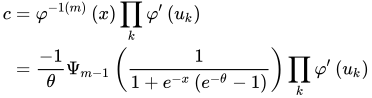
When theta greater-than 0, a Frank copula has a probability density function
StartLayout 1st Row 1st Column c 2nd Column equals 3rd Column phi Superscript minus 1 left-parenthesis m right-parenthesis Baseline left-parenthesis x right-parenthesis product Underscript k Endscripts phi prime left-parenthesis u Subscript k Baseline right-parenthesis 2nd Row 1st Column Blank 2nd Column equals 3rd Column StartFraction negative 1 Over theta EndFraction normal upper Psi Subscript m minus 1 Baseline left-parenthesis StartFraction 1 Over 1 plus e Superscript negative x Baseline left-parenthesis e Superscript negative theta Baseline minus 1 right-parenthesis EndFraction right-parenthesis product Underscript k Endscripts phi prime left-parenthesis u Subscript k Baseline right-parenthesis EndLayout

where x equals sigma-summation Underscript k Endscripts phi left-parenthesis u Subscript k Baseline right-parenthesis.

The log likelihood is

log c equals minus log left-parenthesis theta right-parenthesis plus log left-parenthesis normal upper Psi Subscript m minus 1 Baseline left-parenthesis StartFraction 1 Over 1 plus e Superscript negative x Baseline left-parenthesis e Superscript negative theta Baseline minus 1 right-parenthesis EndFraction right-parenthesis right-parenthesis plus sigma-summation log left-parenthesis phi prime left-parenthesis u Subscript k Baseline right-parenthesis right-parenthesis

Denote

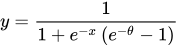
y equals StartFraction 1 Over 1 plus e Superscript negative x Baseline left-parenthesis e Superscript negative theta Baseline minus 1 right-parenthesis EndFraction

Then the derivative of the log likelihood is

StartLayout 1st Row 1st Column StartFraction d log c Over d theta EndFraction 2nd Column equals 3rd Column minus StartFraction 1 Over theta EndFraction plus StartFraction 1 Over normal upper Psi Subscript m minus 1 Baseline left-parenthesis y right-parenthesis EndFraction StartFraction d normal upper Psi Subscript m minus 1 Baseline Over d theta EndFraction plus sigma-summation Underscript k Endscripts StartFraction 1 Over phi prime left-parenthesis u Subscript k Baseline right-parenthesis EndFraction StartFraction d phi prime left-parenthesis u Subscript k Baseline right-parenthesis Over d theta EndFraction EndLayout

The term in the last summation is

StartLayout 1st Row 1st Column StartFraction 1 Over phi prime left-parenthesis u Subscript k Baseline right-parenthesis EndFraction StartFraction d phi prime left-parenthesis u Subscript k Baseline right-parenthesis Over d theta EndFraction 2nd Column equals 3rd Column StartFraction 1 Over theta left-parenthesis 1 minus e Superscript theta u Super Subscript k Superscript Baseline right-parenthesis EndFraction left-bracket 1 minus e Superscript theta u Super Subscript k Superscript Baseline plus theta u e Superscript theta u Super Subscript k Superscript Baseline right-bracket EndLayout

The function normal upper Psi Subscript m minus 1 satisfies a recursive relation

normal upper Psi Subscript k Baseline left-parenthesis x right-parenthesis equals x left-parenthesis x minus 1 right-parenthesis normal upper Psi prime Subscript k minus 1 Baseline left-parenthesis x right-parenthesis

with normal upper Psi 0 left-parenthesis x right-parenthesis equals x minus 1. Note that normal upper Psi Subscript m minus 1 is a polynomial whose coefficients do not depend on theta; therefore,

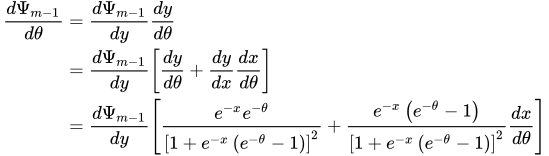
StartLayout 1st Row 1st Column StartFraction d normal upper Psi Subscript m minus 1 Baseline Over d theta EndFraction 2nd Column equals 3rd Column StartFraction d normal upper Psi Subscript m minus 1 Baseline Over d y EndFraction StartFraction d y Over d theta EndFraction 2nd Row 1st Column Blank 2nd Column equals 3rd Column StartFraction d normal upper Psi Subscript m minus 1 Baseline Over d y EndFraction left-bracket StartFraction d y Over d theta EndFraction plus StartFraction d y Over d x EndFraction StartFraction d x Over d theta EndFraction right-bracket 3rd Row 1st Column Blank 2nd Column equals 3rd Column StartFraction d normal upper Psi Subscript m minus 1 Baseline Over d y EndFraction left-bracket StartFraction e Superscript negative x Baseline e Superscript negative theta Baseline Over left-bracket 1 plus e Superscript negative x Baseline left-parenthesis e Superscript negative theta Baseline minus 1 right-parenthesis right-bracket squared EndFraction plus StartFraction e Superscript negative x Baseline left-parenthesis e Superscript negative theta Baseline minus 1 right-parenthesis Over left-bracket 1 plus e Superscript negative x Baseline left-parenthesis e Superscript negative theta Baseline minus 1 right-parenthesis right-bracket squared EndFraction StartFraction d x Over d theta EndFraction right-bracket EndLayout

where

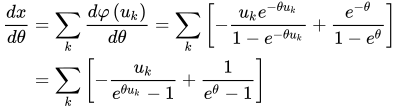
StartLayout 1st Row 1st Column StartFraction d x Over d theta EndFraction 2nd Column equals sigma-summation Underscript k Endscripts StartFraction d phi left-parenthesis u Subscript k Baseline right-parenthesis Over d theta EndFraction equals sigma-summation Underscript k Endscripts left-bracket minus StartFraction u Subscript k Baseline e Superscript minus theta u Super Subscript k Superscript Baseline Over 1 minus e Superscript minus theta u Super Subscript k Superscript Baseline EndFraction plus StartFraction e Superscript negative theta Baseline Over 1 minus e Superscript theta Baseline EndFraction right-bracket 2nd Row 1st Column Blank 2nd Column equals sigma-summation Underscript k Endscripts left-bracket minus StartFraction u Subscript k Baseline Over e Superscript theta u Super Subscript k Superscript Baseline minus 1 EndFraction plus StartFraction 1 Over e Superscript theta Baseline minus 1 EndFraction right-bracket EndLayout

For the case of m equals 2 and theta less-than 0, the bivariate density is

log c equals log left-parenthesis theta left-parenthesis 1 minus e Superscript negative theta Baseline right-parenthesis right-parenthesis minus theta left-parenthesis u 1 plus u 2 right-parenthesis minus log left-parenthesis left-parenthesis 1 minus e Superscript negative theta Baseline minus left-parenthesis 1 minus e Superscript minus theta u 1 Baseline right-parenthesis left-parenthesis 1 minus e Superscript minus theta u 2 Baseline right-parenthesis right-parenthesis squared right-parenthesis
Last updated: June 19, 2025