AUTOREG Procedure
PROC AUTOREG Statement
PROC AUTOREG options;
You can specify the following options:
- COVOUT
writes the covariance matrix for the parameter estimates to the OUTEST= data set. This option is valid only if you specify the OUTEST= option.
- DATA=SAS-data-set
specifies the input SAS data set. If you do not specify this option, PROC AUTOREG uses the most recently created SAS data set.
- JACOBOUT
writes the errors
 and their derivatives with respect to regression parameters to the data set that is specified in the OUTEST= option. The JACOBOUT option is valid only if you specify the OUTEST= option. The errors are written in a column labeled Parameter Estimate for y, and the derivatives with respect to the coefficient of a regression variable x are written in a column labeled Parameter Estimate for x. Note that both the errors and their derivatives appear in the gradient vector of the unconditional least squares objective function S, and hence you can use them to compute the Jacobian matrix.
 - OUTEST=SAS-data-set
writes the parameter estimates to an output data set. For information about the contents of this data set, see the section OUTEST= Data Set.
- PLOTS<(global-plot-options)> < = (specific-plot-options)>
-
requests that the AUTOREG procedure produce statistical graphics via the Output Delivery System, provided that the ODS GRAPHICS statement has been specified. For general information about ODS Graphics, see Chapter 24, Statistical Graphics Using ODS (SAS/STAT User's Guide). The global-plot-options apply to all relevant plots generated by the AUTOREG procedure. You can specify the following global-plot-options.
Global Plot Options
- ONLY
suppresses the default plots. Only the plots that you specifically request are produced.
- UNPACKPANEL | UNPACK
displays each graph separately. (By default, some graphs can appear together in a single panel.)
Specific Plot Options
- ACF
produces the autocorrelation function plot.
- IACF
produces the inverse autocorrelation function plot of residuals.
- PACF
produces the partial autocorrelation function plot of residuals.
- ALL
produces all plots appropriate for the particular analysis.
- COOKSD
produces the Cook’s D plot.
- FITPLOT
plots the predicted and actual values.
- NONE
suppresses all plots.
produces the Q-Q plot of residuals.
- RESIDUAL | RES
plots the residuals.
- RESIDUALHISTOGRAM | RESIDHISTOGRAM
plots the histogram of residuals.
- STANDARDRESIDUAL
plots the standardized residuals, which are the residuals divided by the standard errors of individual predicted values. The formula of the standardized residuals for the observation
 is
is 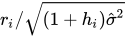 , where
  and
and  . For the models that use the NLAG= or GARCH= option in the MODEL statement or use the HETERO statement, this option replaces the STUDENTRESIDUAL option.
 - STUDENTRESIDUAL
plots the studentized residuals, which are the residuals divided by their standard errors. The formula of the studentized residuals for the observation
is 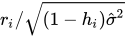 , where and . For the models that use the NLAG= or GARCH= option in the MODEL statement or use the HETERO statement, this option is replaced by the STANDARDRESIDUAL option.
 - WHITENOISE
plots the white noise probabilities.
In addition, any of the following MODEL statement options can be specified in the PROC AUTOREG statement, which is equivalent to specifying the option for every MODEL statement: ALL, ARCHTEST, BACKSTEP, CENTER, COEF, CONVERGE=, CORRB, COVB, DW=, DWPROB, GINV, ITER, ITPRINT, MAXITER=, METHOD=, NOINT, NOMISS, NOPRINT, and PARTIAL.