ARIMA Procedure
General Notation for ARIMA Models
The order of an ARIMA (autoregressive integrated moving-average) model is usually denoted by the notation ARIMA(p,d,q ), where
- p
is the order of the autoregressive part
- d
is the order of the differencing
- q
is the order of the moving-average process
If no differencing is done  0), the models are usually referred to as ARMA(
 models.
The final model in the preceding example is an ARIMA(1,1,1) model since the IDENTIFY statement specified
models.
The final model in the preceding example is an ARIMA(1,1,1) model since the IDENTIFY statement specified  1, and the final ESTIMATE statement specified
  1 and
1 and  1.
1.
Notation for Pure ARIMA Models
Mathematically the pure ARIMA model is written as
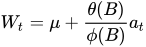
where
- t
indexes time

is the response series
 or a difference of the response series
is the mean term
- B
is the backshift operator; that is,


is the autoregressive operator, represented as a polynomial in the backshift operator:


is the moving-average operator, represented as a polynomial in the backshift operator:


is the independent disturbance, also called the random error
The series  is computed by the IDENTIFY statement and is the series processed by the ESTIMATE statement. Thus, is either the response series
  or a difference of specified by the differencing operators in the IDENTIFY statement.
For simple (nonseasonal) differencing,  . For seasonal differencing
  , where d is the degree of nonseasonal differencing, D is the degree of seasonal differencing, and s is the length of the seasonal cycle.
For example, the mathematical form of the ARIMA(1,1,1) model estimated in the preceding example is

Model Constant Term
The ARIMA model can also be written as

or

where

Thus, when an autoregressive operator and a mean term are both included in the model, the constant term for the model can be represented as  . This value is printed with the label "Constant Estimate" in the ESTIMATE statement output.
Notation for Transfer Function Models
The general ARIMA model with input series, also called the ARIMAX model, is written as

where

is the ith input time series or a difference of the ith input series at time t

is the pure time delay for the effect of the ith input series

is the numerator polynomial of the transfer function for the ith input series

is the denominator polynomial of the transfer function for the ith input series
The model can also be written more compactly as
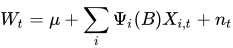
where

is the transfer function for the ith input series modeled as a ratio of the
 and
and  polynomials:

is the noise series:

This model expresses the response series as a combination of past values of the random shocks and past values of other input series. The response series is also called the dependent series or output series. An input time series is also referred to as an independent series or a predictor series. Response variable, dependent variable, independent variable, or predictor variable are other terms often used.
Notation for Factored Models
ARIMA models are sometimes expressed in a factored form. This means that the  ,
,  , , or polynomials are expressed as products of simpler polynomials. For example, you could express the pure ARIMA model as
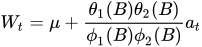
where  and
and  .
.
When an ARIMA model is expressed in factored form, the order of the model is usually expressed by using a factored notation also. The order of an ARIMA model expressed as the product of two factors is denoted as ARIMA(p,d,q) (P,D,Q).
Notation for Seasonal Models
ARIMA models for time series with regular seasonal fluctuations often use differencing operators and autoregressive and moving-average parameters at lags that are multiples of the length of the seasonal cycle. When all the terms in an ARIMA model factor refer to lags that are a multiple of a constant s, the constant is factored out and suffixed to the ARIMA(p,d,q ) notation.
Thus, the general notation for the order of a seasonal ARIMA model with both seasonal and nonseasonal factors is ARIMA(p,d,q)(P,D,Q) . The term (p,d,q) gives the order of the nonseasonal part of the ARIMA model; the term (P,D,Q) gives the order of the seasonal part. The value of s is the number of observations in a seasonal cycle: 12 for monthly series, 4 for quarterly series, 7 for daily series with day-of-week effects, and so forth.
For example, the notation ARIMA(0,1,2)(0,1,1) describes a seasonal ARIMA model for monthly data with the following mathematical form:
