ARIMA Procedure
The SCAN Method
The smallest canonical (SCAN) correlation method can tentatively identify the orders of a stationary or nonstationary ARMA process. Tsay and Tiao (1985) proposed the technique, and for useful descriptions of the algorithm, see Box, Jenkins, and Reinsel (1994); Choi (1992).
Given a stationary or nonstationary time series  with mean corrected form
  with a true autoregressive order of
  and with a true moving-average order of
  , you can use the SCAN method to analyze eigenvalues of the correlation matrix of the ARMA process. The following paragraphs provide a brief description of the algorithm.
For autoregressive test order  and for moving-average test order
  , perform the following steps:
-
Let
 . Compute the following
  matrix,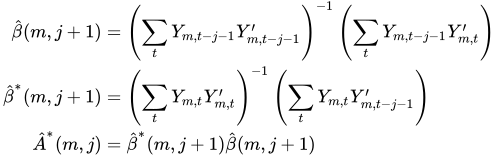
where t ranges from
 to n.
to n. Find the smallest eigenvalue,
 , of
, of  and its corresponding normalized eigenvector,
  . The squared canonical correlation estimate is .
 Using the
 as AR(m) coefficients, obtain the residuals for
  to n, by following the formula:
  .
. -
From the sample autocorrelations of the residuals,
 , approximate the standard error of the squared canonical correlation estimate by
where
 .
.
The test statistic to be used as an identification criterion is

which is asymptotically  if
if  and
and  or if
or if  and
and  . For
. For  and
and  , there is more than one theoretical zero canonical correlation between
  and
and  . Since the
  are the smallest canonical correlations for each
  , the percentiles of
  are less than those of a ; therefore, Tsay and Tiao (1985) state that it is safe to assume a . For
  and
and  , no conclusions about the distribution of are made.
A SCAN table is then constructed using to determine which of the are significantly different from zero (see Table 7). The ARMA orders are tentatively identified by finding a (maximal) rectangular pattern in which the are insignificant for all test orders  and
and  . There might be more than one pair of values (
 ) that permit such a rectangular pattern. In this case, parsimony and the number of insignificant items in the rectangular pattern should help determine the model order. Table 8 depicts the theoretical pattern associated with an ARMA(2,2) series.
Table 7: SCAN Table
| MA | ||||||
| AR | 0 | 1 | 2 | 3 |  |
|
| 0 |  |
 |
 |
 |
|
|
| 1 |  |
 |
 |
 |
|
|
| 2 |  |
 |
 |
 |
|
|
| 3 |  |
 |
 |
 |
|
|
|
|
|
|
|
|
|
|
|
|
|
|
|
|
|
|
Table 8: Theoretical SCAN Table for an ARMA(2,2) Series
| MA | ||||||||
| AR | 0 | 1 | 2 | 3 | 4 | 5 | 6 | 7 |
| 0 | * | X | X | X | X | X | X | X |
| 1 | * | X | X | X | X | X | X | X |
| 2 | * | X | 0 | 0 | 0 | 0 | 0 | 0 |
| 3 | * | X | 0 | 0 | 0 | 0 | 0 | 0 |
| 4 | * | X | 0 | 0 | 0 | 0 | 0 | 0 |
| X = significant terms | ||||||||
| 0 = insignificant terms | ||||||||
| * = no pattern | ||||||||