ARIMA Procedure

The MINIC Method

The minimum information criterion (MINIC) method can tentatively identify the order of a stationary and invertible ARMA process. Note that Hannan and Rissanen (1982) proposed this method; for useful descriptions of the algorithm, see Box, Jenkins, and Reinsel (1994); Choi (1992).

Given a stationary and invertible time series StartSet z Subscript t Baseline colon 1 less-than-or-equal-to t less-than-or-equal-to n EndSet with mean corrected form z overTilde Subscript t Baseline equals z Subscript t Baseline minus mu Subscript z with a true autoregressive order of p and with a true moving-average order of q, you can use the MINIC method to compute information criteria (or penalty functions) for various autoregressive and moving average orders. The following paragraphs provide a brief description of the algorithm.

If the series is a stationary and invertible ARMA(p, q ) process of the form

normal upper Phi Subscript left-parenthesis p comma q right-parenthesis Baseline left-parenthesis upper B right-parenthesis z overTilde Subscript t Baseline equals normal upper Theta Subscript left-parenthesis p comma q right-parenthesis Baseline left-parenthesis upper B right-parenthesis epsilon Subscript t

the error series can be approximated by a high-order AR process

ModifyingAbove epsilon With caret Subscript t Baseline equals ModifyingAbove normal upper Phi With caret Subscript left-parenthesis p Sub Subscript epsilon Subscript comma q right-parenthesis Baseline left-parenthesis upper B right-parenthesis z overTilde Subscript t Baseline almost-equals epsilon Subscript t

where the parameter estimates ModifyingAbove normal upper Phi With caret Subscript left-parenthesis p Sub Subscript epsilon Subscript comma q right-parenthesis are obtained from the Yule-Walker estimates. The choice of the autoregressive order p Subscript epsilon is determined by the order that minimizes Akaike’s information criterion (AIC) in the range p Subscript epsilon comma m i n Baseline less-than-or-equal-to p Subscript epsilon Baseline less-than-or-equal-to p Subscript epsilon comma m a x,

normal upper A normal upper I normal upper C left-parenthesis p Subscript epsilon Baseline comma 0 right-parenthesis equals normal l normal n left-parenthesis sigma overTilde Subscript left-parenthesis p Sub Subscript epsilon Subscript comma 0 right-parenthesis Superscript 2 Baseline right-parenthesis plus 2 left-parenthesis p Subscript epsilon Baseline plus 0 right-parenthesis slash n

where

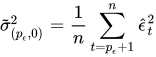
sigma overTilde Subscript left-parenthesis p Sub Subscript epsilon Subscript comma 0 right-parenthesis Superscript 2 Baseline equals StartFraction 1 Over n EndFraction sigma-summation Underscript t equals p Subscript epsilon Baseline plus 1 Overscript n Endscripts ModifyingAbove epsilon With caret Subscript t Superscript 2

Note that Hannan and Rissanen (1982) use the Bayesian information criterion (BIC) to determine the autoregressive order used to estimate the error series while others recommend the AIC (Box, Jenkins, and Reinsel 1994; Choi 1992).

Once the error series has been estimated for autoregressive test order m equals p Subscript m i n Baseline comma ellipsis comma p Subscript m a x Baseline and for moving-average test order j equals q Subscript m i n Baseline comma ellipsis comma q Subscript m a x Baseline, the OLS estimates ModifyingAbove normal upper Phi With caret Subscript left-parenthesis m comma j right-parenthesis and ModifyingAbove normal upper Theta With caret Subscript left-parenthesis m comma j right-parenthesis are computed from the regression model


z overTilde Subscript t Baseline equals sigma-summation Underscript i equals 1 Overscript m Endscripts phi Subscript i Superscript left-parenthesis m comma j right-parenthesis Baseline z overTilde Subscript t minus i Baseline plus sigma-summation Underscript k equals 1 Overscript j Endscripts theta Subscript k Superscript left-parenthesis m comma j right-parenthesis Baseline ModifyingAbove epsilon With caret Subscript t minus k Baseline plus e r r o r

From the preceding parameter estimates, the BIC is then computed

normal upper B normal upper I normal upper C left-parenthesis m comma j right-parenthesis equals normal l normal n left-parenthesis sigma overTilde Subscript left-parenthesis m comma j right-parenthesis Superscript 2 Baseline right-parenthesis plus 2 left-parenthesis m plus j right-parenthesis normal l normal n left-parenthesis n right-parenthesis slash n

where

StartLayout 1st Row  sigma overTilde Subscript left-parenthesis m comma j right-parenthesis Superscript 2 Baseline equals StartFraction 1 Over n EndFraction sigma-summation Underscript t equals t 0 Overscript n Endscripts left-parenthesis z overTilde Subscript t Baseline minus sigma-summation Underscript i equals 1 Overscript m Endscripts phi Subscript i Superscript left-parenthesis m comma j right-parenthesis Baseline z overTilde Subscript t minus i Baseline plus sigma-summation Underscript k equals 1 Overscript j Endscripts theta Subscript k Superscript left-parenthesis m comma j right-parenthesis Baseline ModifyingAbove epsilon With caret Subscript t minus k Baseline right-parenthesis EndLayout

where t 0 equals p Subscript epsilon Baseline plus normal m normal a normal x left-parenthesis m comma j right-parenthesis.

A MINIC table is then constructed using normal upper B normal upper I normal upper C left-parenthesis m comma j right-parenthesis; see Table 6. If p Subscript m a x Baseline greater-than p Subscript epsilon comma m i n, the preceding regression might fail due to linear dependence on the estimated error series and the mean-corrected series. Values of normal upper B normal upper I normal upper C left-parenthesis m comma j right-parenthesis that cannot be computed are set to missing. For large autoregressive and moving-average test orders with relatively few observations, a nearly perfect fit can result. This condition can be identified by a large negative normal upper B normal upper I normal upper C left-parenthesis m comma j right-parenthesis value.

Table 6: MINIC Table

MA
AR 0 1 2 3 dot dot
0 normal upper B normal upper I normal upper C left-parenthesis 0 comma 0 right-parenthesis normal upper B normal upper I normal upper C left-parenthesis 0 comma 1 right-parenthesis normal upper B normal upper I normal upper C left-parenthesis 0 comma 2 right-parenthesis normal upper B normal upper I normal upper C left-parenthesis 0 comma 3 right-parenthesis dot dot
1 normal upper B normal upper I normal upper C left-parenthesis 1 comma 0 right-parenthesis normal upper B normal upper I normal upper C left-parenthesis 1 comma 1 right-parenthesis normal upper B normal upper I normal upper C left-parenthesis 1 comma 2 right-parenthesis normal upper B normal upper I normal upper C left-parenthesis 1 comma 3 right-parenthesis dot dot
2 normal upper B normal upper I normal upper C left-parenthesis 2 comma 0 right-parenthesis normal upper B normal upper I normal upper C left-parenthesis 2 comma 1 right-parenthesis normal upper B normal upper I normal upper C left-parenthesis 2 comma 2 right-parenthesis normal upper B normal upper I normal upper C left-parenthesis 2 comma 3 right-parenthesis dot dot
3 normal upper B normal upper I normal upper C left-parenthesis 3 comma 0 right-parenthesis normal upper B normal upper I normal upper C left-parenthesis 3 comma 1 right-parenthesis normal upper B normal upper I normal upper C left-parenthesis 3 comma 2 right-parenthesis normal upper B normal upper I normal upper C left-parenthesis 3 comma 3 right-parenthesis dot dot
dot dot dot dot dot dot dot


Last updated: June 19, 2025