Specifying Linear Models for SAS Viya Analytical Actions
Introduction
Many SAS Viya analytical actions model the value of one designated variable (the dependent, response, or target variable) based on the values of other variables (the independent, covariate, or predictor variables, which are often called simply "the inputs"). A fundamental concept is that of a linear model, which is a sum of multiples of the predictors, where each constituent product consists of a known covariate part  and an unknown parameter part
  :
:

For some actions (such as regression.glm), this linear form models the expected response:
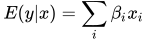
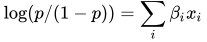
For other actions, a linear model is used to model other characteristics of the response. For example, in logistic regression (performed with the regression.logistic action) you often use a linear model to model the logit of the conditional probability  of the response:
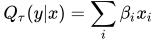
In contrast, for quantile regression (performed with the quantreg.quantreg action) you use a linear model to model the conditional quantile  of the response:
Each action makes different additional assumptions about the response, such as assumptions about its distribution or the dependence structure of observed values. In all cases, the linear model is what relates the predictors to the response.
Some linear models are relatively simple. In fact, a very common one is called a "simple linear model" and consists of just one predictor, plus an intercept term:

However, you do not need to stop there. Depending on how the covariate parts of the model depend on the actual predictor values, you can define linear models of great versatility and utility. These covariate parts are called effects. Common effects include the following:
an effect directly proportional to a single predictor value
an effect that is an unspecified smooth function of a predictor value
a categorical effect of a predictor
a crossproduct effect of two or more predictors
a categorical effect of two or more predictors
The next section discusses common modeling concepts that use the linear model framework.