Shared Concepts
Optimization Parameters
This section applies to actions in the following action sets: gam, mixed, nonlinear, phreg, and regression.
This section describes parameters that are typically available for the actions in this book that perform optimizations.
The following notation is used to describe the subparameters.  denotes the
  vector of parameters for the optimization and
  is its ith element. The objective function being minimized, its gradient vector, and its
  Hessian matrix are denoted as
  ,
,  , and
, and  , respectively. The gradient with respect to the ith parameter is denoted as
  . Superscripts in parentheses denote the iteration count; for example,
  is the value of the objective function at iteration k.
-
absConv=r
absTol=r specifies an absolute function convergence criterion. For minimization, termination requires
 r, where is the vector of parameters in the optimization and
  is the objective function. The default value of r is the negative square root of the largest double-precision value, which serves only as a protection against overflows.
 -
absFconv=r
absFtol=r -
specifies an absolute function difference convergence criterion. For all techniques except NMSIMP, termination requires a small change of the function value in successive iterations:

Here,
is the vector of parameters in the optimization and is the objective function. The same formula is used for the NMSIMP technique, but  is defined as the vertex that has the lowest function value and
  is defined as the vertex that has the highest function value in the simplex.
 -
absFconvN=n
absFtolN=n specifies the number of successive iterations for which the
absFconvsubparameter criterion must be satisfied before the process can be terminated. By default,absFconvN=0. The only SAS Viya action that supports this method is thenlmodaction.-
absGconv=r
absGtol=r -
specifies an absolute gradient convergence criterion. Termination requires the maximum absolute gradient element to be small:
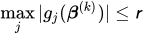
Here,
is the vector of parameters in the optimization and  is the gradient of the objective function with respect to the jth parameter. This criterion is not used by the NMSIMP technique. By default,
 absGconv=1E–5. -
absGconvN=n
absGtolN=n specifies the number of successive iterations for which the
absGconvcriterion must be satisfied before the process can be terminated. By default,absGconvN=0. The only SAS Viya action that supports this method is thenlmodaction.-
absXconv=r
absXtol=r -
specifies an absolute parameter convergence criterion: For all techniques except NMSIMP, termination requires a small Euclidean distance between successive parameter vectors,

For the NMSIMP technique, termination requires either a small length
 of the vertices of a restart simplex,
or a small simplex size,

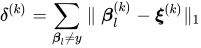
where the simplex size
 is defined as the L1 distance from the simplex vertex
  that has the smallest function value to the other p simplex points
  :
: 
The default is r = 1E–8 for the NMSIMP technique and r = 0 otherwise.
-
corrections=m specifies the number of the stored quasi-Newton update histories, which is referred to as the number of corrections, for the LBFGS technique. The m value is usually set as small as 3. In general, larger values improve convergence speed and solution quality for the LBFGS technique. However, for many problems, after reaching a certain threshold, the improvement can stall and the memory usage and solver’s per-iteration computation cost can increase. In practice, you can set high values for small or medium problems and small values for large problems. By default,
corrections=20.-
fConv=r
fTol=r -
specifies a relative function difference convergence criterion. For all techniques except NMSIMP, termination requires a small relative change of the function value in successive iterations,
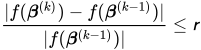
Here,
denotes the vector of parameters that participate in the optimization, and is the objective function. The same formula is used for the NMSIMP technique, but is defined as the vertex that has the lowest function value and is defined as the vertex that has the highest function value in the simplex. The default value is r=
 where
where  is the machine precision, which is the smallest double-precision floating-point number such that
  .
. -
fConvN=r
fTolN=r specifies the number of successive iterations for which the
fConvsubparameter criterion must be satisfied before the process can terminate. By default,fConvN=0. The only SAS Viya action that supports this method is thenlmodaction.-
fConv2=r
fTol2=r -
specifies a second function convergence criterion. For all techniques except NMSIMP, termination requires a small predicted reduction of the objective function:

The predicted reduction
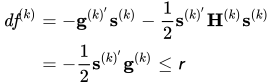
is computed by approximating the objective function f by the first two terms of the Taylor series and substituting the Newton step,

For the NMSIMP technique, termination requires a small standard deviation of the function values of the
 simplex vertices
  ,
,  ,
, 
where
 . If there are
  boundary constraints active at , the mean and standard deviation are computed only for the
  unconstrained vertices.
 The default value is r = 1E–6 for the NMSIMP technique and r = 0 otherwise.
-
gConv=r
gTol=r -
specifies a relative gradient convergence criterion. For all techniques except CONGRA and NMSIMP, termination requires that the normalized predicted function reduction be small:
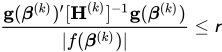
Here,
denotes the vector of parameters that participate in the optimization, is the objective function, and  is the gradient. For the CONGRA technique (where a reliable Hessian estimate
  is not available), the following criterion is used:
This criterion is not used by the NMSIMP technique. By default,
gConv=1E–8. -
gConvN=n
gTolN=n specifies the number of successive iterations for which the
gConvsubparameter criterion must be satisfied before the process can terminate. The only SAS Viya action that supports this method is thenlmodaction. By default,gConvN=0.-
gConv2=r
gTol2=r -
specifies another relative gradient convergence criterion. For the TRUREG, LEVMAR, NRRIDG, and NEWRAP techniques, the following criterion of Browne (1982) is used:
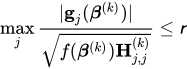
This criterion is not used by the other techniques.
By default,
gConv2=0. -
maxFunc=n -
specifies the maximum number n of function calls in the optimization process. The default values are as follows, depending on the optimization technique:
The optimization can terminate only after completing a full iteration. Therefore, the number of function calls that are actually performed can exceed the number that is specified by this option. You can specify the optimization technique in the
techniquesubparameter. -
maxIter=n -
specifies the maximum number n of iterations in the optimization process. The default values are as follows, depending on the optimization technique:
These default values also apply when n is specified as a missing value. You can specify the optimization technique in the
techniquesubparameter. -
maxTime=r specifies an upper limit of r seconds of CPU time for the optimization process. The time specified by r is checked only once at the end of each iteration. Therefore, the actual running time can be longer than r. The default value is the largest floating-point double representation of your computer.
-
minIter=n specifies the minimum number of iterations. If you request more iterations than are actually needed for convergence to a stationary point, the optimization algorithms can behave strangely. For example, the effect of rounding errors can prevent the algorithm from continuing for the required number of iterations. By default,
minIter=0.-
technique='technique' -
specifies the optimization technique for obtaining maximum likelihood estimates. You can specify one of the following techniques:
- CONGRA
performs a conjugate-gradient optimization.
- DBLDOG
performs a version of double-dogleg optimization.
- DUQUANEW
performs a dual quasi-Newton optimization.
- LBFGS
performs a limited-memory BFGS optimization.
- LEVMAR
performs a Levenberg-Marquardt nonlinear least-squares minimization. This technique is available only with the
nlmodaction.- NEWRAP
performs a Newton-Raphson optimization with line search.
- NMSIMP
performs a Nelder-Mead simplex optimization.
- NONE
performs no optimization.
- NRRIDG
performs a Newton-Raphson optimization with ridging.
- QUANEW
performs a dual quasi-Newton optimization.
- TRUREG
performs a trust-region optimization
By default,
technique='NRRIDG'.For more information, see the section Choosing an Optimization Algorithm.
-
xConv=r
xTol=r -
specifies the relative parameter convergence criterion. Convergence requires a small relative parameter change in subsequent iterations,
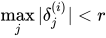
where
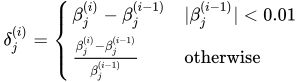
and
 is the estimate of the jth parameter at iteration i. For the NMSIMP technique, the same formula is used, but
  is defined as the vertex that has the lowest function value and
  is defined as the vertex that has the highest function value in the simplex. The default value is r = 1E–8 for the NMSIMP technique and r = 0 otherwise.